

.webp)

.svg)


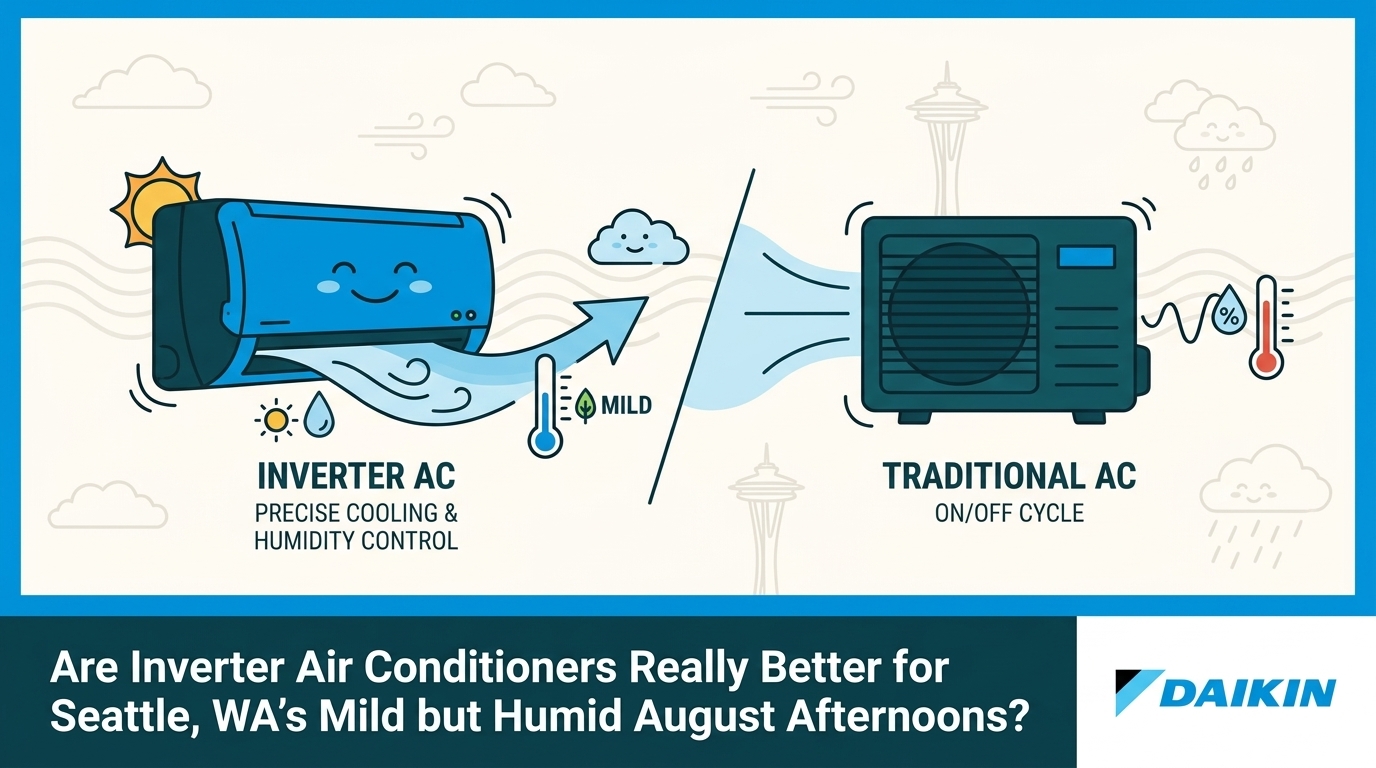
Are Inverter Air Conditioners Better for Humid Augusts?
Why Does My Seattle Home Feel So Clammy When the AC is Running?
Is your air conditioner running constantly, yet your house still feels like a damp sponge? Are inverter air conditioners really better for Seattle's mild but humid August afternoons, or is your current system simply struggling to keep up with the weather? At the Daikin Seattle Experience Center, our team typically sees this as one of the most common HVAC frustrations in the Pacific Northwest. If you have ever walked into your living room during late summer and felt cold but inexplicably sticky, you know exactly what we mean. You check the thermostat, and it reads a perfectly reasonable temperature, but your skin feels clammy, and the air feels heavy. This uncomfortable phenomenon happens because cooling the air and removing moisture from the air are two entirely different processes.
Here is the thing: most traditional cooling systems are designed to blast freezing air into a room as quickly as possible. While that brute-force approach works well in desert climates, it completely fails to address the unique moisture challenges of our region. When the outside weather hovers around a 75-degree ambient temperature, your home does not need a massive drop in heat; it needs continuous, steady dehumidification. Solving this exact Pacific Northwest climate quirk often comes down to choosing the right compressor technology for your local environment. Upgrading to a modern system requires a fundamental shift in how we think about cooling. By exploring inverter technology, you can transform how your home handles late-summer weather. Whether you are installing a central system or a single zone mini split, selecting a system that actively manages humidity is the key to true indoor comfort.
The Physics of Single-Stage Cooling During Late-Summer Marine Pushes
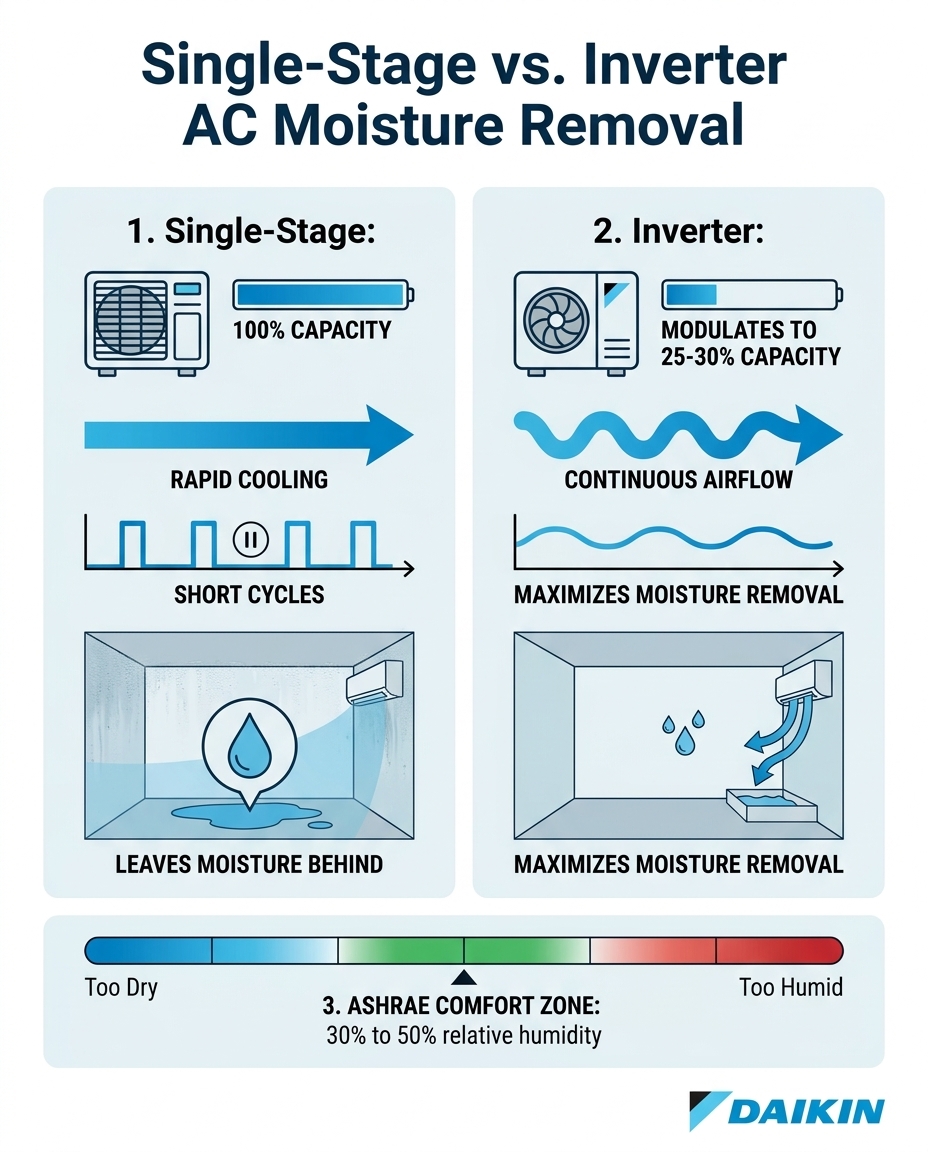
To understand why your house feels like a cold cave, you have to look at how a traditional air conditioner operates. Standard single-stage compressors only have two modes: 100% ON or 100% OFF. There is no middle ground, no low gear, and no way to adjust their output based on the actual conditions inside your house. When the thermostat detects that the room has crept above your set temperature, the single-stage system kicks on with maximum force, blasting cold air through your vents to rapidly drop the temperature.
This all-or-nothing design creates a massive problem during the August late-summer humidity that rolls in with Seattle's marine pushes. The coastal weather patterns trap moisture indoors, making rooms feel incredibly sticky even when the ambient temperature is quite mild. Because your traditional AC is blowing at maximum capacity, it cools the room down to your target temperature in a matter of minutes. Once the thermostat is satisfied, the system abruptly shuts off.
The short-cycling dilemma: This rapid on-and-off process is known as "short-cycling." Because the target temperature is reached so quickly on a mild day, the system shuts off long before it has time to pull the excess moisture out of the air. Dehumidification requires air to pass slowly and continuously over the cold indoor evaporator coil, allowing condensation to form and drain away. When the system only runs for ten minutes at a time, that condensation never fully drains. Instead, the moisture sits on the coil and evaporates right back into your ductwork, leaving your indoor air cold but heavily saturated with humidity.
Why 100% Capacity is the Wrong Tool for Mild Weather
Most traditional HVAC systems are sized and installed with extreme heat waves in mind. In our experience consulting with homeowners across the region, our team typically sees that contractors historically calculated the maximum cooling power needed for the absolute hottest day of the year and installed a single-stage unit capable of meeting that peak demand. However, raw cooling power is entirely counterproductive when dehumidification is the actual goal.
• Overcooling: Using 100% capacity on a mild day forces you to lower the thermostat to uncomfortable levels just to keep the machine running long enough to remove moisture.
• Wasted energy: Starting up a heavy compressor requires a massive surge of electricity. Turning it on and off constantly wastes significantly more power than letting a smaller motor run continuously.
• Uneven temperatures: The constant blasting of cold air followed by periods of stagnant silence creates noticeable hot and cold spots throughout your living space.
When the outdoor temperature is only in the mid-70s, you do not need a hurricane of freezing air. You need a gentle, continuous breeze that quietly wrings the water out of your indoor environment.
How Inverter Compressors Win the Battle Against Indoor Humidity
If a single-stage AC is like a light switch, an inverter compressor is like a dimmer switch. Variable-speed inverter mechanics give your HVAC system the ability to precisely modulate its cooling capacity, often throttling down to operate at just 25% to 30% of its maximum power. Instead of blasting the house with cold air and shutting down, an inverter system constantly monitors the indoor conditions and adjusts its speed to match the exact cooling load required at any given moment.
This variable-speed capability introduces the "low and slow" approach to home cooling. By running continuously at very low speeds, the system allows indoor air to constantly flow over the cold evaporator coil. This continuous circulation is the absolute secret to effective dehumidification. As the air gently washes over the freezing coil hour after hour, moisture is constantly extracted, condensed, and drained away out of your house. Because the system is operating at a low capacity, it removes maximum moisture without drastically dropping the room temperature.
This continuous, gentle operation stands in direct contrast to the harsh limitations of single-stage units. When you are dealing with a 75-degree ambient temperature, you want your system to act as a dedicated dehumidifier that happens to provide a little bit of cooling, rather than a massive freezer that accidentally removes a little bit of moisture. The ability to separate temperature control from humidity control is exactly why researching Daikin inverter vs traditional HVAC technology is so critical for Pacific Northwest homeowners. Inverter systems simply do not suffer from the short-cycling issues that plague older technology, meaning your home stays perfectly dry and comfortable regardless of how mild or sticky the weather gets outside.
Side-by-Side: Inverter vs. Single-Stage AC in Seattle
Seattle's maritime climate requires HVAC systems that prioritize continuous dehumidification over rapid, drastic temperature drops. When evaluating how different technologies handle our specific late-summer weather patterns, a direct comparison reveals exactly why one system leaves you feeling clammy while the other keeps you perfectly comfortable. Let's break down how both systems perform across four critical categories during the peak of August late-summer humidity.
• Moisture Removal — Traditional Single-Stage AC: Poor. Short cycles prevent condensation from draining, leaving residual humidity trapped indoors. — Variable-Speed Inverter AC: Excellent. Continuous low-speed airflow extracts maximum moisture from the air all day long.
• Temperature Consistency — Traditional Single-Stage AC: Noticeable swings. The house alternates between freezing cold during operation and stuffy when off. — Variable-Speed Inverter AC: Precise. Maintains exact setpoints without noticeable fluctuations, eliminating hot and cold spots.
• Energy Consumption — Traditional Single-Stage AC: High. Spikes electricity usage every time the heavy compressor hard-starts and surges. — Variable-Speed Inverter AC: Efficient. Avoids power-hungry hard starts by gently cruising at low speeds, saving energy overall.
• Noise Levels — Traditional Single-Stage AC: Loud. Kicks on with a noticeable clunk and pushes air aggressively through the ductwork. — Variable-Speed Inverter AC: Whisper-quiet. Low-speed operation is often so silent you barely notice the system is running.
The data clearly shows that for our specific coastal environment, raw power is not the answer. The continuous, modulated operation of an inverter system directly targets the sticky, heavy air that makes late summer so uncomfortable indoors.
Achieving True Comfort: The Role of Indoor Environmental Quality
It is a common misconception that the number on your thermostat dictates how comfortable you feel. In reality, human comfort is a delicate combination of both temperature and relative humidity. You can set your thermostat to 68 degrees, but if the relative humidity in the room is sitting at 65%, you are still going to feel sweaty, restless, and uncomfortable. Shifting the focus from purely mechanical differences to the actual health and comfort benefits of proper humidity control is essential for creating a healthy living space.
The American Society of Heating, Refrigerating and Air-Conditioning Engineers (ASHRAE) provides strict guidelines for indoor environmental quality. They recommend that indoor relative humidity be kept strictly between 30% and 50%. When a 75-degree ambient temperature outside brings a wave of moisture inside, and your traditional AC fails to remove it, your indoor humidity can easily spike well above that 50% threshold. This excess moisture creates several tangible problems for your household:
1. Disrupted Sleep: High humidity prevents your sweat from evaporating naturally, making it incredibly difficult for your body to regulate its temperature at night. This leads to tossing, turning, and waking up feeling exhausted.
2. Stuffy, Heavy Air: Moisture-laden air physically feels heavier in your lungs. It can make a perfectly clean home smell musty and feel oppressive.
3. Biological Growth: The damp Pacific Northwest climate is already prone to mold and mildew. Allowing indoor humidity to sit above 60% encourages biological growth in your bathrooms, basements, and inside your ductwork.
4. Damage to Home Interiors: Hardwood floors, wooden cabinetry, and musical instruments can warp or swell when exposed to constant, unmanaged moisture swings.
Inverter systems naturally maintain this optimal 30% to 50% humidity range by running continuously. Because they never shut off entirely during the heat of the day, they never give humidity a chance to build back up. If you are tired of battling damp air, exploring indoor environmental quality solutions is the most effective way to protect your home and upgrade your daily comfort.
Stop Guessing: Feel the Inverter Difference for Yourself
Reading about variable-speed compressors, evaporator coils, and relative humidity percentages is one thing, but actually experiencing their quiet, consistent operation is entirely different. Choosing a new HVAC system is a major decision that impacts your daily life for the next 15 to 20 years. It is not a choice that should be made solely from a glossy brochure, a spec sheet, or a high-pressure sales pitch at your kitchen table.
One local homeowner recently visited our Tukwila educational center because they wanted to learn more about heat pumps and inverter technology without dealing with a high-pressure sales environment. After spending time at our facility, they gained a much clearer understanding of how these home comfort solutions operate in real-time, and they received helpful guidance connecting with qualified local contractors to take the next step. This is exactly why a pressure-free environment where you can physically see, hear, and feel the difference between technologies is so valuable.
Positioned as the ultimate educational resource for homeowners wanting to understand inverter tech before buying, our Daikin Experience Center allows you to interact with live, working systems. You can hear just how whisper-quiet an inverter compressor truly is, feel the gentle, continuous airflow that eliminates clammy air, and speak with educators whose only goal is to help you understand your options. When you are ready, they can connect you with the right local contractors to bring that exact level of comfort into your own home.
Frequently Asked Questions
Why does my house feel cold and clammy with the AC on?
Your house feels clammy because your AC is cooling the air without removing the humidity. This usually happens when a single-stage system short-cycles, meaning it blasts cold air and reaches the target temperature too quickly. Because it shuts off right away, the system does not run long enough to pull the excess moisture out of your indoor air, leaving you feeling sticky even in a cold room.
Are inverter air conditioners better for high humidity?
Yes, inverter air conditioners are significantly better at managing high humidity. Because they can modulate their speed and run continuously at a low capacity, they constantly circulate air over the cold evaporator coil. This "low and slow" operation maximizes moisture extraction without overcooling the room, keeping your indoor air perfectly dry and comfortable.
Do inverter ACs dehumidify better than traditional units?
Inverter ACs absolutely dehumidify better than traditional units. Traditional units operate at 100% capacity and shut off quickly, which leaves condensation sitting on the coil to evaporate back into your home. Inverter units run continuously at lower speeds, allowing that condensation to fully drain away, resulting in vastly superior dehumidification.
What is the difference between single-stage and inverter AC?
The primary difference is how the compressor operates. A single-stage AC only has one speed: 100% on or 100% off, which causes temperature swings and poor humidity control. An inverter AC features a variable-speed compressor that can adjust its output precisely to match the cooling demand, running continuously at lower speeds for better efficiency and comfort.
How does continuous fan operation affect indoor humidity in Seattle?
Continuous fan operation on an inverter system drastically reduces indoor humidity by constantly moving air across the cooling coil. In Seattle's damp climate, this steady airflow is essential for wringing out moisture during mild but sticky days. However, running the fan continuously on a traditional single-stage system can actually increase humidity by blowing moisture off the idle coil back into the house.
Is it worth upgrading to an inverter system just for late-summer cooling?
Upgrading to an inverter system is highly worthwhile because it solves the specific comfort issues caused by late-summer marine pushes. Beyond just cooling, the superior dehumidification, whisper-quiet operation, and long-term energy efficiency make it a massive upgrade for your overall indoor environmental quality. It ensures your home remains comfortable and dry, no matter how sticky the weather gets outside.
Take Control of Your Indoor Comfort Today
Dealing with a cold, clammy house during mild late-summer weather is a frustration you no longer have to live with. By understanding how inverter technology specifically addresses our local climate, you can make an informed decision that finally provides the clear, dry, and consistent comfort your family deserves. As we transition into the back-to-school season, schedule a visit to our Tukwila showroom to experience these systems hands-on, and discover exactly how the right technology can transform your home's indoor air quality.
Schedule a Visit

your individual indoor comfort needs
products firsthand
with an authorized Daikin Dealer
.webp)
See why our customers Choose Us

“Jem is very inviting and knowledgeable. She gave us a walk through of the Daikin Experience Center and patiently answered all our questions. Learned a lot about HVAC’s through this visit.”
“Jem did a great job walking us through the various Daikin products and efficiencies of the products. She was very knowledgeable on everything Daikin. Highly recommend coming in for a tour prior to picking out your various AC systems.”
“Great experience at Daikin Seattle Experience Center: pre-purchase demos of home heating system (Daikin Fit), list of HVAC companies, working Daikin staff and external contractors to ensure highest quality. This experience sets the bar of how any home HVAC experience should be. Have got the Daikin Fit installed and so far seems to work very well – quiet, good home heating in peak winter (heat transfer/BTU/air handling); Functionality of Daikin thermostat and the iPhone app makes it very easy to use.”
“This place is awesome! If you are in the market for a new HVAC system, visit the Daikin Experience Center to get educated on the newest technology as well as available rebates and incentives for where you live. They’ll even connect you with local contractors in your area who install Daikin equipment.”
