

.webp)

.svg)


How Wildfire Smoke Triggers Your Daikin One Monitor
When Late-Summer Skies Darken: The Sudden Shift in Your Home's Airflow
As the August wildfire season approaches, understanding exactly how wildfire smoke in Seattle triggers your Daikin One Indoor Air Quality Monitor can save you from unnecessary panic when the sky turns hazy. Every late summer, residents across the Pacific Northwest experience a familiar, unsettling shift. The sky takes on an orange hue, the air smells of burning timber, and outdoor air quality plummets. Rapidly shifting winds can push dense smoke into the Seattle metro area seemingly overnight, leaving homeowners scrambling to seal up their houses.
During these intense smoke events, a typical pattern we see is sudden confusion over the home's heating and cooling system. You might be sitting in your living room when, without anyone touching the thermostat, the HVAC blower fan suddenly ramps up to high speed. The system sounds like it is working overtime, aggressively pulling air through the return vents. Your immediate instinct might be that the system is malfunctioning or broken under the strain of the weather.
The short answer is: your system is not broken. That unexpected, high-speed circulation is a deliberate, automated defensive response triggered by your indoor air quality equipment. At our facility, we constantly observe this exact automated behavior firsthand. When outdoor pollution infiltrates the home, the system recognizes the threat and takes immediate action to protect the air you breathe.
Understanding the Threat: What PM2.5 Spikes Mean for Seattle Homes
To understand why your system reacts so aggressively, you first have to understand what it is fighting. Wildfire smoke is not just a nuisance odor; it is a complex mixture of gases and fine particles produced when wood and other organic materials burn. The most dangerous component of this smoke is particulate matter, specifically what environmental scientists classify as PM2.5.
The Invisible Danger of Microscopic Particles
The EPA defines PM2.5 as inhalable particles with diameters that are generally 2.5 micrometers and smaller. To put that into perspective, a single strand of human hair is about 70 micrometers in diameter, making it roughly 30 times larger than the largest PM2.5 particle. Because these particles are microscopic, they easily bypass the human body's natural respiratory defenses, traveling deep into the lungs and even entering the bloodstream.
Standard fiberglass HVAC filters—the cheap ones you might buy in a multi-pack at the hardware store—are virtually useless against PM2.5 particulate spikes. Those basic filters are designed to catch large dust bunnies and pet hair to protect the blower motor, not to purify the air for human health. When microscopic smoke particles bypass standard filtration, they circulate freely through your living spaces. This is why having one of the best air quality monitors for Seattle homes is a necessity rather than a luxury during late summer.
The Pacific Northwest Topographical Trap
Seattle faces a unique geographical challenge when it comes to regional wildfires. The Puget Sound region essentially forms a topographical "bowl" surrounded by the Cascade Mountains to the east and the Olympic Mountains to the west. When massive fires burn in the Cascades or up in British Columbia, prevailing wind patterns often funnel that smoke directly into this bowl.
Once the smoke settles into the Seattle area, stagnant atmospheric conditions can trap it here for days or even weeks. During these prolonged events, microscopic particles easily infiltrate homes. Even if you keep every door and window tightly sealed shut, homes naturally breathe. PM2.5 particles slip through microscopic gaps around window frames, under doors, and through exhaust vents. Without a highly sensitive, proactive monitoring system, this invisible invader builds up inside your home until the indoor air is just as dangerous as the air outside.
Inside the Technology: How the Daikin One Indoor Air Quality Monitor Reacts
The sudden fan noise you hear is the result of highly sophisticated hardware working exactly as engineered. The Daikin One Indoor Air Quality Monitor is not just a passive thermometer; it is an active diagnostic tool that continuously tracks the physical and chemical composition of the air moving through your home. It scans for three primary categories of pollutants: particulate matter, volatile organic compounds (VOCs), and carbon dioxide.
To detect microscopic smoke, the monitor utilizes advanced optical sensors. These sensors essentially shine a microscopic beam of light into a small sampling chamber. When tiny particles—like PM2.5 from wildfire smoke—enter that chamber, they scatter the light. The sensor measures the exact angle and intensity of that scattered light to calculate not just the presence of particles, but their size and concentration in real-time. This optical scattering technology allows the Daikin One Indoor Air Quality Monitor to detect a smoke invasion long before you can smell it.
What makes this technology uniquely powerful is how it communicates. The monitor is directly hardwired into your home's broader HVAC network, sharing continuous data streams with your Daikin smart thermostats and the main air handler. This constant, two-way communication loop is the secret behind the system's autonomy. The monitor does not just alert you to a problem via a smartphone notification; it actively commands the mechanical equipment to fix the problem without waiting for human permission.
The Automated Defense Sequence: Step-by-Step System Response
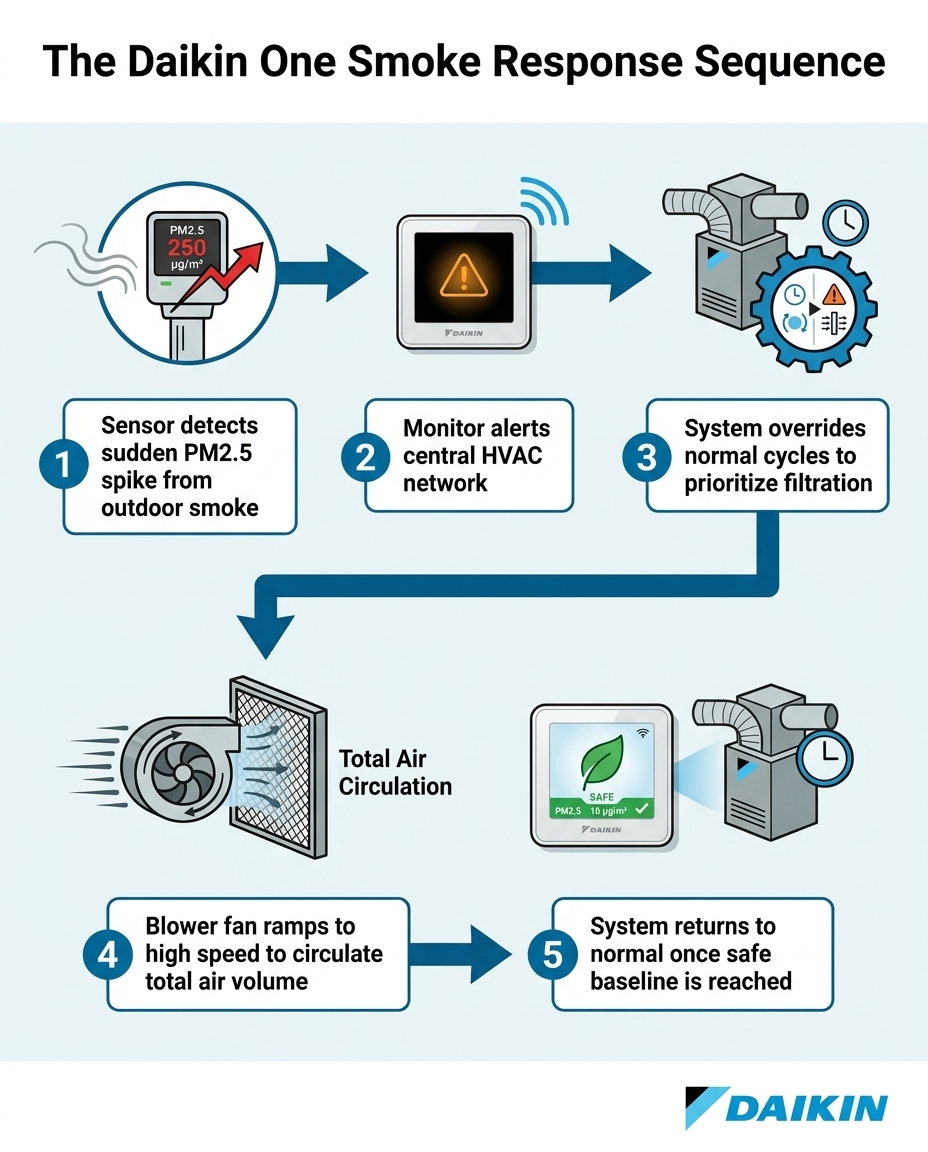
When an August smoke event rolls into the Puget Sound, the resulting PM2.5 particulate spikes trigger a very specific, chronological chain of events inside your HVAC system. If you have ever wondered exactly what is happening when the blower motor suddenly roars to life, here is the exact automated defense sequence:
1. Detection and Measurement: As outdoor smoke naturally infiltrates the home through micro-leaks in the building envelope, the optical sensor registers a sudden, severe drop in indoor air quality. The monitor quantifies the exact concentration of PM2.5 particles crossing the safety threshold.
2. Immediate Alert Transmission: The monitor instantly sends a high-priority alert signal across the communication wire to the central HVAC system's control board, flagging a severe particulate event.
3. System Override Protocol: The control board automatically overrides standard heating or cooling cycles. Even if the thermostat is satisfied regarding temperature, the system prioritizes air purification over thermal conditioning.
4. High-Speed Purge Cycle: The variable-speed blower fan rapidly ramps up to its highest safe operating speed. This aggressive circulation pulls the home's total air volume through the primary, high-efficiency filtration media (usually a MERV 11 or MERV 15 media cabinet) multiple times per hour, physically trapping the microscopic smoke particles.
5. Continuous Monitoring and Stand-Down: The system maintains this high-speed circulation while the sensor continues to sample the air. The fan will not spin down until the optical sensor confirms the indoor air has returned to a safe, healthy baseline level.
Trusting the Process: Why You Should Leave Your System Running
When the blower motor kicks into high gear during a smoke event, the physical noise can be jarring. Many homeowners assume the system is overworking itself, struggling to pull air through a dirty filter, or suffering from a malfunctioning control board. The immediate, gut instinct is to walk over to the thermostat and switch the entire system to "OFF" to save the equipment from perceived damage.
Here is the thing: turning off your HVAC system during a wildfire smoke event is the absolute worst action you can take for your home's indoor air quality.
• The system sounds too loud; it must be breaking. — The System Reality: The variable-speed motor is intentionally running at maximum RPM to maximize air turnover. — The Result of Turning it Off: Filtration stops entirely. Smoke particles remain suspended in the air you breathe.
• Running the fan will pull more smoke inside. — The System Reality: The system is recirculating and filtering indoor air, not pulling fresh air from outside. — The Result of Turning it Off: Smoke naturally leaks into the home anyway, but now there is no mechanism to remove it.
• I should open a window to let the stuffy air out. — The System Reality: The home must remain a sealed envelope for the high-efficiency filter to do its job. — The Result of Turning it Off: Massive amounts of PM2.5 flood the home, overwhelming any standalone air purifiers.
If you notice the fan running aggressively while the sky is dark with smoke, trust the automated response. Keep all windows and exterior doors tightly shut. Allow the Daikin One Indoor Air Quality Monitor to manage the environment. The equipment is designed to handle these exact high-demand scenarios. The only manual intervention required on your part is to check your main system filter after a prolonged smoke event clears; a week of heavy wildfire smoke can load a filter with as much debris as months of normal operation, requiring an early replacement.
First-Hand Observations at the Daikin Seattle Experience Center
At the Daikin Seattle Experience Center, our unique showroom environment allows us to provide hands-on demonstrations of how these sensors actively detect and respond to real-time Seattle smoke events. Because we run live, fully functional equipment on the floor, we see exactly how the hardware behaves when the August wildfire season hits the region.
It is incredibly common for visitors to come into our facility looking to understand the latest HVAC innovations, only to be surprised by seeing these automated reactions happen live. Recently, a visitor came in with extensive questions about modern HVAC capabilities and how to handle the hazy conditions outside. A knowledgeable staff member provided a complete walk-through of the facility, patiently answering every question about inverter technology and air purification. By watching the Daikin One monitor track the air and actively command the blower motors on our display units, the visitor learned a tremendous amount about how these systems operate under environmental stress.
This automated fan response is one of the most frequently asked about features we demonstrate. When homeowners can actually visualize the invisible process—watching the PM2.5 numbers spike on the display screen and immediately hearing the corresponding fan ramp up to scrub the air—the technology suddenly makes perfect sense. It transforms a confusing, noisy event into a reassuring display of modern home protection.
Frequently Asked Questions About Wildfire Smoke and Your HVAC
Why is my Daikin fan running so high during a wildfire?
Your fan is running high because the Daikin One Indoor Air Quality Monitor has detected a dangerous level of microscopic smoke particles in your home. The system automatically ramps up the blower motor to push your home's entire air volume through the main filters as quickly as possible. This high-speed circulation will continue until the air is scrubbed clean.
How does the Daikin One monitor detect wildfire smoke?
The monitor uses advanced optical sensors that shine a tiny beam of light into a sampling chamber. When microscopic smoke particles enter the chamber, they scatter the light. The sensor reads this scattered light to calculate the exact size and concentration of the pollutants in real-time.
What does a high PM2.5 reading mean on my air monitor?
A high PM2.5 reading means there is a large concentration of particulate matter measuring 2.5 micrometers or smaller in your air. These particles are heavily present in wildfire smoke and are small enough to bypass your body's natural respiratory defenses, making them a significant health hazard.
Should I turn off my AC when it is smoky outside?
No, you should never turn off your HVAC system when it is smoky outside. Turning off the system stops the blower fan, which means your home's air is no longer passing through the filters. Keep your windows shut and let the system run to continuously clean the indoor air.
Does the Daikin One monitor automatically clean the air?
The monitor itself does not clean the air; rather, it acts as the brain of the operation. When it detects poor air quality, it automatically commands your central HVAC system's blower fan to turn on, forcing the polluted air through your high-efficiency media filters to clean it.
How often should I change my HVAC filter during the August smoke season?
During a severe smoke event, your filter is trapping millions of microscopic particles daily and will clog much faster than usual. You should check your filter weekly during heavy wildfire conditions and be prepared to replace it immediately after the regional smoke clears to restore proper system airflow.
Breathe Easier This Smoke Season with Automated Protection
When the August wildfire season inevitably brings hazy skies and poor air quality to the Pacific Northwest, an unexpected fan spike in your home is actually a sign of a healthy, proactive defense system. The Daikin One Indoor Air Quality Monitor removes the guesswork from home comfort, actively scanning for invisible threats and deploying your HVAC system's filtration capabilities the moment they are needed.
There is immense satisfaction in knowing that your home is actively monitoring and filtering out dangerous smoke particles, keeping your family breathing clean air while the conditions outside deteriorate. If you want to see this technology in action, or if you need to upgrade your current setup before the next regional smoke event, explore our Daikin Indoor Environmental Quality solutions to ensure your home is fully prepared.
Schedule a Visit

your individual indoor comfort needs
products firsthand
with an authorized Daikin Dealer
.webp)
See why our customers Choose Us

“Jem is very inviting and knowledgeable. She gave us a walk through of the Daikin Experience Center and patiently answered all our questions. Learned a lot about HVAC’s through this visit.”
“Jem did a great job walking us through the various Daikin products and efficiencies of the products. She was very knowledgeable on everything Daikin. Highly recommend coming in for a tour prior to picking out your various AC systems.”
“Great experience at Daikin Seattle Experience Center: pre-purchase demos of home heating system (Daikin Fit), list of HVAC companies, working Daikin staff and external contractors to ensure highest quality. This experience sets the bar of how any home HVAC experience should be. Have got the Daikin Fit installed and so far seems to work very well – quiet, good home heating in peak winter (heat transfer/BTU/air handling); Functionality of Daikin thermostat and the iPhone app makes it very easy to use.”
“This place is awesome! If you are in the market for a new HVAC system, visit the Daikin Experience Center to get educated on the newest technology as well as available rebates and incentives for where you live. They’ll even connect you with local contractors in your area who install Daikin equipment.”
