

.webp)

.svg)


How Daikin Mini Splits Cool Multiple Rooms
Why Split-Level Homes Struggle With Summer Heat
Are you wondering exactly how Daikin mini splits cool multiple rooms without freezing out the basement? In our experience working with multi-level homes across the region, we hear the same frustration every July: sweating in an upstairs bedroom while needing a heavy sweater just to watch television downstairs. The short answer we give our clients is that traditional central air conditioning systems are fundamentally mismatched for multi-level architecture.
Here is the thing: heat naturally rises. In physics, this is known as the stack effect or temperature stratification. During peak July summer heat, the sun beats down on your roof, transferring intense thermal energy into your upper floors. Meanwhile, your lower levels remain shielded and naturally insulated. This creates a massive temperature differential inside the house.
Most traditional central air systems rely on a single thermostat, usually located on the main floor. When the upper floors get unbearably hot, the thermostat on the middle floor might not even register the extreme heat above it. If you force the system to run longer to push cold air upstairs, the central blower invariably dumps massive amounts of chilled air into the lower levels through the shared ductwork. You end up overcooling the spaces that are already cold just to make the bedrooms tolerable.
The Ductwork Dilemma
Traditional HVAC systems use a centralized network of ducts to push air everywhere at once. Because cold air is dense, it naturally cascades down stairwells and settles in the lowest parts of the house. You cannot easily tell a central blower to stop sending air to the basement while pushing it to the second floor. Closing air vents in the basement does not solve the problem—it actually increases static pressure in your ductwork, which can damage your blower motor and reduce overall efficiency.
This architectural challenge is exactly why our team consistently recommends ductless systems as the targeted solution for multi-level temperature control. By removing the shared ductwork from the equation, you eliminate the forced-air cascade that causes lower-level freezing.
The Mechanics: How Do Mini Splits Work for Multiple Rooms?
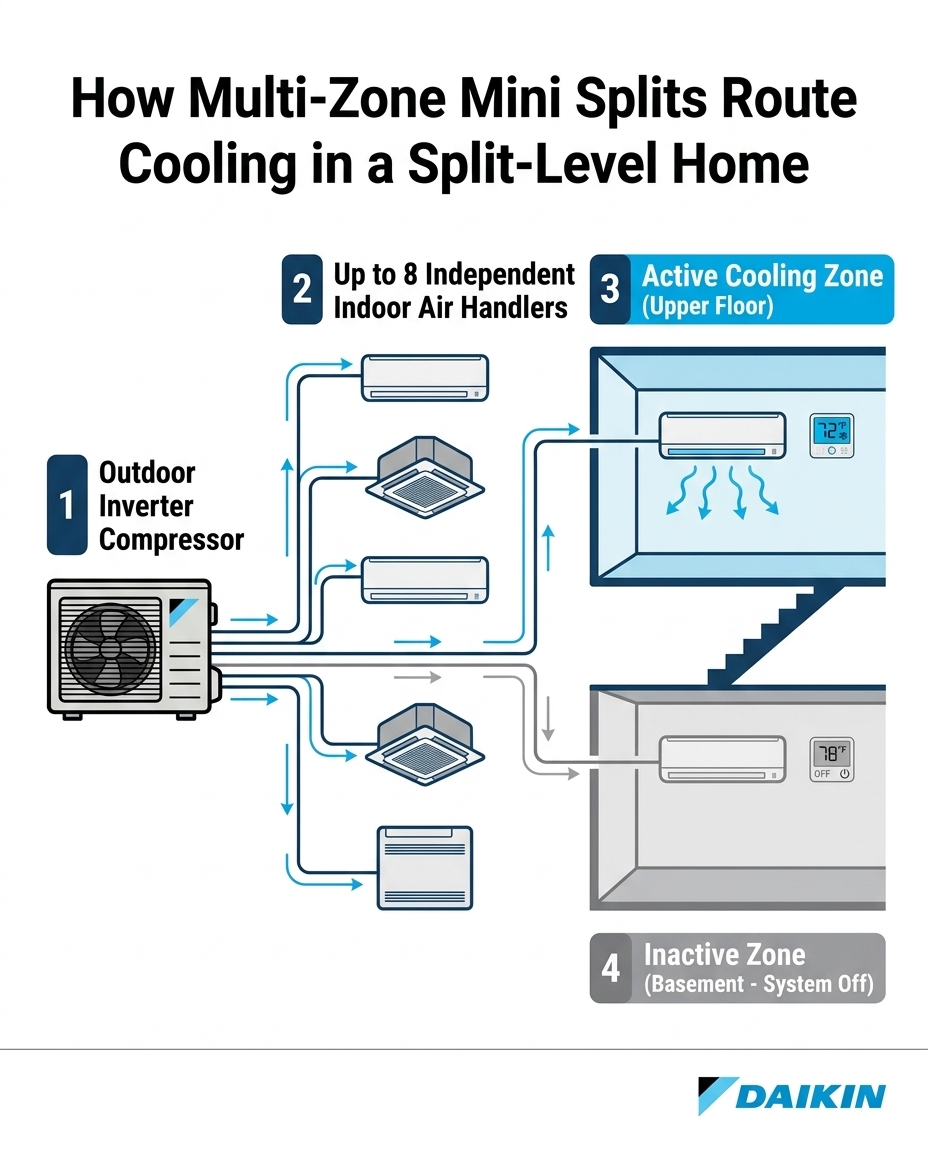
The secret to targeted cooling lies in decentralization. Multi-zone mini splits use a single outdoor compressor connected to up to eight independent indoor air handlers. Instead of pushing cooled air through massive, leaky ducts, the system pumps heat-absorbing refrigerant directly to the specific rooms that need it, completely bypassing the inactive zones.
Achieving whole home comfort with a Daikin multi-zone system requires a fundamentally different approach to moving thermal energy. Here is exactly how we explain the process to visitors at our showroom:
1. The Outdoor Compressor Initiates: The central outdoor unit houses the compressor and condenser. It serves as the heart of the system, managing the flow of refrigerant to the rest of the house.
2. Refrigerant Lines Route the Energy: Instead of bulky air ducts, thin copper lines carry the refrigerant directly to the indoor units. These lines are small enough to be routed through walls or along the exterior of the house, eliminating the energy loss associated with ductwork.
3. Independent Air Handlers Deliver Cooling: Each room (or zone) gets its own indoor unit equipped with a dedicated fan and evaporator coil. The unit draws in the warm air from that specific room, absorbs the heat into the refrigerant, and blows the freshly cooled air directly back into the space.
4. Heat is Expelled Outdoors: The heated refrigerant travels back to the outdoor compressor, where the thermal energy is released into the outside air. The cycle repeats until the specific room reaches your desired temperature.
Because Daikin multi-zone mini split systems do not rely on a central blower pushing air through shared pathways, there is no cross-contamination of temperatures between floors. The upstairs units do their job without impacting the downstairs environment.
Independent Zone Control: Cooling the Upstairs Exclusively
Most homeowners do not realize that multi-zone configurations allow you to completely isolate your cooling efforts. The primary problem with split-level homes is that centralized systems treat the entire house as a single box. When the upper floor swelters, the central system blasts the entire box with cold air.
The Cause: In the Pacific Northwest, split-level architecture often features lower levels built partially or fully below grade. These spaces benefit from natural earth insulation. When our technicians assess Tukwila split-level homes, we consistently see that basements stay naturally cool even during extreme heatwaves. Pumping central air conditioning into these spaces is a complete waste of energy and creates an uncomfortable, refrigerator-like environment.
The Solution: Independent zone control solves this by giving each indoor air handler its own localized thermostat. You are no longer relying on a single sensor in the hallway to dictate the temperature for the entire house.
Creating a Summer Cooling Strategy
Because the indoor units communicate independently with the outdoor compressor, you can execute a highly specific cooling strategy. During a hot afternoon, you can set the upper-floor bedrooms to a comfortable 70 degrees. Those specific indoor units will actively draw in warm air, cool it, and circulate it.
Meanwhile, you can set the basement unit to "off" or switch it to a low-energy "fan-only" mode just to keep the air from getting stale. The system's computer registers that the lower zone requires zero active cooling. It directs 100% of the necessary refrigerant flow to the upstairs units, completely bypassing the basement. You get maximum relief exactly where you need it, and you stop wasting energy freezing out the lower levels.
Inverter Technology: The Secret to Perfect Temperature Balance
To truly understand how these systems maintain perfect balance, we always show our clients the compressor technology driving them. Traditional air conditioners use fixed-speed compressors. They operate on a simple binary: they are either 100% on or 100% off. When the thermostat calls for cooling, the system blasts cold air at full capacity until the target temperature is reached, then abruptly shuts down. This leads to massive temperature swings, loud operational noises, and poor humidity control.
Modern heat pump solutions utilize advanced inverter technology, which fundamentally changes how the system responds to heat loads.
How Modulation Changes the Game
Variable Speed Operation: Instead of blasting at full capacity, a Daikin inverter compressor modulates its speed. Think of it like the accelerator pedal in a car, rather than a simple on/off light switch. It can ramp up to maximum capacity during the hottest part of the day, and then smoothly throttle down to a low, continuous hum to maintain the temperature.
Matching the Exact Demand: This is critical for multi-zone setups. If you have four indoor units connected to your outdoor compressor, but you only turn on the master bedroom unit, the inverter compressor senses that low demand. It ramps down its output to match exactly what that single room needs. It does not over-pressurize the system or force excess cold air anywhere else.
Eliminating Short-Cycling: Because Daikin multi-zone mini split systems run continuously at lower speeds, we find they provide superior dehumidification. They constantly filter and condition the air without the jarring starts and stops of traditional systems, ensuring your upper floors remain perfectly balanced without drawing excess power.
Comparing Layout Needs: Single vs. Multi-Zone Applications
If you are trying to solve a temperature imbalance in a split-level home, our team recommends evaluating your specific architectural layout to determine the right equipment configuration. Not every home requires a massive eight-zone setup, but trying to stretch a single unit too far will leave you with the same hot spots you started with.
A single-zone mini split consists of one outdoor compressor paired with exactly one indoor air handler. This is perfect if you have an isolated problem area—for example, if only the master bedroom gets too hot, or if you have a converted garage that needs dedicated cooling. However, a single indoor unit cannot push air through walls or down hallways effectively.
If you need to cool an entire upper floor with multiple bedrooms and a living area, a multi-zone configuration is absolutely necessary. In larger Tukwila split-level homes, our technicians might even utilize a branch box—a central distribution hub that streamlines the refrigerant piping, allowing multiple indoor units to connect back to the outdoor compressor efficiently.
Configuration Comparison Guide
• Equipment Setup — Single-Zone Application: 1 Outdoor Compressor + 1 Indoor Unit — Multi-Zone Application: 1 Outdoor Compressor + 2 to 8 Indoor Units
• Ideal Use Case — Single-Zone Application: Cooling a single isolated room (e.g., master bedroom, sunroom, or home office). — Multi-Zone Application: Managing temperatures across an entire upper floor or whole home layout.
• Thermostat Control — Single-Zone Application: One dedicated zone control. — Multi-Zone Application: Independent thermostats for every connected room.
• Installation Footprint — Single-Zone Application: Minimal exterior piping; straightforward installation. — Multi-Zone Application: Requires careful routing of multiple refrigerant lines or branch boxes.
• System Flexibility — Single-Zone Application: Fixed to one specific area. — Multi-Zone Application: Allows active cooling upstairs while leaving downstairs units turned off.
Frequently Asked Questions About Multi-Zone Cooling
How do multi zone mini splits work?
Multi-zone mini splits operate by connecting a single outdoor inverter compressor to multiple independent indoor air handlers via small refrigerant lines. Instead of using centralized ductwork to push air everywhere, the system routes heat-absorbing refrigerant directly to the specific rooms that require cooling. Because each indoor unit has its own thermostat, the system can provide targeted temperature control to different areas of the home simultaneously.
Can one mini split cool multiple rooms?
Yes, a multi-zone system can effectively cool up to eight separate rooms depending on the capacity of the outdoor compressor. However, you cannot rely on a single indoor air handler to push cool air through walls or down long hallways to reach other rooms. To cool multiple rooms properly, our installation teams ensure each distinct space receives its own dedicated indoor unit connected to the main outdoor compressor.
Can you run just one zone on a multi zone mini split?
Absolutely, you can operate a single zone while all the other connected indoor units remain completely turned off. The outdoor inverter compressor is designed to modulate its speed and output based on real-time demand. If only one unit is calling for cooling, the compressor throttles down to match that exact requirement, saving energy while keeping that specific room perfectly comfortable.
How to cool upstairs without freezing downstairs?
To cool the upstairs without affecting the downstairs, you must install independent indoor units in the upper-level rooms and set those specific thermostats to your desired cooling temperature. Because the system does not rely on shared ductwork, you can simply leave any downstairs indoor units turned off. The system will direct all its cooling power to the active upper zones, bypassing the naturally cool lower levels entirely.
Do I need an indoor unit in the basement if it's already naturally cold?
You do not necessarily need an indoor unit in a naturally cold basement if your only goal is summer cooling. However, we often recommend installing one because these systems provide excellent dehumidification and air filtration year-round. During peak July summer heat, you can simply leave the basement unit powered off, ensuring you never waste energy cooling a space that does not need it.
Experience Zoning Control Before You Install
Reading about independent zoning and inverter technology is one thing, but understanding how it actually feels in your home is another. One common pattern we see at the Daikin Seattle Experience Center is homeowners who are hesitant to upgrade because they have suffered through years of noisy, inefficient central air and cannot visualize how a ductless system operates differently.
Recently, a local family visited our showroom wanting to learn more about advanced heat pumps and inverter technology before making a major decision. By visiting our educational center, they were able to interact with live, operational systems. They gained valuable hands-on insights, heard exactly how quiet the indoor units are, and developed a clear understanding of how the technology routes air specifically to active zones.
The Daikin Seattle Experience Center is designed precisely for this purpose. Instead of guessing how a system might perform based on a brochure, you can physically test the equipment. You can feel the precise air distribution, listen to the ultra-quiet operation of Daikin multi-zone mini split systems, and see firsthand how adjusting one zone's thermostat has zero negative impact on the neighboring zones. Taking the time to experience the technology with our team removes the guesswork from solving your home's unique temperature challenges.
Take Control of Your Home's Temperature
Achieving perfect temperature balance in a split-level home is entirely possible when you stop relying on outdated, centralized ductwork. By utilizing independent air handlers and advanced inverter technology, you can direct powerful cooling exactly where you need it most, without ever dumping excess cold air into your naturally insulated lower levels.
If you are tired of battling the severe temperature stratification in Tukwila split-level homes, it is time to explore a targeted approach. Our local experts can help you design a system tailored to your exact square footage, layout, and specific hot spots. Schedule an inspection or visit our facility today to discuss custom multi-zone mini split solutions, and get a clear, accessible explanation of how independent zone control can finally make your entire home comfortable.

Schedule a Visit

your individual indoor comfort needs
products firsthand
with an authorized Daikin Dealer
.webp)
See why our customers Choose Us

“Jem is very inviting and knowledgeable. She gave us a walk through of the Daikin Experience Center and patiently answered all our questions. Learned a lot about HVAC’s through this visit.”
“Jem did a great job walking us through the various Daikin products and efficiencies of the products. She was very knowledgeable on everything Daikin. Highly recommend coming in for a tour prior to picking out your various AC systems.”
“Great experience at Daikin Seattle Experience Center: pre-purchase demos of home heating system (Daikin Fit), list of HVAC companies, working Daikin staff and external contractors to ensure highest quality. This experience sets the bar of how any home HVAC experience should be. Have got the Daikin Fit installed and so far seems to work very well – quiet, good home heating in peak winter (heat transfer/BTU/air handling); Functionality of Daikin thermostat and the iPhone app makes it very easy to use.”
“This place is awesome! If you are in the market for a new HVAC system, visit the Daikin Experience Center to get educated on the newest technology as well as available rebates and incentives for where you live. They’ll even connect you with local contractors in your area who install Daikin equipment.”
