

.webp)

.svg)


Daikin Portable AC vs. Mini Split: Upstairs Heat
Why Second-Floor Bedrooms Trap Summer Heat
Are you tossing and turning, trying to sleep in a stifling second-floor bedroom while the ground floor feels perfectly comfortable? When you are deciding between a Daikin Portable Air Conditioner vs. Mini Split: Which Solves the Seattle Upstairs Heat Problem Better is the most critical question for your long-term summer comfort. Heat naturally rises, and multi-story homes trap that thermal energy upstairs, turning your bedroom into a sauna by late afternoon. This creates a clear decision point for homeowners: do you rely on a temporary window-vented unit for immediate relief, or do you upgrade to a permanent, localized cooling system?
For those living in older Seattle and Tukwila homes without ductwork, finding a reliable way to cool the second floor is a constant battle. At Daikin Seattle, our technicians see this exact scenario play out every July. Summer heat domes severely exacerbate the lack of ductwork in older Pacific Northwest architecture, making standard fans completely ineffective. If you are ready to evaluate your options, comparing Daikin ductless systems against temporary room coolers will help you find the right path forward, whether that means a quick fix or having our team install a single-zone mini split.
The Dynamics of the Seattle Upstairs Heat Problem
To understand why your second floor feels like an oven, we have to look at the thermal dynamics of your home. During peak July heatwaves, second-floor temperatures can easily exceed the ground floor by 10 to 15 degrees. This is not just a minor inconvenience; it completely disrupts your ability to rest, recover, and sleep comfortably.
The Physics of Thermal Stratification
Thermal stratification is the scientific term for what happens when warm air rises and cold air sinks. Throughout the day, the sun beats down on your roof, transferring radiant heat directly into your attic and upper living spaces. Because older Seattle homes without ductwork often lack modern, high-density roof insulation, this solar heat easily penetrates the ceiling of your second-floor bedrooms. At the same time, any heat generated downstairs from cooking, electronics, or simple human activity naturally migrates up the staircase, compounding the problem.
Architectural Challenges in the Pacific Northwest
In our years of installing cooling systems across the region, we've found that many of the beautiful, historic homes in our area—such as classic Craftsman, Tudor, and mid-century styles—were built long before residential air conditioning was a standard requirement. The architectural layout of these homes presents unique challenges. They feature thick plaster walls, tight crawlspaces, and zero existing central air infrastructure. Retrofitting these homes with traditional sheet metal ductwork is often physically impossible without tearing down walls and lowering ceilings.
This lack of infrastructure forces homeowners to look for alternative Seattle heat pump solutions. When the upstairs traps heat all day, the thermal mass of your walls and furniture holds onto that energy well into the night. Even if the outdoor temperature drops to 65 degrees by midnight, your bedroom can remain stubbornly stuck at 80 degrees, leading to poor sleep quality and constant discomfort.
Evaluating the Daikin Portable Air Conditioner
When the heat becomes unbearable, we often hear from homeowners looking for an immediate, plug-and-play solution. A Daikin portable air conditioner offers a fast way to introduce active cooling into a sweltering room. These units operate by housing the entire refrigeration cycle—including the noisy compressor, the evaporator coil, and the condenser fan—inside a single appliance that sits directly on your bedroom floor.
The Advantages of Portable Cooling
Portable units serve a very specific purpose and come with several distinct benefits for homeowners who need a fast fix:
• Immediate relief: You can purchase a unit, plug it into a standard electrical outlet, and have cold air blowing in minutes.
• Zero structural installation: There is no need to drill holes through your exterior walls, hire an electrician, or schedule our professional installation team.
• Room-to-room portability: If you want to cool your home office during the workday and your bedroom at night, you can roll the unit down the hallway.
The Drawbacks: Floor Space and Negative Air Pressure
While convenient, portable air conditioners come with significant performance trade-offs. First, they require a substantial floor space footprint, which can be frustrating in smaller second-floor bedrooms. They also require window access to vent the hot exhaust air outside via a large plastic hose.
The negative air pressure problem: The biggest hidden drawback of a portable unit is how it handles air. Because the unit pulls indoor air across its condenser coil and blows that hot air outside through the window hose, it physically removes air from your bedroom. This creates negative air pressure. To replace the air being blown outside, your house pulls warm, unconditioned air in through gaps around your doors, windows, and attic hatches. You are effectively cooling the room while simultaneously sucking hot air into the rest of the house, which drastically reduces overall energy efficiency.
The Case for a Daikin Ductless Mini-Split Head
If you want to move away from temporary fixes and invest in permanent architectural comfort, our Daikin Seattle team consistently recommends a Daikin ductless mini-split head as the professional standard. Unlike a portable unit, a mini-split system separates the cooling process into two distinct components: a sleek indoor air handler mounted high on your wall, and an outdoor compressor unit located outside your home.
The Benefits of Permanent Ductless Cooling
By separating the noisy, heat-generating components and moving them outdoors, a mini-split fundamentally changes how your room feels and sounds. For a deeper look at how these systems operate, you can review this best ductless AC guide.
• Whisper-quiet operation: Because the compressor is outside, the indoor unit only houses a quiet fan and a cooling coil. This makes it ideal for light sleepers.
• High SEER energy efficiency: Mini-splits use advanced inverter technology. Instead of blasting on and shutting off repeatedly, the compressor smoothly ramps up and down to maintain a perfectly consistent temperature, using significantly less electricity.
• Zero ductwork energy loss: By delivering cold air directly into the room where you need it, you avoid the 20% to 30% energy loss typically associated with leaky central ductwork.
Structural and Installation Considerations
The primary trade-off for this level of performance is the installation process. A ductless system is a permanent home upgrade. It requires professional installation by our licensed technicians, who will drill a small, three-inch hole through your exterior wall to connect the indoor and outdoor units with refrigerant lines. You also need dedicated wall space in the bedroom for the indoor head, and a suitable outdoor location on the ground or mounted to the exterior for the compressor.
Head-to-Head: Noise, Efficiency, and Indoor Air Quality
To truly understand which system solves the upstairs heat problem better, we always compare them side-by-side during our in-home consultations across the metrics that impact your daily life the most: sound, energy use, and air quality.
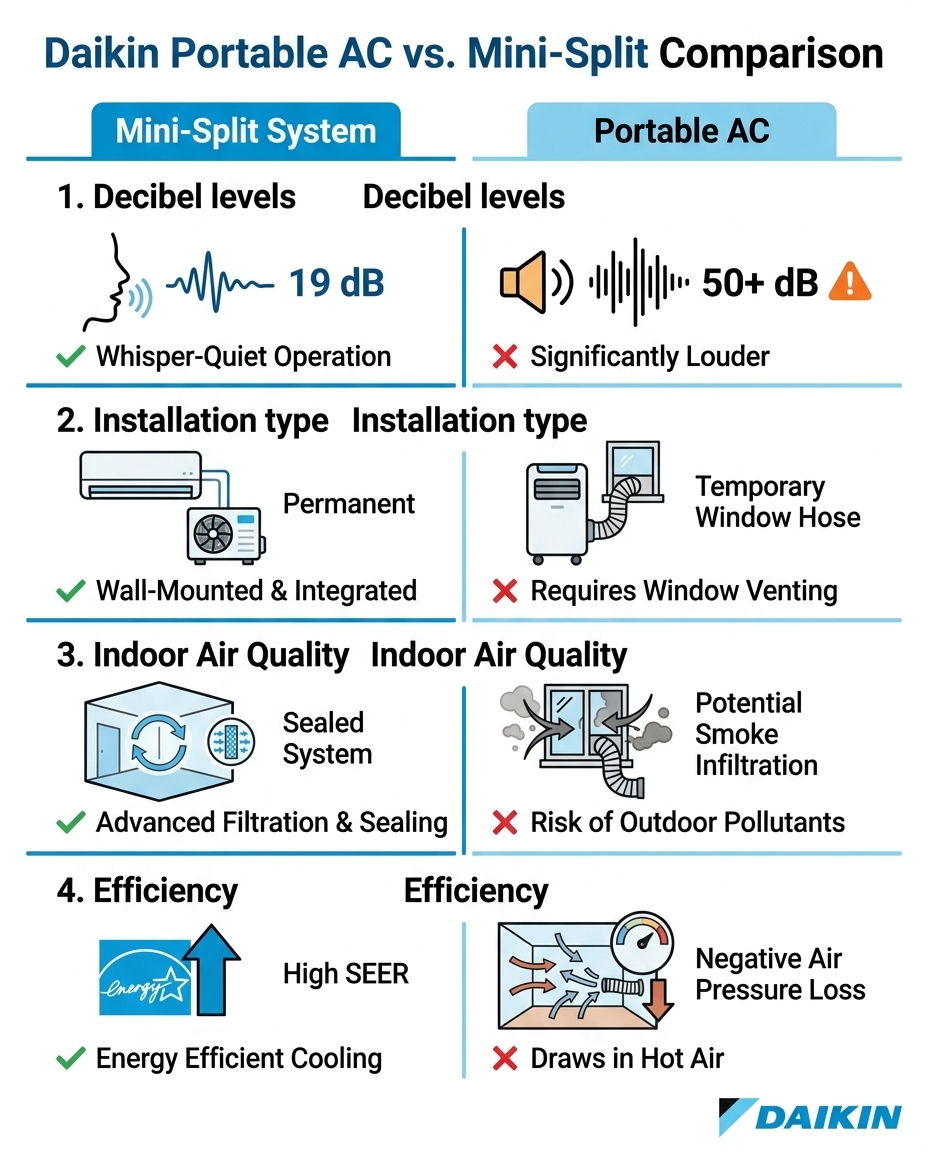
• Noise Level (Indoor) — Daikin Portable Air Conditioner: Typically 50 to 60 decibels (similar to a normal conversation or a loud refrigerator). — Daikin Ductless Mini-Split Head: As low as 19 decibels (quieter than a whisper or rustling leaves).
• Energy Efficiency — Daikin Portable Air Conditioner: Lower efficiency due to negative air pressure and single-speed compressor cycling. — Daikin Ductless Mini-Split Head: Ultra-high SEER ratings with variable-speed inverter technology.
• Installation Footprint — Daikin Portable Air Conditioner: Takes up floor space and blocks a portion of the window for the exhaust hose. — Daikin Ductless Mini-Split Head: Mounted high on the wall, completely freeing up floor and window space.
• Indoor Air Quality — Daikin Portable Air Conditioner: Window adapters are rarely airtight, allowing outdoor pollutants to seep in. — Daikin Ductless Mini-Split Head: Fully sealed system with advanced built-in air filtration.
The Wildfire Smoke Factor
As local HVAC professionals, we know that late summer in the Pacific Northwest often brings a secondary problem alongside the heat: poor outdoor air quality. When wildfire smoke rolls in, the way your cooling system interacts with the outdoors becomes critical. A portable AC requires a partially open window fitted with a plastic hose adapter. These adapters are notoriously difficult to seal perfectly. When the unit creates negative pressure, it can pull fine particulate matter and smoke directly into your home through the gaps around the window bracket.
In contrast, a mini-split maintains a completely sealed indoor environment. The small hole drilled for the refrigerant lines is thoroughly insulated and weather-sealed by our installers. The system simply recirculates and filters the air already inside your bedroom, allowing you to stay cool without inviting outdoor pollution or wildfire smoke into your sleeping space.
Testing the Systems: Hear the Difference in Person
Reading about sound levels on a specification sheet is one thing, but visualizing what "19 decibels" actually sounds like in a quiet room is difficult. When you are trying to cool a bedroom, noise is often the deciding factor. A compressor kicking on and off loudly throughout the night can disrupt your sleep just as much as the heat itself.
Because a ductless system requires a permanent structural change to your home, our team always recommends experiencing the technology before making a commitment. Hearing the equipment run provides absolute peace of mind, especially for light sleepers who have suffered through the loud droning of window units or portable floor models in the past.
This is where visiting the Daikin Experience Center makes a massive difference. Homeowners can physically walk in, adjust the thermostats, and hear the whisper-quiet operation of a Daikin ductless mini-split head for themselves. Comparing that near-silent airflow to the notoriously loud, vibrating compressor of a portable unit makes the value of a permanent installation instantly clear. You do not have to guess how loud the system will be; you can verify it with your own ears.
Frequently Asked Questions About Cooling Upstairs Rooms
Is it worth installing a mini split for just one room?
Yes, in our experience, single-zone systems are specifically designed to target isolated problem areas without wasting energy cooling the whole house. If your ground floor stays perfectly comfortable but your master bedroom is unbearable, a single-zone unit provides localized control. This allows you to sleep comfortably without paying to over-cool the rest of your home, making it a highly efficient investment for older Seattle homes without ductwork.
Why is my upstairs so much hotter than downstairs?
Heat naturally rises, and older roofs often lack modern insulation, allowing solar radiant heat to penetrate the second floor. Throughout the day, the sun bakes your roof, transferring thermal energy into the attic and the rooms directly below it. Combined with the heat rising from the lower levels of the house, this creates a "stack effect" that traps hot air in your upper bedrooms until late at night.
How noisy is a portable air conditioner compared to a mini split?
Portable units house the noisy compressor indoors, often exceeding 50 decibels, while mini-split indoor heads can operate as low as 19 decibels. Because the portable unit contains all the moving parts right next to your bed, it cycles on and off with a noticeable rumble. A mini-split moves the loud compressor outside to your yard, leaving only a gentle, whisper-quiet fan inside your bedroom.
Can a portable AC effectively cool an upstairs room?
While they provide localized relief, their negative air pressure effect can pull warm air in from other parts of the house, reducing overall efficiency. They will certainly lower the temperature of the immediate space, but they have to work much harder to maintain it. Furthermore, they take up valuable floor space and require a window to remain partially open to accommodate the bulky exhaust hose.
Do window exhaust hoses let in outdoor pollution?
Yes, the window adapters for portable units are rarely perfectly sealed, which can be problematic during periods of poor outdoor air quality. When the unit blows exhaust air outside, it pulls replacement air into the house through any available gaps. During late summer when wildfire smoke is prevalent, this can draw fine particulate matter directly into your sleeping environment, reducing your indoor air quality.
Secure Your Permanent Summer Comfort Today
Solving the upstairs heat problem requires choosing the right tool for your specific home. While a portable unit offers a quick, temporary fix for a sudden heatwave, it comes with sacrifices in noise, floor space, and energy efficiency. A permanent ductless installation provides quiet, efficient, and smoke-free comfort that fundamentally changes how you experience your home during the summer months.
You do not have to spend another July losing sleep in a sweltering bedroom. If you are ready to upgrade your home's cooling infrastructure, exploring a permanent single-zone mini split will give you the precise temperature control you deserve. Reach out to our Daikin Seattle team today to schedule a consultation and take the first step toward a cooler, more comfortable home.

Schedule a Visit

your individual indoor comfort needs
products firsthand
with an authorized Daikin Dealer
.webp)
See why our customers Choose Us

“Jem is very inviting and knowledgeable. She gave us a walk through of the Daikin Experience Center and patiently answered all our questions. Learned a lot about HVAC’s through this visit.”
“Jem did a great job walking us through the various Daikin products and efficiencies of the products. She was very knowledgeable on everything Daikin. Highly recommend coming in for a tour prior to picking out your various AC systems.”
“Great experience at Daikin Seattle Experience Center: pre-purchase demos of home heating system (Daikin Fit), list of HVAC companies, working Daikin staff and external contractors to ensure highest quality. This experience sets the bar of how any home HVAC experience should be. Have got the Daikin Fit installed and so far seems to work very well – quiet, good home heating in peak winter (heat transfer/BTU/air handling); Functionality of Daikin thermostat and the iPhone app makes it very easy to use.”
“This place is awesome! If you are in the market for a new HVAC system, visit the Daikin Experience Center to get educated on the newest technology as well as available rebates and incentives for where you live. They’ll even connect you with local contractors in your area who install Daikin equipment.”
