

.webp)

.svg)


Smart Thermostat Placement Issues & False Readings
Why Is My Smart Thermostat Reading Colder Than the Rest of the House?
If you are constantly adjusting your temperature settings because the air conditioning shuts off long before you actually feel comfortable, the answer to Why Your Smart Thermostat Thinks It's Colder Than It Is: Placement Issues in Seattle Homes is often the hidden culprit behind this frustrating disconnect. Here at the Daikin Seattle Experience Center in Tukwila, our team regularly sees homeowners sweating on their living room couches while the screen on the wall insists the house is a perfectly chilled 70 degrees. During August late-summer cooling, as families prepare for the back-to-school transition, this architectural mismatch becomes painfully obvious. Your air conditioner stops running right when you need it the most, leaving your main living areas uncomfortably warm while the system mistakenly believes its job is finished.
Smart thermostats are brilliant pieces of technology, but they are ultimately only as accurate as the air immediately surrounding their sensors. If the device is mounted in a location that stays naturally cooler than the rest of the house, it will send a false signal to your HVAC equipment to power down prematurely. When faced with this issue, you have a distinct decision to make to restore your indoor comfort. You must choose whether to invest in the structural relocation of your main thermostat, attempt to balance the airflow through your ductwork, or upgrade to advanced remote sensor technology that can bypass the bad placement entirely. To solve this dilemma, many homeowners explore upgrading their smart thermostats and cloud services or investing in modern heat pump solutions in Seattle.
The Historical Heating Bias in Seattle Area Architecture
To understand why your modern smart thermostat is struggling to cool your home properly, our experts often explain that you have to look at the history of how local houses were built. The vast majority of older Seattle area homes were constructed in an era when central air conditioning was considered a rare luxury, not a standard necessity. Builders and architects designed these homes strictly with robust winter heating in mind. Because heat naturally rises and disperses outward, the central hallway was historically deemed the most logical place to install a thermostat. It was an interior, protected wall that represented the core of the house, making it the perfect spot to measure how well the basement furnace was distributing warmth during a cold January night.
However, when you introduce modern central cooling into these older floor plans, that historical hallway placement quickly becomes a massive liability. Upgrading your old dial thermostat to a brand-new smart device does not fix the underlying issue of a fundamentally flawed physical location. The smart device is still measuring the air in the hallway, which behaves completely differently during the end-of-season cooling push than the air in your exterior-facing rooms.
Why Hallways Are the Worst Place for Summer AC Sensors
When you shift from heating to cooling, the physics of your home's thermal dynamics flip upside down. A central hallway that was perfectly insulated for winter heating becomes an artificially cool cave during the summer. There are several structural reasons why this happens, and why it ruins your system's efficiency.
• Lack of direct sunlight: Most central hallways do not have windows, meaning they never experience the intense solar heat gain that bakes your south-facing living room or west-facing kitchen.
• Proximity to exterior doors: Hallways are often connected to entryways. Older, poorly insulated front doors can introduce cool drafts that wash directly over the thermostat sensor, artificially lowering its reading.
• Distance from heat sources: The hallway is physically isolated from major heat-generating appliances like ovens, dishwashers, and entertainment centers, meaning it fails to measure the true cooling load of your active living spaces.
• Trapped conditioned air: Because hallways are narrow and enclosed, cool air from nearby supply vents can easily become trapped in the corridor, creating a pocket of cold air right where the thermostat sits.
To visualize how drastic this difference is, consider how your home's original design priorities clash with your current comfort needs:
• Thermostat Location — Historical Heating Focus (Winter): Central hallway to measure core warmth — Modern Cooling Reality (Summer): Hallway stays artificially cool, ignoring hot rooms
• Solar Influence — Historical Heating Focus (Winter): Sunlight welcomed to help heat the home — Modern Cooling Reality (Summer): Sunlight creates severe hot spots in living areas
• Air Circulation — Historical Heating Focus (Winter): Designed for rising warm air — Modern Cooling Reality (Summer): Struggles to push heavy cool air to distant rooms
• System Goal — Historical Heating Focus (Winter): Keep the center of the house from freezing — Modern Cooling Reality (Summer): Keep the perimeter of the house from overheating
How Microclimates Create Conflicting Temperature Readings
When different rooms in your house experience vastly different temperatures due to environmental factors, you have what HVAC professionals call indoor microclimates. In our years of helping Tukwila area homeowners, we've found that these microclimates are the primary reason your system gets confused. Solar heat gain is one of the biggest drivers of this phenomenon. As the afternoon sun beats down on the exterior of your home, the rooms with large windows absorb an immense amount of radiant energy, while the interior rooms remain heavily shaded and cool.
This creates a frustrating scenario: you might have a thermostat reading 70°F in a shaded hallway while the sunlit living room is 78°F. Because the smart thermostat only knows what it feels directly on its own sensor, it registers that the house has successfully reached the 70-degree setpoint. It immediately sends a signal to the air conditioner to shut down. This is known as "short cycling." The AC turns off prematurely because the thermostat thinks the job is done, leaving the people sitting in the 78-degree living room completely miserable. Over time, short cycling not only ruins your indoor comfort but also puts excessive wear and tear on your compressor.
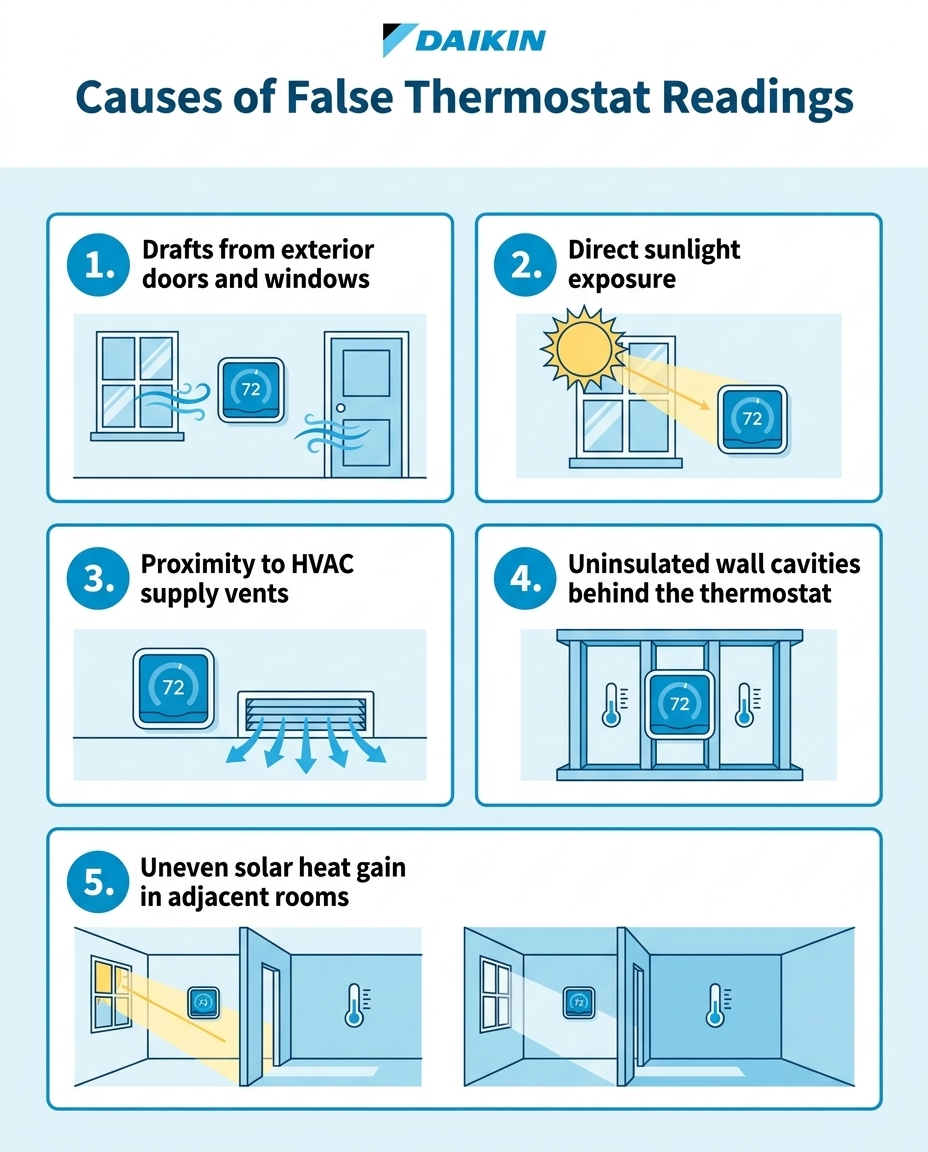
Common Causes of False Thermostat Readings
Beyond just the hallway problem, several other localized factors can trick your smart thermostat into reading a false temperature. If your system is short cycling, one of these microclimate triggers is likely to blame:
• Drafts from exterior doors and windows: Poorly sealed entryways can leak cool air directly onto the device, making it think the room is colder than it is.
• Direct sunlight exposure: If the sun hits the thermostat faceplate at a specific time of day, it will read artificially high, causing the AC to run nonstop.
• Proximity to supply vents: If a nearby vent is blowing cold conditioned air directly onto or near the thermostat, the sensor will satisfy almost immediately and shut the system down.
• Ghost readings from uninsulated walls: If the wall cavity behind the thermostat lacks insulation, drafts from the attic or crawlspace can travel down the wall and chill the back of the device.
• Uneven solar heat gain: South- or west-facing rooms heat up drastically faster than the rest of the house, creating a demand that an interior thermostat simply cannot detect.
The Complexities of Relocating Your Main Thermostat
If your thermostat is in a terrible location, the most permanent and structural fix is to move it to a more accurate spot. Relocating the main interface to the primary living area ensures that the system is taking its cues from the space where you actually spend your time. The U.S. Department of Energy strictly recommends placing thermostats on interior walls, approximately 52 to 60 inches above the floor, and far away from direct sunlight, drafts, and doorways.
However, moving a thermostat is not a simple weekend project. Because many older Seattle area homes feature complex wall assemblies, lath and plaster, or finished basements, relocating the device is a highly complex job that requires a licensed HVAC professional. Attempting to move it yourself can result in severe damage to your system's control board or a violation of local building codes.
When a professional relocates your thermostat, they manage a rigorous process to ensure safety and accuracy. This involves vital system isolation to prevent electrical shorts that could fry the control board, alongside complex route planning to fish new multi-strand low-voltage wire through walls or crawlspaces without causing signal interference. Proper wall preparation is critical to ensure the space behind the new baseplate is sealed against wall-cavity drafts. Finally, the technician handles intricate terminal connections at the furnace control board and conducts thorough system testing to verify the new location accurately reflects the home's temperature.
Bypassing Bad Placement With Remote Sensors and Two-Way Communication
If opening up your drywall to relocate wires sounds too invasive, modern technology offers a brilliant alternative. You can completely bypass a bad hallway placement without moving the main unit by utilizing wireless remote room sensors. These small, battery-operated sensors can be placed in your hottest, most problematic rooms—like the sunlit living room or an upstairs bedroom.
Once synced with your compatible smart thermostat, these sensors take over the temperature monitoring duties. You can program the system to either average the temperatures across the house or prioritize a specific occupied room. For example, if you have a thermostat reading 70°F in a shaded hallway while the sunlit living room is 78°F, you can tell the system to ignore the hallway entirely and run the air conditioning until the living room sensor hits your desired target. This ensures that the AC continues to run until the space you are actually sitting in is comfortable.
This solution becomes even more powerful when paired with advanced HVAC equipment. Older systems only know how to turn on at 100% capacity or turn off completely. Modern inverter heat pumps, however, feature two-way communication between the thermostat and the system. (It is worth noting that federal tax credits and local utility incentive programs may apply to qualifying heat pump installations—we always advise our clients to verify current programs with their utility provider or a tax professional.) Instead of just blasting cold air and shutting off, the system receives continuous data from the remote sensors and modulates its cooling power up or down in precise increments. This means the system can run at a low, steady speed, gently evening out the temperatures across the house without freezing out the hallway. Understanding how two-way thermostat communication improves comfort is key to solving persistent microclimate issues in older floor plans.
Test Drive Your Comfort Solutions at the Daikin Experience Center
Reading about smart thermostats, remote sensors, and inverter technology is one thing, but seeing how they interact with real HVAC equipment is entirely different. It can be difficult to visualize exactly how a small wireless sensor in your living room is going to communicate with a heat pump outside to fix your cooling problems. That is why having a physical destination to explore these solutions is so incredibly valuable for homeowners.
The Daikin Experience Center serves as a no-pressure, highly educational environment where you can get hands-on with this technology before you ever commit to an installation. Instead of guessing how a new thermostat interface works, you can interact with live displays of the Daikin One+ smart thermostat. You can see exactly how remote sensors communicate with the main interface, how the menus allow you to prioritize different rooms, and how the two-way communication modulates the system in real-time to solve uneven cooling.
This hands-on approach makes a massive difference. One local homeowner, who was shopping around for new heating and cooling systems for their older home, recently visited the Experience Center to see the products in operation and compare them side-by-side. Being able to see the equipment running live, interact with the thermostats, and ask technical questions in a showroom environment directly influenced their final equipment purchase and contractor selection. If you are struggling with placement issues in older Seattle area homes, bringing your specific floor plan challenges to the experts on-site allows you to find a tailored solution that fits your architecture perfectly.
Frequently Asked Questions About Thermostat Placement
Why does my smart thermostat read the wrong temperature?
Your smart thermostat is likely measuring a local microclimate rather than the true average temperature of your home. This happens when the device is exposed to a draft, direct sunlight, or is located too close to a supply vent. Because the sensor only reads the air immediately touching it, these localized factors cause it to display a temperature that feels completely wrong compared to the rest of the house. Moving the thermostat or adding remote sensors can correct this localized bias.
Can a draft affect my thermostat?
Yes, a draft can severely impact your thermostat's accuracy. Cool air leaking from an exterior door, an older window, or even an unsealed wall cavity behind the device can artificially lower the sensor's reading. When the thermostat feels this cold draft, it mistakenly believes the entire house is cool, causing the air conditioner to shut off early while your living spaces remain hot.
Where is the best place to put a smart thermostat?
The optimal location for a smart thermostat is on an interior wall, approximately 52 to 60 inches above the floor, in a frequently used room like a living room or family room. It must be positioned away from direct sunlight, exterior doors, drafty windows, and HVAC supply vents. Placing it in the room where you spend the most time ensures the system prioritizes your actual comfort rather than the temperature of an empty hallway.
Why is my AC shutting off before the house is cool?
This frustrating issue, known as "short cycling," often happens when the thermostat is located in a naturally cooler area of the home, such as a shaded central hallway. The hallway reaches the target temperature very quickly, prompting the thermostat to shut the system down before the heavier cooling load in the sunlit rooms has been addressed. Relocating the device or using remote room sensors is the best way to force the system to run until the whole house is cool.
Can I use a smart thermostat without rewiring my hallway?
Yes, you can absolutely upgrade your comfort without opening up your walls to run new wires. Many modern smart thermostat systems allow you to leave the main wired unit in its original hallway location while utilizing wireless remote sensors in your main living areas. You can program the system to read the temperature exclusively from these remote sensors, effectively bypassing the bad hallway wiring entirely.
Take Control of Your Late-Summer Comfort
You shouldn't have to tolerate uneven cooling and sweaty living rooms just because your home's original wiring was placed in a bad location decades ago. During August late-summer cooling, the flaws of a hallway thermostat become impossible to ignore, but you have clear, effective options to fix the problem. Whether you choose to have a professional properly relocate your main unit or you opt to integrate wireless remote sensors to bypass the old wiring, you can achieve the precise, even comfort your family deserves. Do not let a confused sensor dictate your indoor climate—schedule a professional inspection or visit the Daikin Experience Center today to find the perfect technological solution for your unique home layout.
Schedule a Visit

your individual indoor comfort needs
products firsthand
with an authorized Daikin Dealer
.webp)
See why our customers Choose Us

“Jem is very inviting and knowledgeable. She gave us a walk through of the Daikin Experience Center and patiently answered all our questions. Learned a lot about HVAC’s through this visit.”
“Jem did a great job walking us through the various Daikin products and efficiencies of the products. She was very knowledgeable on everything Daikin. Highly recommend coming in for a tour prior to picking out your various AC systems.”
“Great experience at Daikin Seattle Experience Center: pre-purchase demos of home heating system (Daikin Fit), list of HVAC companies, working Daikin staff and external contractors to ensure highest quality. This experience sets the bar of how any home HVAC experience should be. Have got the Daikin Fit installed and so far seems to work very well – quiet, good home heating in peak winter (heat transfer/BTU/air handling); Functionality of Daikin thermostat and the iPhone app makes it very easy to use.”
“This place is awesome! If you are in the market for a new HVAC system, visit the Daikin Experience Center to get educated on the newest technology as well as available rebates and incentives for where you live. They’ll even connect you with local contractors in your area who install Daikin equipment.”
