

.webp)

.svg)


How Two Way Communication Between Thermostat And System Improves Comfort
Why Two-Way Thermostat Communication Is the Key to Real Home Comfort
How two-way communication between thermostat and system improves comfort comes down to one simple idea: your thermostat stops being a light switch and starts being a brain.
Here is a quick summary of how it works and why it matters:
- Precise temperature control - The system makes small, continuous adjustments instead of blasting on and off, eliminating hot and cold spots.
- Better humidity management - Real-time data lets the system actively control moisture levels, not just temperature.
- Smarter energy use - Variable-speed equipment runs at exactly the capacity needed, cutting waste and lowering utility bills.
- Proactive maintenance alerts - The system detects faults early and sends alerts before small issues become expensive repairs.
- Full variable-speed performance - Without two-way communication, a variable-speed system defaults to basic on/off behavior and loses 20-40% of its efficiency and comfort benefits.
Most thermostats do one thing: they send a command. You set a temperature, and your HVAC system turns on or off. That is it. There is no feedback, no adjustment, no awareness of what is actually happening inside your home.
Modern communicating systems work completely differently. The thermostat and the HVAC equipment have a continuous, two-way conversation — exchanging real-time data on temperature, humidity, airflow, and compressor speed. That exchange is what allows the system to fine-tune its output moment by moment, rather than swinging between full blast and complete silence.
For Seattle homeowners dealing with the Pacific Northwest's damp winters, unpredictable spring weather, and increasingly intense summer heat events, that level of precision is not a luxury. It is the difference between a home that feels consistently comfortable and one that never quite gets it right.
This guide breaks down exactly how that two-way communication works, why it matters for your comfort and energy bills, and what to look for when evaluating an upgrade.
Learn more about how two way communication between thermostat and system improves comfort:
- Daikin One+ Smart Thermostat Benefits
- How the Daikin One Plus Communicates Directly with Your Daikin System
What is Two-Way HVAC Communication and How Does It Work?
To understand how two-way communication works, it helps to look at how we got here. For nearly 50 years, the standard for residential HVAC control has been the 24V legacy system. This system uses basic on/off signals sent via a bundle of individual wires. When the temperature in your living room drops below your setpoint, the thermostat closes a switch, sends a 24-volt signal down the wire, and tells your heating system to run at 100% capacity. When the setpoint is reached, it cuts the power, and the system shuts down.
Two-way communication replaces this binary system with a digital handshake. Instead of using simple on/off switches, the thermostat and the indoor and outdoor units communicate over a digital network. This setup relies on a continuous command-and-response loop.
In a communicating system, the thermostat does not just shout orders; it listens. It receives sensor-to-controller feedback regarding exactly what the system is doing. The outdoor heat pump and indoor air handler send back real-time data about compressor speeds, air temperatures, system pressure, and fan rates. This continuous stream of information allows the entire system to act as a single, coordinated ecosystem rather than a collection of separate parts.
The Difference Between One-Way and Two-Way Thermostats
Traditional and even standard third-party smart thermostats operate on one-way communication. They read the room temperature and send a binary start or stop command. Because they cannot receive performance data back from the equipment, they have no way of knowing how hard the system is working or if it is operating efficiently.
A two-way communicating thermostat uses Proportional-Integral-Derivative (PID) control. Instead of waiting for the temperature to drift far enough to trigger an on/off switch, the thermostat calculates how quickly the temperature is changing and how far it is from your target setpoint. It then tells the system to run at the precise capacity required to bridge that gap.
By utilizing How the Daikin One Plus Communicates Directly with Your Daikin System, the controller can make micro-adjustments to the equipment's output. This prevents the wide temperature swings common with older systems and keeps your home within a fraction of a degree of your target setting.
Why Variable-Speed Systems Require Communicating Controls
If you install a high-efficiency variable-speed heat pump but pair it with a standard one-way thermostat, you are essentially driving a sports car with only two gears: park and full throttle.
Variable-speed systems rely on inverter technology to modulate compressor speeds and adjust indoor blower RPM. Rather than running at either 0% or 100% capacity, an inverter-driven system can run anywhere from 10% to 100% capacity in tiny increments.
To achieve this level of precision, the system needs a communicating thermostat. Without a constant stream of digital data detailing the exact indoor temperature, outdoor temperature, and rate of change, the equipment cannot calculate the correct operating speed. If you force a variable-speed system to run on standard 24V wiring, it will default to basic single-stage or two-stage operation. You lose up to 40% of the efficiency and comfort benefits you paid for.
To see how this technology scales to your home's exact layout, read more about How Daikin Single Zone Inverter Technology Adjusts to Your Exact Needs.
How Two Way Communication Between Thermostat and System Improves Comfort
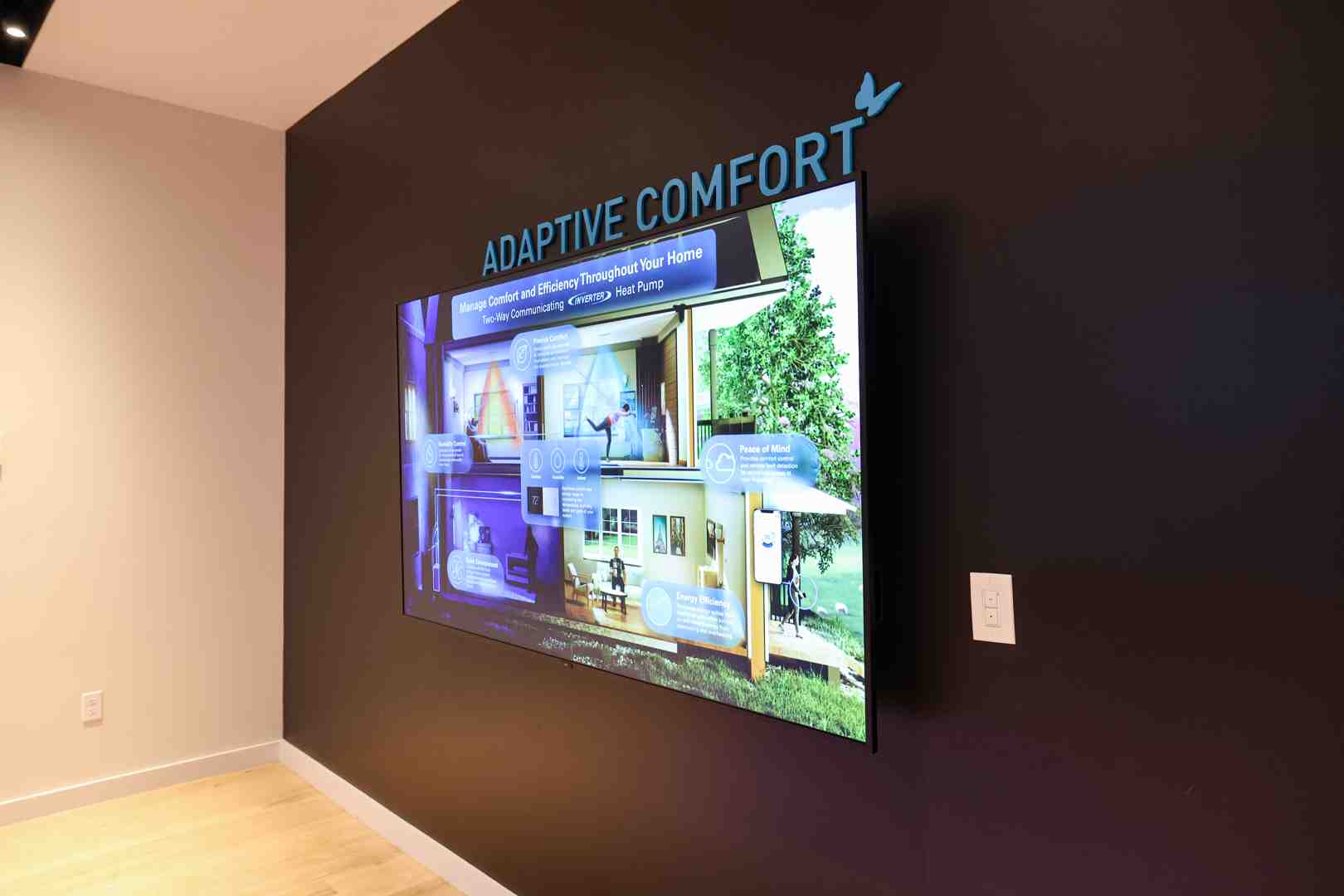
The primary reason to choose a communicating system is the level of comfort it delivers. By replacing harsh on/off cycles with continuous, low-capacity operation, the system maintains a highly stable indoor climate.
When your HVAC system runs continuously at a lower speed, it keeps air moving throughout your home. This continuous circulation eliminates the hot and cold spots that often develop in multi-story Seattle homes. Instead of feeling a blast of hot air followed by a long period of chill, you experience a steady, quiet flow of conditioned air that keeps every room at a consistent temperature.
This stability is a direct result of the system's ability to make micro-adjustments. If a cloud blocks the afternoon sun or you open the front door, the thermostat instantly registers the slight change in load and coordinates with the inverter compressor to adjust output by a fraction of a percent.
For a deeper look at how this works day-to-day, see How Daikin Variable Speed Operation Maintains Your Set Temperature.
Managing Humidity and Indoor Air Quality in the Pacific Northwest
In the Pacific Northwest, comfort is as much about moisture control as it is about temperature. Our damp shoulder seasons and humid summer days can make indoor spaces feel clammy, even when the thermometer reads a reasonable 72°F.
Traditional systems are poor at dehumidification because they run in short, intense bursts. They cool the air quickly and shut off before they have a chance to pull moisture out of the air.
A communicating system solves this by monitoring both temperature and humidity in real time. If the thermostat detects high indoor humidity, it can instruct the indoor blower to slow down and the compressor to run at a specific speed. This keeps the cooling coil cold enough to wring moisture out of the air without overcooling your living space.
Furthermore, continuous airflow means your air is constantly passing through your filtration and purification systems. This is crucial for managing indoor air pollution, which can often be two to five times higher than outdoor levels.
For a complete guide to maintaining healthy indoor air in our region, check out the Daikin One Indoor Air Quality Guide Kent WA.
How Two Way Communication Between Thermostat and System Improves Comfort During Extreme Weather
Weather patterns in Western Washington have become increasingly variable. From winter cold snaps that bring freezing temperatures to King County to summer heatwaves that push triple digits, our homes are facing wider environmental extremes than ever before.
During extreme weather, a communicating system shines through intelligent load coordination. During a sudden winter freeze, the thermostat doesn't just call for emergency heat. It monitors the outdoor temperature and calculates the most efficient combination of heat pump output and auxiliary heat to keep your home warm without spiking your energy use.
During a summer heatwave, the system avoids the hard starts that strain older equipment. It ramps up smoothly, matching the cooling load of your home as the outdoor temperature rises, ensuring your indoor spaces remain a safe, cool haven.
Discover how this level of system coordination creates a hands-off home environment in How Daikin Technology Creates a Self-Managing Comfort Ecosystem.
Maximizing Energy Efficiency and System Lifespan
While the comfort benefits of two-way communication are immediate, the long-term financial benefits are equally compelling. By allowing your heating and cooling system to run at lower, more efficient speeds, you significantly reduce overall energy consumption.
| System Feature | Traditional Non-Communicating System | Modern Communicating System |
|---|---|---|
| Control Signal | 24V Binary (On/Off) | Digital Bidirectional Data |
| Compressor Speed | Single or Two-Stage | Fully Variable (Inverter-Driven) |
| Temperature Swing | ±2°F to ±3°F | Within 0.5°F of Setpoint |
| Humidity Control | Passive (Only when cooling) | Active (Real-time adjustments) |
| Energy Savings | Baseline | 30% to 60% Savings |
| Equipment Lifespan | Standard (Frequent start/stop wear) | Extended (Soft-start, low-wear operation) |
When an HVAC system starts up, it draws a massive spike of electricity to get the motor and compressor spinning. Traditional systems cycle on and off several times an hour, repeating this high-draw process constantly. Communicating systems utilize "soft starts," slowly ramping up motor speeds to avoid these energy spikes. By running at 30% or 40% capacity for longer periods rather than 100% capacity in short bursts, the system operates in its most efficient range.
Real-Time Diagnostics and Proactive Maintenance Alerts
Because a communicating system is constantly monitoring its own vitals, it can identify performance anomalies long before they cause a system breakdown.
For example, the system can perform real-time duct static-pressure analysis. If your air filter is clogged and restricting airflow, the system detects the increase in pressure and alerts you via the thermostat screen or a smartphone app.
If a sensor detects an unusual temperature differential or a drop in refrigerant pressure, it logs a specific fault code. This proactive fault detection means that when a technician does visit your home, they often already know exactly what parts are needed, reducing repair times and preventing minor issues from turning into major equipment failures.
To see how cloud connectivity keeps your home protected, read about Daikin One Cloud Integration Seattle.
How Two Way Communication Between Thermostat and System Improves Comfort and Lowers Utility Bills
By combining variable-speed equipment with a matched communicating thermostat, homeowners typically see energy savings of 30% to 60% compared to older, non-communicating systems. Additionally, a communicating thermostat can deliver an additional 8% to 15% savings on top of the equipment's efficiency gains by optimizing daily run times.
These savings are enhanced by smart scheduling and geofencing features. When you leave your home for the day, the system doesn't just shut down completely (which can lead to a long, energy-intensive recovery period when you return). Instead, it enters an energy-saving setback mode.
As you return home, geofencing technology detects your approach and gently ramps the system back up to your preferred comfort setting, ensuring your home is perfect the moment you walk through the door.
Learn more about how these smart home features interact by exploring How Daikin Connected Home Technology Works Together.
Evaluating the Trade-offs and Compatibility Factors
While the benefits of two-way communication are extensive, there are a few trade-offs to keep in mind when planning an upgrade.
The primary consideration is that communicating systems are proprietary. Unlike traditional 24V thermostats, which are universally compatible across brands, communicating protocols are specific to each manufacturer. To get the full benefit of a communicating variable-speed system, you must use the manufacturer's matching thermostat.
If you are determined to use a specific third-party smart thermostat, you can often do so using a 24V adapter board, but you will sacrifice the variable-speed modulation and advanced diagnostics that make communicating systems so efficient.
Additionally, communicating thermostats require a dedicated power source, meaning a C-wire (common wire) or a proprietary four-wire connection is necessary for installation. If your home has older, two-wire thermostat cabling, our installation team will need to run new low-voltage wiring to support the digital communication network.
When to Upgrade to a Communicating Thermostat
If you are replacing an HVAC system that is 10 years or older, upgrading to a communicating, variable-speed system is highly recommended. Most homeowners find that the initial investment pays for itself through utility savings within 3 to 7 years.
You should also consider upgrading if you are planning a major home renovation, adding zoning to your home, or if you struggle with consistent comfort and high energy bills during our peak winter and summer seasons.
When evaluating your home for an upgrade, consider these key compatibility factors:
- Existing Equipment Age: Are your indoor and outdoor units compatible with digital communication, or is it time for a full system replacement?
- Wiring Infrastructure: Does your home have the necessary wiring to support a communicating thermostat, or will new lines need to be run?
- Zoning Needs: Do you have multi-story comfort imbalances that would benefit from modulated, communicating dampers?
- Smart Home Preferences: Do you want a system that integrates seamlessly with voice assistants and mobile devices?
To explore the specific features of our premier control interface, read about the Daikin One Plus Smart Thermostat Benefits.
Frequently Asked Questions About Communicating Thermostats
Can I use a standard smart thermostat with a variable-speed system?
Technically, yes, but it is not recommended. If you connect a standard 24V smart thermostat to a variable-speed system, you lose the ability to modulate the compressor and fan speeds in small increments. The system will operate as a basic single-stage or two-stage unit, which reduces its efficiency by 20% to 40% and eliminates the precise temperature and humidity control that variable-speed systems are designed to provide.
How much energy can a communicating thermostat save?
While smart thermostats alone can save homeowners up to 10% to 12% on heating and 15% on cooling, pairing a communicating thermostat with variable-speed equipment can deliver total energy savings of 30% to 60%. The communicating thermostat itself contributes an additional 8% to 15% savings on top of the equipment's baseline efficiency by optimizing system run times and preventing short-cycling.
Do communicating thermostats work with older HVAC systems?
Generally, no. Communicating thermostats rely on digital control boards and proprietary communication protocols built into modern, variable-speed equipment. If you have an older, single-stage or two-stage system, it will not have the necessary components to exchange digital data with a communicating thermostat. However, you can still upgrade to a high-quality standard smart thermostat to enjoy scheduling and remote access benefits on an older system.
Conclusion
Upgrading your home with a communicating HVAC system is one of the most impactful investments you can make in your daily comfort and long-term energy savings. By enabling a continuous, intelligent conversation between your thermostat and your heating and cooling equipment, you eliminate the drafts, hot spots, and humidity issues common with traditional systems.
At Daikin Seattle, we specialize in helping Pacific Northwest homeowners find the perfect balance of comfort, efficiency, and sustainability. If you want to see this technology in action, we invite you to visit our unique Pacific Northwest Daikin Experience Center in Seattle (Tukwila), where you can interact with our smart thermostats, heat pumps, and inverter technology firsthand.
Ready to transform your home comfort? Upgrade your home comfort with a smart HVAC system in Renton or contact our team today to schedule a personalized consultation.
Schedule a Visit

your individual indoor comfort needs
products firsthand
with an authorized Daikin Dealer
.webp)
See why our customers Choose Us

“Jem is very inviting and knowledgeable. She gave us a walk through of the Daikin Experience Center and patiently answered all our questions. Learned a lot about HVAC’s through this visit.”
“Jem did a great job walking us through the various Daikin products and efficiencies of the products. She was very knowledgeable on everything Daikin. Highly recommend coming in for a tour prior to picking out your various AC systems.”
“Great experience at Daikin Seattle Experience Center: pre-purchase demos of home heating system (Daikin Fit), list of HVAC companies, working Daikin staff and external contractors to ensure highest quality. This experience sets the bar of how any home HVAC experience should be. Have got the Daikin Fit installed and so far seems to work very well – quiet, good home heating in peak winter (heat transfer/BTU/air handling); Functionality of Daikin thermostat and the iPhone app makes it very easy to use.”
“This place is awesome! If you are in the market for a new HVAC system, visit the Daikin Experience Center to get educated on the newest technology as well as available rebates and incentives for where you live. They’ll even connect you with local contractors in your area who install Daikin equipment.”
