

.webp)

.svg)


Daikin Aurora Upgrade: The Financial Reality
When Your Cooling System Fails Just Before the Autumn Chill
Late August in the Pacific Northwest often delivers one final, punishing heat wave, making the financial reality of upgrading to a Daikin Aurora Series after a late summer breakdown a pressing consideration for many homeowners. At the Daikin Seattle Experience Center, our team frequently sees the frustration that sets in when an aging HVAC system finally gives out during a period of peak August late-summer cooling demand. The house becomes uncomfortably hot within hours, and the immediate instinct we hear from our guests is to find the fastest, most basic replacement just to get cold air flowing again as kids head back to school. However, treating this failure purely as a summer emergency ignores the broader seasonal picture. We always advise homeowners that an August breakdown actually presents a strategic window to future-proof your home's comfort infrastructure before the heating season begins. By pausing to evaluate high-efficiency replacements rather than rushing into a standard emergency swap, you position yourself for long-term operational success.
To explore your options, learn more about heat pump systems or discover our comprehensive Seattle heat pump solutions.
The Hidden Costs of Rushed Emergency Replacements
When the temperature inside your home is steadily climbing, patience is usually in short supply. The panic of a hot house frequently leads homeowners to purchase standard, lower-efficiency units simply because they are available immediately. The problem we see with this approach is that an HVAC system is a long-term investment that you will live with for the next ten to fifteen years. A rushed decision in August often locks you into a decade of elevated monthly utility usage and subpar performance during the colder months.
In our experience helping residents in Tukwila WA and the broader Seattle area, the transition from late summer heat to damp, chilly autumn weather happens rapidly. This rapid shift makes winter preparedness just as urgent as immediate cooling relief. Rushing into a contract without evaluating the contractor's credentials or the equipment's cold-weather specifications can have severe consequences. One homeowner we recently hosted experienced this firsthand, spending an entire winter without heat after rushing into an installation with an unreliable contractor. They eventually visited our Experience Center multiple times to evaluate equipment live, ask our specialists detailed questions, and get help locating reputable local Daikin contractors to completely sort out their HVAC situation.
Why Haste Leads to Heating Headaches
Standard heat pump units might handle an August heat wave without issue, but our experts know they frequently struggle with the low-ambient heating demands of a Pacific Northwest winter. Rushed installations often skip vital steps like proper load calculations, resulting in an undersized or oversized system. The true cost of a seemingly affordable emergency fix compounds year after year through higher winter utility bills, frequent repair calls, and uneven temperatures across your living spaces.
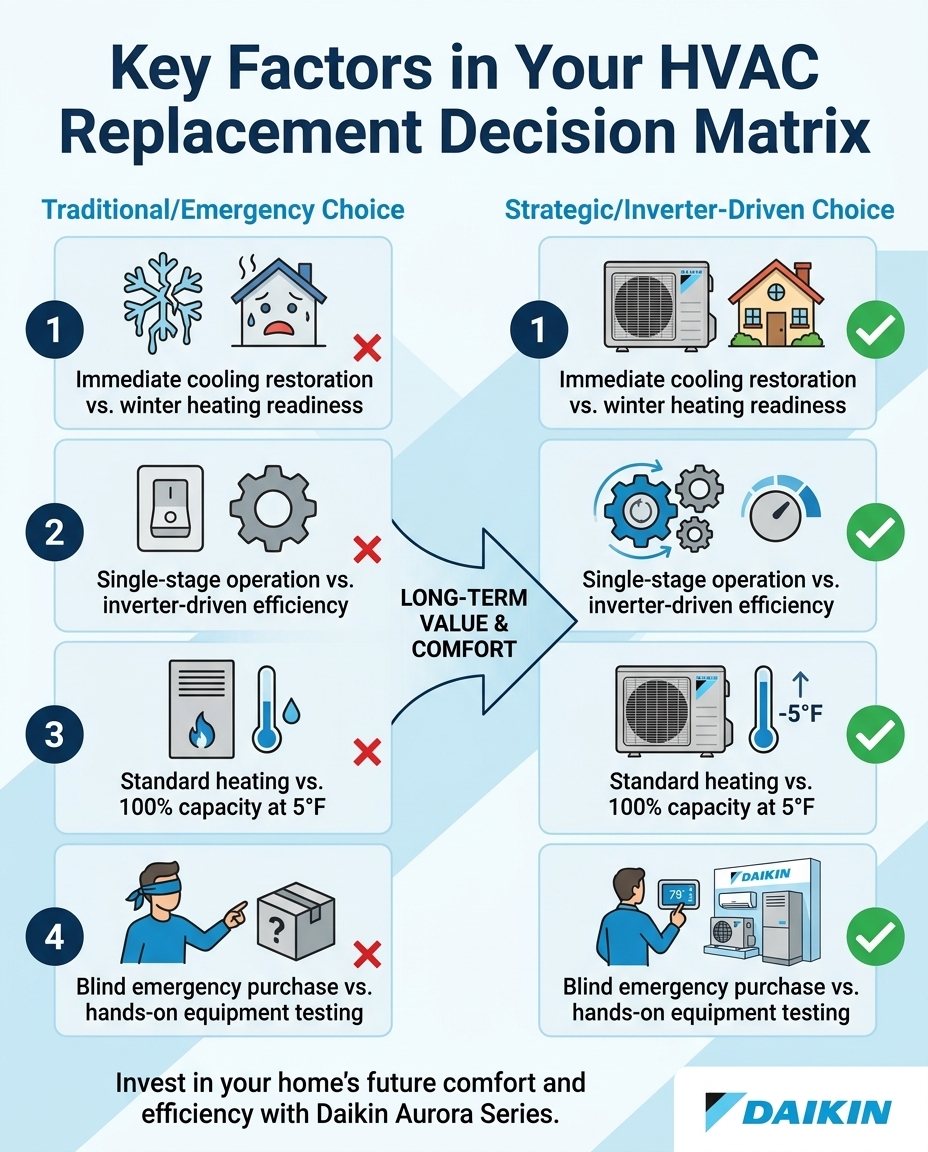
• Primary Focus — Rushed Emergency Replacement: Restoring immediate cooling capacity — Strategic High-Efficiency Upgrade: Year-round comfort and efficiency
• Contractor Selection — Rushed Emergency Replacement: Whoever is available first — Strategic High-Efficiency Upgrade: Vetted professionals with proper training
• Winter Performance — Rushed Emergency Replacement: Often struggles in low-ambient conditions — Strategic High-Efficiency Upgrade: Engineered for sustained cold-climate heating
• Long-Term Costs — Rushed Emergency Replacement: Higher monthly utility usage over 10-15 years — Strategic High-Efficiency Upgrade: Optimized energy consumption via inverter technology
Taking a breath to consult with professionals and evaluate options that serve your year-round needs is the most effective way to protect your long-term comfort. A well-planned upgrade addresses the immediate cooling crisis while simultaneously securing reliable, efficient warmth for the impending winter.
Evaluating Cold-Climate Capabilities for the Coming Winter
Shifting your focus from the immediate summer cooling emergency to the necessity of robust winter heating is critical in our region. Having helped countless homeowners navigate this transition, we've seen firsthand how standard heat pumps—generally designed for moderate climates—lose their heating capacity significantly as the outdoor temperature falls toward freezing. In contrast, cold-climate engineered models are built specifically to extract heat from frigid outdoor air, ensuring your home stays warm even during severe cold snaps.
The damp, chilly conditions of the Pacific Northwest require advanced defrost capabilities and sustained low-ambient performance. When humidity is high and temperatures hover near freezing, standard units spend excessive time and energy in defrost mode, leaving your home feeling drafty and cold. Advanced systems minimize this downtime, providing consistent, uninterrupted warmth. This is exactly where our team finds the specific engineering of the Daikin Aurora heat pump stands out. The Daikin Aurora Series is engineered for extreme conditions, capable of providing up to 100% heating capacity at 5 degrees Fahrenheit.
What Makes a Cold-Climate System Different?
We believe understanding the mechanical differences helps clarify why an upgrade is a smart long-term strategy. Cold-climate systems utilize specialized components that standard units simply lack.
• Enhanced compressor technology: Designed to operate safely and efficiently at much higher speeds when outdoor temperatures plummet, capturing latent heat that standard compressors miss.
• Advanced coil design: Optimized to facilitate better heat transfer and resist the rapid ice buildup common in damp, near-freezing weather.
• Intelligent defrost cycles: Sensors monitor actual ice accumulation rather than running on a simple timer, ensuring the system only pauses heating when absolutely necessary.
• Base pan heaters: Prevents melted ice from refreezing in the bottom of the outdoor unit, protecting the fan blades and internal components from winter damage.
By choosing a system with these capabilities, you reframe the August breakdown. It becomes a dual-solution: you gain immediate, high-efficiency cooling relief for the remainder of the summer, and you secure uninterrupted, powerful warmth for December and beyond.
The Long-Term Financial Calculus of High-Efficiency Systems
Upgrading to a premium system involves evaluating how the upfront decision pays off over time. When walking guests through our showroom, we explain that the financial reality of this choice is rooted in sustained energy savings, reduced wear and tear, and the potential for generic incentives. When you move away from basic, single-stage equipment, the mechanics of how your home consumes electricity change fundamentally.
1. Assess your current energy waste: Older systems operate on a harsh on/off cycle, drawing massive amounts of power every time they start up. This continuous cycling is highly inefficient.
2. Evaluate inverter-driven performance: Modern high-efficiency systems adjust their speed continuously to match the exact heating or cooling demand of the home, drastically reducing energy waste.
3. Factor in year-round utility reduction: Because the system operates efficiently in both peak summer heat and deep winter cold, homeowners typically see a reduction in monthly utility usage across all seasons.
4. Explore flexible zoning options: Implementing a single zone mini split or multi-zone system allows you to heat or cool only the rooms you actively use, further optimizing operational costs by not conditioning empty spaces.
5. Investigate available incentives: Qualifying high-efficiency heat pump installations may be eligible for generic federal tax credits and local utility rebates. Always consult a tax professional to verify current programs and determine your specific eligibility.
Inverter Technology vs. Traditional Operation
The core of this long-term financial viability lies in the compressor technology. Traditional systems blast at 100% capacity until the thermostat registers the target temperature, then shut off completely. This causes noticeable temperature swings and massive energy spikes upon every restart. Our specialists often compare it to driving a car by either flooring the accelerator or slamming on the brakes.
In contrast, inverter technology acts like cruise control. The compressor "cruises" at lower speeds, ramping up or down gently to maintain consistent comfort. This continuous, low-power operation prevents the energy-heavy startup cycles. By running longer at much lower capacities, the system dehumidifies better in the summer and maintains a perfectly even temperature in the winter, all while minimizing the electrical load on your home.
Removing the Guesswork: Why You Should Test Before You Commit
Upgrading your home comfort infrastructure is a major commitment, and making that decision solely from a glossy brochure or a hurried conversation during an August breakdown can induce significant anxiety. When your current system is dead and the house is hot, the pressure to sign a contract quickly is immense. However, we have found that physically interacting with a system before you buy it completely changes the decision-making process.
You need to know exactly how the equipment will sound and feel in your daily life. Modern inverter systems are known for their ultra-quiet operation, but reading "low decibel rating" on a specification sheet is very different from standing next to the unit while it runs. Removing the guesswork means finding an educational, no-pressure environment where you can evaluate equipment performance firsthand.
This is where our team at the Daikin Seattle Experience Center serves as a vital resource for homeowners. Rather than rushing a blind purchase, you can visit our Tukwila facility to test, hear, and feel the Daikin Aurora series in person. We recently assisted a homeowner who, considering major HVAC replacements, visited the Experience Center specifically to check out Daikin products and compare them to others. Noting the exceptionally quiet operation of the equipment in a real-world setting directly influenced their final equipment purchase and contractor selection. By taking the time to visit our Experience Center, you remove the anxiety from an August replacement decision, ensuring the system you choose truly fits your home and lifestyle.
Frequently Asked Questions About Late-Summer Upgrades
Why choose a cold climate heat pump in the Pacific Northwest?
Our team recommends a cold climate heat pump in the Pacific Northwest because our winters are characterized by damp, near-freezing temperatures. Standard heat pumps lose their heating capacity and struggle with excessive defrost cycles in these conditions. Cold climate models are specifically engineered with advanced compressors and intelligent defrost controls to maintain powerful, consistent heat even when the air outside is freezing and humid.
What are the long-term financial benefits of a Daikin Aurora heat pump?
We highlight to our guests that the long-term financial benefits stem primarily from the system's inverter-driven technology, which continuously adjusts energy usage to match your home's exact needs. This prevents the costly energy spikes associated with traditional systems turning on and off constantly. Over a 10-to-15-year lifespan, this optimized operation significantly reduces monthly utility usage, while the system's durability minimizes the likelihood of frequent, expensive winter repair calls.
How to choose a replacement HVAC system after a summer breakdown?
Choosing a replacement system requires looking past the immediate need for cooling and evaluating how the unit will perform during the upcoming winter. We advise starting by assessing cold-weather capabilities, ensuring the system can handle low-ambient temperatures without relying on backup heat. Finally, take the time to test the equipment in person at an experience center so you can verify its noise levels, airflow, and overall build quality before signing a contract.
Should I replace my AC and furnace at the same time?
Our professionals generally recommend replacing both your AC and furnace simultaneously to ensure maximum system efficiency and compatibility. Modern heat pumps provide both heating and cooling from a single unit, often eliminating the need for a traditional separate furnace entirely. Upgrading the entire system at once prevents an older, inefficient component from bottlenecking the performance of your new, high-efficiency equipment.
How does inverter technology affect monthly utility usage?
We frequently explain that inverter technology lowers monthly utility usage by operating at variable speeds rather than constantly cycling between 100% capacity and shutting completely off. By running continuously at lower, more efficient speeds, the system maintains a steady indoor temperature while drawing significantly less electricity. This smooth, cruise-control style of operation eliminates the massive power surges required to start up a traditional single-stage compressor.
Make Your Next Home Comfort Decision with Confidence
Experiencing an equipment failure during peak August late-summer cooling demand is stressful, but our team at the Daikin Seattle Experience Center knows it does not have to result in a panicked, short-sighted purchase. An August breakdown is a valuable opportunity to secure long-term, year-round comfort for your home. By shifting your perspective toward the impending winter, you can make a strategic choice that benefits your household for over a decade.
Evaluating long-term efficiency, inverter technology, and cold-climate winter performance leads to vastly better financial outcomes than simply opting for the fastest emergency fix. We encourage you to explore your options visually and audibly with our specialists, testing the equipment in a real-world setting to ensure it is the perfect fit for your home. Taking the time to understand the technology today ensures you will enjoy reliable, quiet, and highly efficient comfort through every season to come.
Schedule a Visit

your individual indoor comfort needs
products firsthand
with an authorized Daikin Dealer
.webp)
See why our customers Choose Us

“Jem is very inviting and knowledgeable. She gave us a walk through of the Daikin Experience Center and patiently answered all our questions. Learned a lot about HVAC’s through this visit.”
“Jem did a great job walking us through the various Daikin products and efficiencies of the products. She was very knowledgeable on everything Daikin. Highly recommend coming in for a tour prior to picking out your various AC systems.”
“Great experience at Daikin Seattle Experience Center: pre-purchase demos of home heating system (Daikin Fit), list of HVAC companies, working Daikin staff and external contractors to ensure highest quality. This experience sets the bar of how any home HVAC experience should be. Have got the Daikin Fit installed and so far seems to work very well – quiet, good home heating in peak winter (heat transfer/BTU/air handling); Functionality of Daikin thermostat and the iPhone app makes it very easy to use.”
“This place is awesome! If you are in the market for a new HVAC system, visit the Daikin Experience Center to get educated on the newest technology as well as available rebates and incentives for where you live. They’ll even connect you with local contractors in your area who install Daikin equipment.”
