

.webp)

.svg)


Upgrade Your Daikin Filter MERV Rating for Wildfires
Balancing Breathable Air and System Health During Wildfire Season
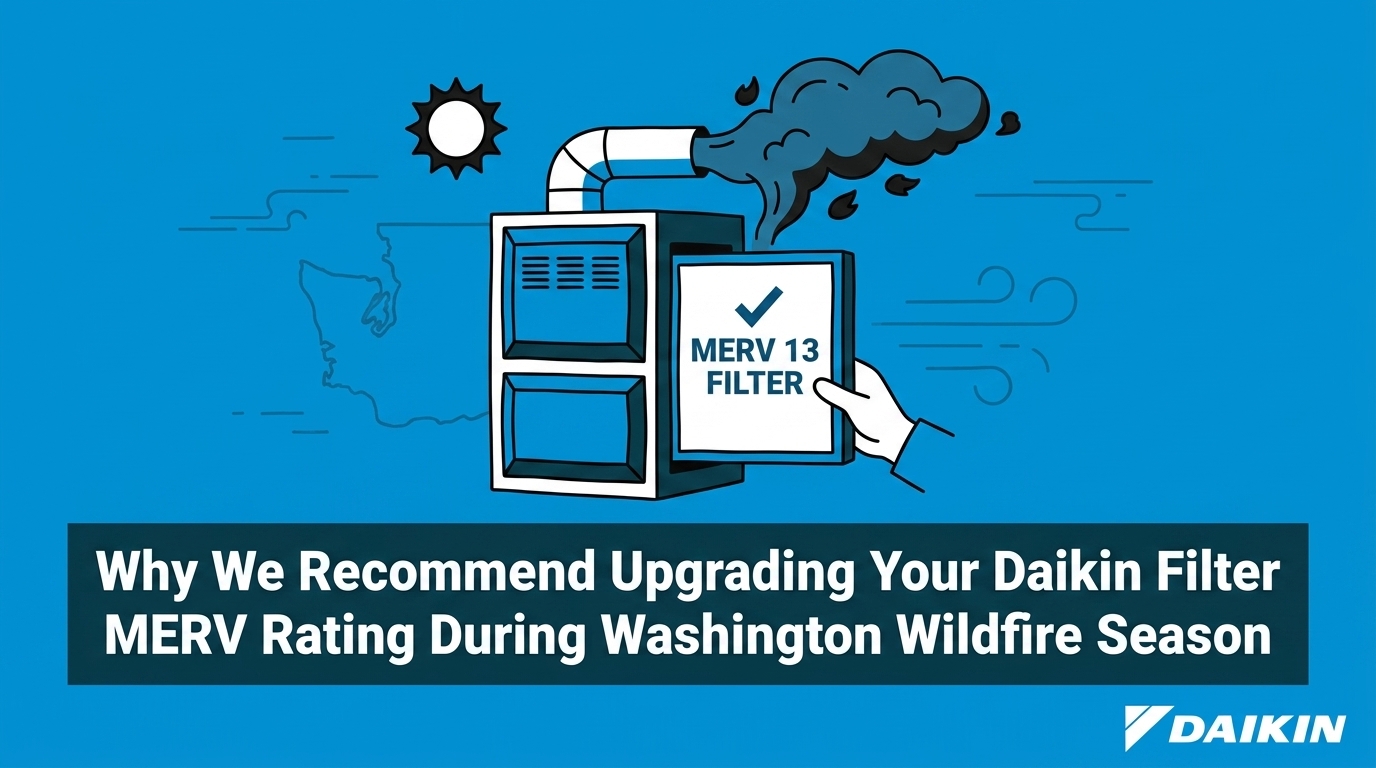
Summer in the Pacific Northwest used to mean weeks of clear skies, but now late summer brings a familiar, hazy reality that forces homeowners to rethink their indoor environments. If you are wondering exactly why we recommend upgrading your Daikin filter MERV rating during Washington wildfire season, the short answer is that you must protect your respiratory health without accidentally suffocating your sophisticated HVAC equipment. When the sky turns orange and the air smells like a campfire, the immediate instinct is to rush to the hardware store and purchase the thickest, highest-rated air filter available. However, upgrading to a highly restrictive filter without understanding the underlying mechanics of your system can cause far more harm than good.
The core conflict lies in the balance between rigorous air filtration and necessary airflow. Your heating and cooling equipment requires a specific volume of air moving across its internal components to function correctly. When you insert a dense filter to block microscopic smoke particles, you inherently increase the resistance that the blower motor must overcome. Finding the exact right MERV (Minimum Efficiency Reporting Value) rating means establishing a delicate equilibrium that keeps your indoor air safe to breathe while maintaining the proper airflow your equipment needs to operate efficiently. For a comprehensive approach to home comfort, understanding the foundations of indoor air quality is critical before exploring specific Daikin indoor environmental quality solutions.
Navigating the August Washington wildfire season requires more than just a trip to the store; it demands a strategic approach to how you operate your home's mechanical systems. A typical pattern we see is homeowners installing a heavy-duty filter and leaving it in place for months, completely unaware that their system is struggling to pull air through a wall of accumulated ash. This article breaks down the science of air filtration, the physics of airflow, and the exact steps you should take to protect both your family's lungs and your investment in your HVAC system.
The Threat of PM2.5: Why Standard Filters Fail When Seattle AQI Plummets
Wildfire smoke is not just ordinary dust; it is a complex mixture of gases and fine particles produced when wood and other organic materials burn. The most significant health threat from this smoke is fine particulate matter, commonly referred to as PM2.5. These particles are 2.5 microns in diameter or smaller—about 30 times smaller than the width of a single human hair. Because they are so microscopic, PM2.5 particles can bypass the body's natural respiratory defenses, traveling deeply into the lungs and even entering the bloodstream. This makes wildfire ash particularly dangerous to respiratory health, especially for children, the elderly, and individuals with pre-existing conditions like asthma.
Most homes are equipped with standard fiberglass or pleated filters rated between MERV 4 and MERV 8. It is crucial to understand that these standard filters are designed primarily to protect the HVAC equipment itself from large debris, pet dander, and heavy dust—not to purify the air for human lungs. When late-summer eastern winds push dense wildfire smoke into the Puget Sound region, causing sudden and dangerous spikes in local AQI (Air Quality Index), a MERV 8 filter will let the vast majority of dangerous PM2.5 particles pass right through into your living space. Effectively capturing these microscopic smoke particles requires a filter with a MERV 13 or higher rating, according to guidelines established by the EPA.
Because local environmental conditions can change overnight, indoor air quality solutions in Tukwila and the surrounding communities must be highly adaptable. Homeowners in the Tukwila and greater Seattle area need to be prepared to swap their filtration strategy the moment the wind shifts.
• MERV 4 - 8 — Primary Purpose: Basic equipment protection, large dust — PM2.5 Capture Efficiency: Less than 20% — Wildfire Suitability: Poor (Fails to stop smoke)
• MERV 11 — Primary Purpose: Pet dander, smog, fine dust — PM2.5 Capture Efficiency: 20% to 65% — Wildfire Suitability: Moderate (Better, but not ideal)
• MERV 13 — Primary Purpose: Bacteria, virus carriers, smoke — PM2.5 Capture Efficiency: Up to 85% — Wildfire Suitability: Excellent (EPA recommended baseline)
• MERV 16 — Primary Purpose: Hospital-level air purification — PM2.5 Capture Efficiency: 95% or higher — Wildfire Suitability: Maximum (High risk of airflow restriction)
The Static Pressure Dilemma: How High MERV Filters Affect Daikin Airflow
To understand why you cannot simply install the highest-rated filter on the market and forget about it, you have to understand a concept called static pressure. Static pressure is the resistance that airflow faces as it moves through your home's ductwork, vents, and air filter. Think of it like blood pressure for your HVAC system. If the pressure is too high, the heart of the system—the blower motor—has to work incredibly hard to circulate the air.
Daikin variable-speed air handlers are engineered for precise static pressure parameters to maximize energy efficiency and acoustic performance. These systems are incredibly smart, designed to quietly ramp up or down based on the exact needs of the home. However, blindly inserting a highly restrictive MERV 16 filter acts like a brick wall inside your return duct. The system senses the drop in airflow and forces the blower motor to work harder, pulling more electricity and generating more heat just to drag air through the dense pleats of the filter. Over time, this excessive strain can lead to premature motor failure and drastically reduced efficiency.
At our facility, our core philosophy is built on an educational approach: we focus on teaching the physics of airflow and system health rather than utilizing high-pressure sales tactics. One local homeowner recently visited our center wanting to learn about the latest HVAC solutions and current Daikin technology. After spending time with a Brand Ambassador exploring interactive displays, they left with a deep understanding of how advanced systems respond to airflow changes, empowering them to make informed decisions about their home comfort without compromising their equipment.
Understanding Inverter Technology and Airflow
The secret behind modern efficiency is inverter technology. Unlike older, single-stage systems that blast on at 100% capacity and then shut off completely, variable-speed blowers adjust their speed continuously based on real-time demand. This allows for whisper-quiet operation and precise temperature control.
• Continuous adjustment: The inverter communicates with the thermostat to deliver exactly the right amount of conditioned air, no more and no less.
• The restriction penalty: Excessive filter restriction disrupts this calculation. It forces the motor to run at higher RPMs continuously to overcome the static pressure barrier.
• Accelerated wear and tear: Running a variable-speed motor at its absolute maximum capacity for weeks on end during a smoke event increases mechanical wear, potentially shortening the lifespan of the equipment.
The Late-Summer Double Threat: Cooling Demand Meets Filter Loading
The most dangerous aspect of the August Washington wildfire season is the timing. Peak wildfire activity almost always coincides with the hottest weeks of the year in the Pacific Northwest. This creates a severe double threat for your home's mechanical systems: the reality of August heat waves overlapping with smoke events creates a dual demand for maximum cooling capacity and maximum air filtration simultaneously.
The Problem: Your air conditioning system requires a massive volume of warm indoor air to blow across its cold evaporator coil to remove heat and humidity from your home. When you install a high-MERV filter to block smoke, you reduce that volume of air. If the airflow drops too low, the temperature of the evaporator coil will plummet below freezing, causing the condensation on the coil to turn into solid ice. A frozen coil completely blocks all airflow, eventually causing the system to shut down on a high-pressure safety switch or, worse, damaging the compressor.
The Cause: The situation is compounded by a phenomenon known as "filter loading." As a high-MERV filter successfully captures heavy ash, soot, and smoke particles, those microscopic pores begin to clog. A filter that was moderately restrictive on day one becomes severely restrictive by day five. The more smoke it catches, the harder it is for air to pass through.
The Solution: Surviving this double threat requires abandoning the "set it and forget it" mentality. You cannot leave a smoke-loaded filter in place during periods of high cooling demand. The system requires maximum airflow to cool effectively, making aggressive, proactive filter monitoring critical during the late summer months. If your system is struggling to keep the house cool during a smoke event, a loaded, restrictive filter is almost always the primary culprit.
Your Wildfire Season Timeline: When to Upgrade and When to Swap
Managing your indoor air quality during a prolonged smoke event requires a tactical approach. You need to know exactly when to deploy your high-efficiency filters and exactly when to pull them out. Following a strict timeline ensures your lungs stay clear and your blower motor stays safe.
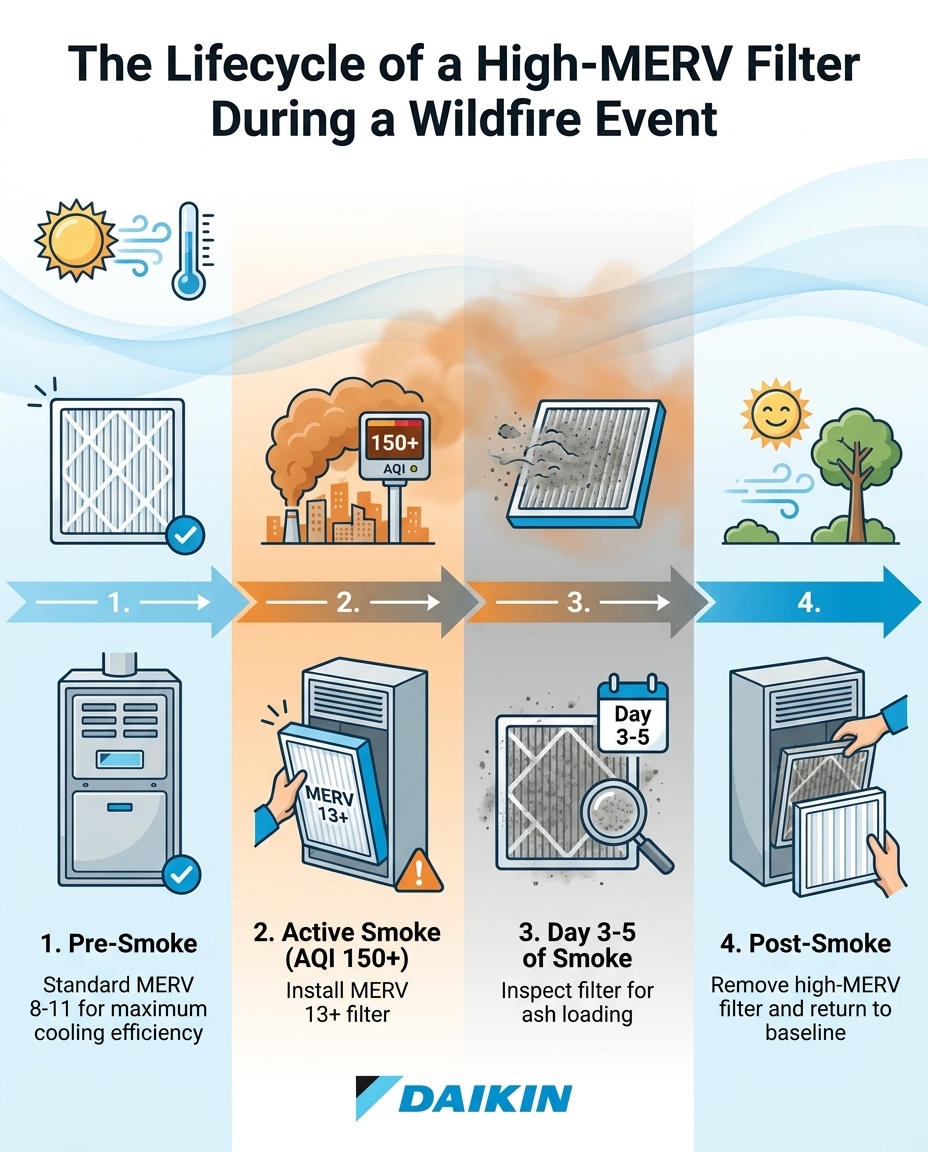
1. Pre-Smoke (Early August): Preparation is everything. Ensure you have at least two MERV 13+ filters on hand before the smoke arrives. However, do not install them yet. Run your standard MERV 8 or MERV 11 filter for daily cooling efficiency, allowing your system to breathe easily during the heat of early August.
2. Active Smoke Event: The moment you smell smoke or see the local AQI enter the "Unhealthy" range (typically an AQI above 150), swap to the high-MERV filter immediately. Ensure all windows and doors are tightly sealed to prevent outdoor air from bypassing the filtration system.
3. During the Event: This is the most critical phase. Check the high-MERV filter every 3 to 5 days. Pull it out and inspect the pleats. If the filter is visibly darkened with dark gray or black ash, replace it immediately with your backup high-MERV filter to restore airflow while maintaining protection.
4. Post-Event: Once the wind shifts and the outdoor air clears, remove the high-MERV smoke filter entirely. Return to your standard maintenance filter (MERV 8-11) to relieve the static pressure on your blower motor and return your system to peak cooling efficiency.
Smart Monitoring: Taking the Guesswork Out of Air Quality
While checking the local AQI on your smartphone is a good starting point, relying solely on outdoor weather apps doesn't tell you what is actually happening inside your home. Outdoor sensors measure the air miles away from your neighborhood; they do not measure how much smoke is successfully infiltrating your living room through drafty windows, open doors, or microscopic gaps in your home's envelope.
This is where dedicated indoor air quality monitors become invaluable. By tracking the exact particulate levels inside your home in real-time, you can determine exactly when high-MERV filtration is actively needed and when it is safe to return to standard filtration. This data-driven approach removes the guesswork, ensuring you only strain your HVAC system with a high-MERV filter when absolutely necessary.
Advanced systems integrate this monitoring directly into the HVAC controls. For example, Daikin One Plus air quality monitoring continuously tracks particulate levels, humidity, and volatile organic compounds (VOCs). When the system detects a spike in indoor PM2.5 from outdoor smoke infiltration, it can automatically adjust the system's fan speeds and filtration algorithms to clean the air rapidly. For homeowners without integrated smart thermostats, researching the best air quality monitors in Seattle is a highly recommended step to maintain a healthy indoor environment without over-straining the HVAC system.
Frequently Asked Questions About Wildfire Smoke and HVAC Filters
What MERV rating is best for wildfire smoke?
For capturing the microscopic PM2.5 particles found in wildfire smoke, a MERV 13 rating is widely considered the best balance of filtration and airflow. MERV 13 filters capture up to 85% of fine particulate matter, effectively cleaning the air inside your home. While higher ratings like MERV 16 exist, they often cause severe airflow restrictions in standard residential systems.
Does MERV 13 restrict airflow too much?
A MERV 13 filter will restrict airflow more than a standard MERV 8, but most modern systems can handle it if the filter is clean. The danger arises when the MERV 13 filter becomes loaded with ash and debris, at which point the restriction becomes severe. Frequent monitoring and replacement during a smoke event are required to prevent airflow issues.
How often should I change my HVAC filter during wildfire season?
During an active smoke event, you should physically inspect your filter every 3 to 5 days. Because wildfire ash loads into the filter material incredibly fast, a high-MERV filter may need to be completely replaced in as little as one to two weeks. Once the smoke clears, you can return to a standard 30-to-90-day replacement schedule with a lower MERV filter.
Can a high MERV filter damage my HVAC system?
Yes, if left unmonitored, a high-MERV filter can cause significant damage. The dense material increases static pressure, forcing the blower motor to work harder, which can lead to overheating and premature motor failure. Additionally, severely restricted airflow can cause the air conditioner's evaporator coil to freeze solid, potentially damaging the compressor.
How do I know if my Daikin system can handle a MERV 16 filter?
Determining if your specific system can handle a MERV 16 filter requires a professional static pressure test. Because MERV 16 filters are exceptionally dense, they are typically only recommended for systems specifically designed or modified for hospital-grade filtration. A certified technician can measure your ductwork's pressure capabilities to advise you safely.
Should I run my AC fan continuously during a smoke event?
Running your fan continuously (setting the thermostat to "On" instead of "Auto") is highly recommended during a smoke event, provided you have a clean MERV 13+ filter installed. This continuously cycles the indoor air through the filtration system, rapidly reducing PM2.5 levels in the home. Just remember to monitor the filter closely, as continuous operation will cause it to load with ash much faster.
Protect Your Air and Your Equipment This Wildfire Season
Surviving the hazy days of late summer requires a delicate balancing act. You must protect your family's respiratory health from dangerous PM2.5 particles while simultaneously protecting your equipment's critical airflow. Upgrading your filter rating is a vital defense mechanism, but it comes with the strict responsibility of proactive monitoring and accelerated filter replacements.
If you are unsure about your system's static pressure limits or want to explore permanent, low-restriction air purification technology, we are here to help. Taking the time to understand your home's mechanics is the key to lasting comfort. We encourage you to reach out to our team or visit the center to speak with an expert about optimizing your specific system for the challenges of the season ahead.
Schedule a Visit

your individual indoor comfort needs
products firsthand
with an authorized Daikin Dealer
.webp)
See why our customers Choose Us

“Jem is very inviting and knowledgeable. She gave us a walk through of the Daikin Experience Center and patiently answered all our questions. Learned a lot about HVAC’s through this visit.”
“Jem did a great job walking us through the various Daikin products and efficiencies of the products. She was very knowledgeable on everything Daikin. Highly recommend coming in for a tour prior to picking out your various AC systems.”
“Great experience at Daikin Seattle Experience Center: pre-purchase demos of home heating system (Daikin Fit), list of HVAC companies, working Daikin staff and external contractors to ensure highest quality. This experience sets the bar of how any home HVAC experience should be. Have got the Daikin Fit installed and so far seems to work very well – quiet, good home heating in peak winter (heat transfer/BTU/air handling); Functionality of Daikin thermostat and the iPhone app makes it very easy to use.”
“This place is awesome! If you are in the market for a new HVAC system, visit the Daikin Experience Center to get educated on the newest technology as well as available rebates and incentives for where you live. They’ll even connect you with local contractors in your area who install Daikin equipment.”
