

.webp)

.svg)


Daikin Ductless: Hot Afternoons to Chilly Nights
The Late-Summer Temperature Rollercoaster
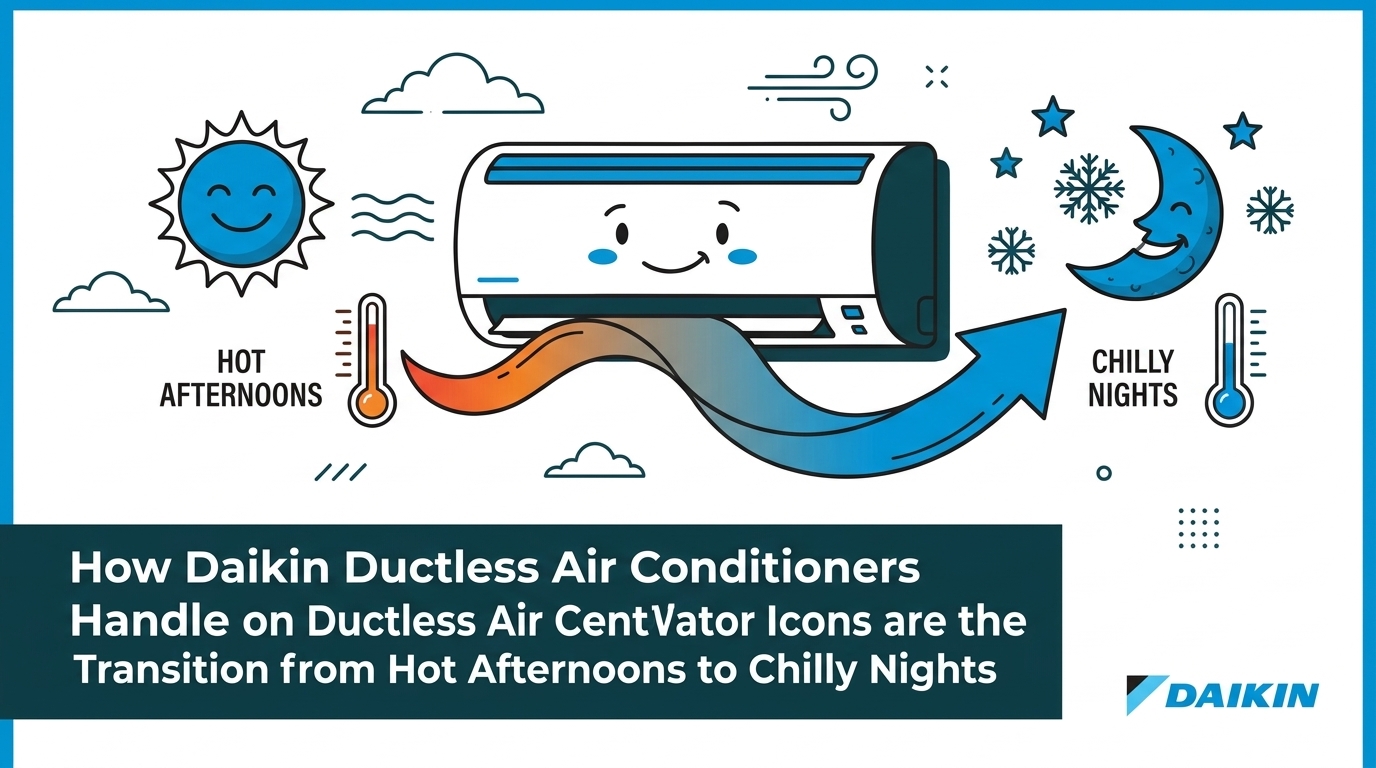
If you are wondering how Daikin ductless air conditioners handle the transition from hot afternoons to chilly nights, you are not alone in dealing with the Pacific Northwest's notorious late-summer weather. At the Daikin Seattle Experience Center, our team regularly speaks with homeowners who describe a frustratingly familiar pattern: your home is sweltering at 4 p.m., but by midnight, you are reaching for an extra blanket. Managing these aggressive 30-plus degree temperature swings during the late August back-to-school transition often turns into a frustrating game of thermostat micromanagement. You find yourself constantly walking over to the wall unit to switch from cooling to heating as the sun goes down. The decision point for many homeowners we work with is whether to keep fighting the thermostat or trust a smart system to do the heavy lifting. To understand how this works, it helps to look at modern Ductless Air Conditioners and the specific Daikin inverter technology that powers them.
Instead of treating your HVAC system as a manual switch between summer cooling and winter heating, Daikin's smart technology actively reads the room. It bridges the gap between those hot afternoons and chilly nights without requiring you to lift a finger. By utilizing advanced sensors and intelligent programming, these systems adapt in real time to whatever the unpredictable weather throws your way.
The Anatomy of a Pacific Northwest Temperature Swing
The Greater Seattle area is famous for its diurnal temperature variation—a fancy meteorological term for massive daily temperature swings. During late summer and early fall, our installation teams know it is entirely normal to see daytime highs in the upper 70s or 80s, followed by a rapid plunge into the low 50s at night. Traditional single-stage heating and cooling systems simply lack the nuance to handle this specific weather pattern effectively.
Afternoon Heat Load Accumulation
Throughout the day, your home acts like a thermal battery. Sunlight streams through the windows, the roof absorbs solar radiation, and daily activities like cooking or running appliances add to the indoor heat load. By late afternoon, homes in the Pacific Northwest trap this heat inside their well-insulated walls. You need steady, consistent cooling to remove both the sensible heat (temperature) and latent heat (humidity) so your living space remains comfortable.
Rapid Evening Heat Loss
As the sun dips below the horizon, the outdoor ambient temperature drops dramatically. The same home envelope that trapped heat just a few hours earlier suddenly begins losing it to the cool night air. This sudden drop requires your HVAC system to make a hard pivot. Traditional systems struggle here. They either blast freezing air because you left the AC on, or they blast scorching heat because you panicked and switched the furnace on. The result is a cycle of waking up sweating, adjusting the thermostat, and then waking up freezing—a complaint we hear constantly during end-of-season cooling transitions.
• Response to Temp Drop — Traditional Single-Stage System: Hard stop, waits for room to freeze, then blasts maximum heat. — Daikin Inverter System: Smoothly ramps down cooling and gently introduces heating as needed.
• Thermostat Management — Traditional Single-Stage System: Requires manual switching between "Cool" and "Heat" modes. — Daikin Inverter System: Auto-changeover handles the transition automatically.
• Energy Consumption — Traditional Single-Stage System: High power spikes during hard starts and stops. — Daikin Inverter System: Low, steady power usage matching the exact room load.
• Comfort Level — Traditional Single-Stage System: Noticeable temperature swings and loud operation. — Daikin Inverter System: Consistent, quiet comfort regardless of outdoor changes.
Beyond On and Off: How Inverter Compressors Bridge the Gap
The secret to managing volatile weather lies in the compressor. Older air conditioners operate on a simple binary principle: they are either running at 100 percent capacity or they are completely off. When you need just a little bit of cooling as the afternoon heat fades, a traditional system still blasts you with full power, overcooling the room before shutting off abruptly.
Eliminating the Hard Stop and Start
Daikin Ductless Inverter Systems operate differently. An inverter-driven compressor acts more like the accelerator pedal in a car. Instead of stopping and starting, the compressor smoothly adjusts its speed to match the exact heating or cooling load required at any given moment. By eliminating abrupt on-and-off cycles, the system prevents the drastic temperature spikes and dips that make shoulder-season weather so uncomfortable. This continuous, modulated operation also translates to significantly quieter performance and better energy efficiency.
Adapting to the Exact Load Requirement
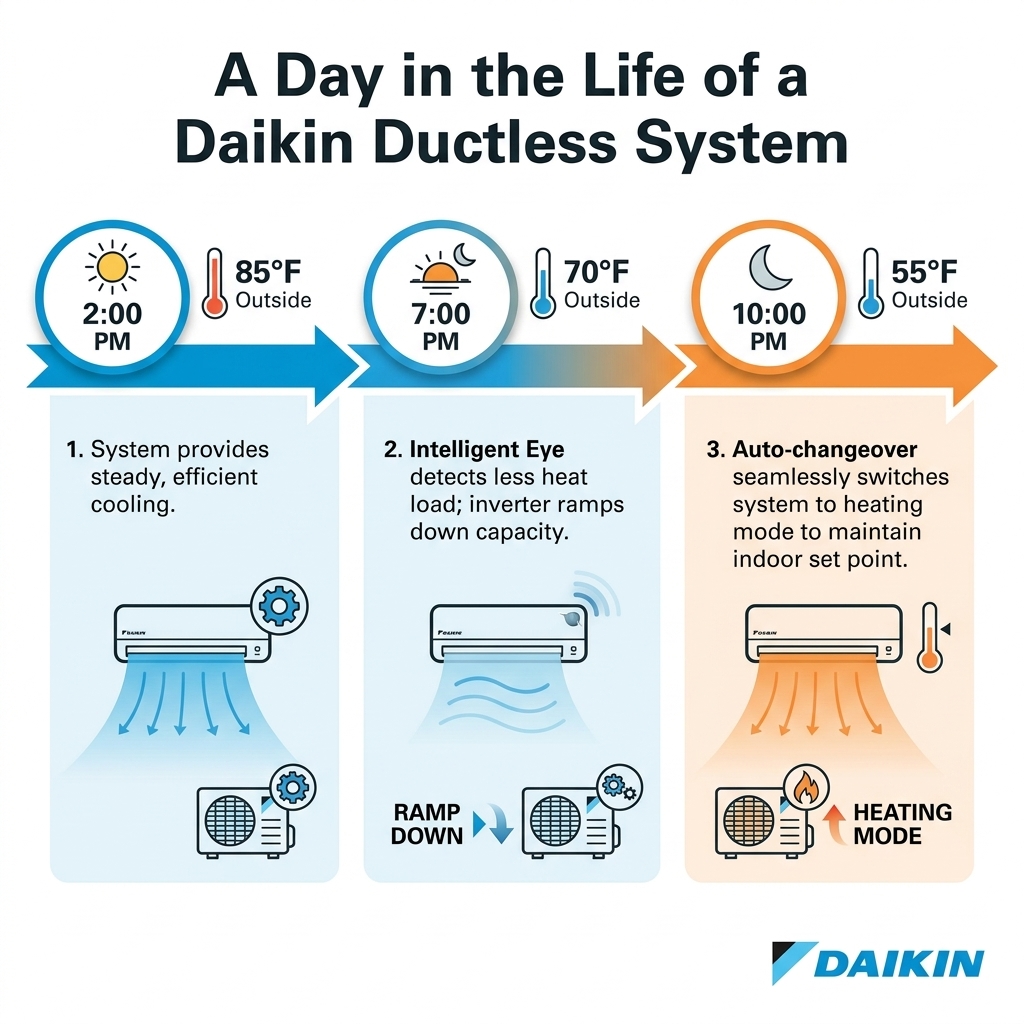
As the late-summer afternoon heat fades into evening, the inverter simply ramps down its cooling capacity. It uses just enough energy to maintain your set temperature. If you want to understand the deeper mechanics of this process, reading about how Daikin variable speed operation maintains your set temperature provides great insight into the physics of frequency modulation. When the night air cools the home further, the system seamlessly transitions into a low-level heating mode. We often see local homeowners visit our educational center specifically to understand heat pumps and inverter technology before making a decision. By letting them see the equipment operate in person, our team helps them gain valuable insights into how these systems adapt without aggressive starts and stops, leading to a high-quality installation tailored to their home.
Reading the Room: Daikin's Intelligent Eye Sensor
A smart compressor is only as good as the information it receives. Daikin Ductless Inverter Systems elevate indoor comfort by using built-in sensors that actively detect environmental changes. The Intelligent Eye sensor is a sophisticated piece of technology that tracks both human movement and ambient temperature variations across the room.
Detecting Occupancy and Movement
The Intelligent Eye does not just measure the air temperature at the wall unit; it reads the room's activity level. Here is how the sensor actively manages your comfort:
1. Scanning the space: The infrared sensor divides the room into zones and continuously scans for human heat signatures and movement.
2. Adjusting for absence: If the sensor detects that the room has been empty for 20 minutes, it automatically shifts the set temperature by a few degrees to save energy.
3. Reacting to return: As soon as family members walk back into the room during the evening, the system instantly returns to the original comfort setting.
Directing Airflow for Optimal Comfort
Beyond saving energy, the Intelligent Eye actively prevents drafts. During a hot afternoon cooling cycle, the sensor locates where people are sitting and directs the cold airflow away from them, preventing that uncomfortable chilled feeling. Conversely, when the system switches to heating during a chilly night, it directs the warm air straight down toward the floor. Since heat naturally rises, this ensures an even, cozy distribution of warmth from the ground up. Integrating these sensors with Daikin smart thermostats gives you total control over how your system reads and reacts to your living space.
Seamless Transitions with Auto-Changeover Mode
The ultimate antidote to late-August weather volatility is Daikin's Auto-Changeover mode. This feature completely eliminates the need for manual thermostat micromanagement. You no longer have to act as the traffic controller between your home's heating and cooling functions.
Setting a Single Temperature Target
Auto-Changeover mode allows you to choose a single, comfortable set point—for example, 70 degrees. The system's internal logic continuously monitors the indoor temperature against this target. During the late August back-to-school transition, the system will actively cool the home while the sun is beating down on the roof. As the sun sets and the outdoor temperature plummets, the system recognizes that the indoor temperature is dropping below the 70-degree target. It then automatically switches the reversing valve, turning the air conditioner into a heat pump to gently warm the space.
Uninterrupted Sleep Quality
The true benefit: Uninterrupted sleep. There is nothing worse than waking up at 2 a.m. freezing because the air conditioner was left running on a 50-degree night. Auto-Changeover ensures your bedroom maintains a stable, comfortable environment overnight. You get the simplicity of "set it and forget it" operation, allowing you to sleep peacefully while the technology handles the drastic Pacific Northwest temperature swings happening just outside your window.
Testing the Technology Before You Commit
Reading about smart sensors and inverter compressors is one thing, but feeling them in action is entirely different. Choosing a new HVAC system is a significant decision, and our team believes you should not have to guess how the equipment will perform in your home. This is where our staff at the Daikin Seattle Experience Center in Tukwila changes the game for local homeowners.
We designed this state-of-the-art facility specifically so you can physically test and visualize these systems in real-world settings. When we walk you through our simulated living room, you can watch the Intelligent Eye track movement, and listen to just how quietly the inverter compressor ramps up and down. We recently helped a local homeowner who was shopping for a new heating and cooling system and visited us precisely for this reason. They wanted to touch, hear, and visualize the systems in real settings while getting expert explanations from our staff. Providing this hands-on learning experience gave them total confidence in their choice, knowing exactly how the equipment would handle the Greater Seattle area climate before installation day.
Common Questions About Ductless Temperature Control
How does Daikin auto changeover work?
This is a question our team answers frequently. Daikin auto changeover works by monitoring the room's temperature against your desired set point. When the indoor temperature drifts beyond a specific range (often called a deadband), the system's internal logic automatically switches the reversing valve. This shifts the unit from cooling mode to heating mode, or vice versa, without any manual input from the user.
Does a ductless mini split switch from heat to cool automatically?
Yes, provided the system is set to the "Auto" mode rather than strictly "Cool" or "Heat." Once engaged, the ductless mini split uses its built-in sensors to determine whether the room requires warm or cold air to maintain your chosen temperature, making it perfect for unpredictable shoulder seasons.
What is the best temperature to set a ductless AC in summer?
The ideal summer setting for a ductless AC is typically between 72 and 75 degrees when you are home. Because inverter technology is highly efficient at maintaining temperatures, setting it at a comfortable, moderate level allows the compressor to run at a low, energy-saving speed rather than constantly stopping and starting.
Do Daikin mini splits have built-in thermostats?
Yes, Daikin mini splits feature built-in thermistors located inside the indoor air handling unit. These highly sensitive components constantly measure the temperature of the air being pulled into the unit, feeding that real-time data back to the compressor to adjust output instantly.
How quickly does the inverter compressor react to evening temperature drops?
The inverter compressor reacts almost instantaneously to changing heat loads. As soon as the indoor air temperature begins to drop in the evening, the system smoothly ramps down its cooling output, and if Auto-Changeover is active, it will gently introduce heat as soon as the room falls below your target set point.
Reclaiming Your Comfort This Season
Understanding how Daikin ductless air conditioners handle the transition from hot afternoons to chilly nights takes the stress out of late-summer weather. By leveraging intelligent sensors, variable-speed inverter compressors, and seamless auto-changeover features, these systems actively manage your indoor climate. You no longer have to act as a human thermostat, constantly adjusting settings as the Pacific Northwest weather shifts from one extreme to the other.
Just last week, our knowledgeable staff at the Experience Center gave a local customer a full walkthrough of various Daikin products and their efficiencies. This hands-on guidance provided them a much better understanding of how the technology adapts to daily temperature swings. If you are tired of waking up freezing or sweating, we invite you to visit us in Tukwila to explore how these advanced systems can eliminate manual thermostat adjustments and keep your home perfectly comfortable all year long.
Schedule a Visit

your individual indoor comfort needs
products firsthand
with an authorized Daikin Dealer
.webp)
See why our customers Choose Us

“Jem is very inviting and knowledgeable. She gave us a walk through of the Daikin Experience Center and patiently answered all our questions. Learned a lot about HVAC’s through this visit.”
“Jem did a great job walking us through the various Daikin products and efficiencies of the products. She was very knowledgeable on everything Daikin. Highly recommend coming in for a tour prior to picking out your various AC systems.”
“Great experience at Daikin Seattle Experience Center: pre-purchase demos of home heating system (Daikin Fit), list of HVAC companies, working Daikin staff and external contractors to ensure highest quality. This experience sets the bar of how any home HVAC experience should be. Have got the Daikin Fit installed and so far seems to work very well – quiet, good home heating in peak winter (heat transfer/BTU/air handling); Functionality of Daikin thermostat and the iPhone app makes it very easy to use.”
“This place is awesome! If you are in the market for a new HVAC system, visit the Daikin Experience Center to get educated on the newest technology as well as available rebates and incentives for where you live. They’ll even connect you with local contractors in your area who install Daikin equipment.”
