

.webp)

.svg)


Heat Pump Troubleshooting Chart: Short Cycling Fixes
The Late Summer Struggle: When Your Heat Pump Won't Stay Running
Late August in the Pacific Northwest brings a very specific type of weather. The days are still hot, the afternoons can get unexpectedly sticky, and your cooling equipment has been running hard for months. If you find yourself navigating the heat pump troubleshooting chart for short cycling in late summer, you are certainly not alone. It is incredibly frustrating when your home feels warm, yet your system keeps turning on, running for just a few minutes, and shutting right back down.
This rapid on-and-off behavior is known as short cycling. Not only does it fail to maintain consistent comfort in your living space, but it also places a massive strain on your equipment during the demanding late August peak cooling season. When this happens, you are faced with a crucial decision: is this a simple end-of-season maintenance task you can handle yourself, or is it a larger structural issue that requires a professional? Before you panic, the best first step is to consult your manufacturer's diagnostic tools. Understanding what your system is trying to tell you is the key to protecting your heat pump systems from unnecessary wear and tear.
What Is Short Cycling and Why Does It Peak in August?
To understand why your system is struggling, we first need to define what short cycling actually is. A healthy cooling cycle should run long enough to steadily lower the indoor temperature to your thermostat's set point, and then shut off. Short cycling occurs when a cooling cycle terminates prematurely. The system fires up, runs briefly, and then shuts down before the set point is properly reached and stabilized. This rapid on/off sequence causes immense wear and tear on the compressor, which requires the most energy during startup.
So, why does this happen so frequently during late summer? In Tukwila and Greater Seattle, late August often brings warm, humid afternoons. This specific climate exposes systems that are struggling to manage latent heat. When a system is not properly calibrated to handle the specific moisture levels of the late summer air, it behaves erratically.
The Difference Between Sensible and Latent Heat
To truly grasp why your home feels uncomfortable during a short cycle, you need to understand the two types of heat your system battles:
• Sensible heat: This is the temperature you read on the thermostat. It is the physical warmth in the air that you can feel.
• Latent heat: This refers to the moisture or humidity trapped in the air. High latent heat makes a room feel sticky, heavy, and uncomfortable.
• The cooling balance: A system must run long enough to address both. Short cycling lowers the sensible heat quickly but leaves the latent heat behind, resulting in a cold but clammy room.
• Normal Cycle — Duration: 15 to 20 minutes — Temperature Impact: Gradual, even cooling — Humidity Impact (Latent Heat): Extracts moisture effectively — Overall Comfort Level: Crisp, dry, and comfortable
• Short Cycle — Duration: 5 to 10 minutes — Temperature Impact: Rapid, uneven cooling — Humidity Impact (Latent Heat): Fails to remove moisture — Overall Comfort Level: Cold, sticky, and clammy
The Oversized Equipment Dilemma
One of the most common root causes of late-summer short cycling is something that surprises many homeowners: an oversized HVAC system. There is a persistent misconception that "bigger is better" when it comes to heating and cooling. People often assume that a larger unit will cool the house faster and run less often, saving money. In reality, the exact opposite is true, and the physics of air conditioning prove why.
When an oversized system kicks on, it blasts the home with cold air. It cools the sensible air temperature so rapidly that it satisfies the thermostat in just a few minutes. However, because it only ran for five or ten minutes, it never had the chance to pull the latent humidity out of the indoor air. The thermostat senses that the room is cool and shuts the system down, but the air remains thick and humid. This leaves your home with that dreaded "clammy" feeling.
Because the air is still humid, it holds onto heat, causing the indoor temperature to rise quickly again. The thermostat senses this rise and kicks the oversized system back on. This creates a relentless, damaging loop of rapid starts and stops. This sizing mismatch often becomes glaringly obvious during the late August peak cooling demands, when the humidity fluctuates and the equipment is forced to show its true capabilities.
Locating and Deciphering Your Heat Pump Troubleshooting Chart
If your system is caught in this rapid loop, your next step is to find out why. Modern HVAC equipment is incredibly smart and is designed to tell you exactly what is wrong. You just need to know where to look and how to translate the message. This is where your diagnostic chart becomes an invaluable tool.
Step-by-Step Code Retrieval
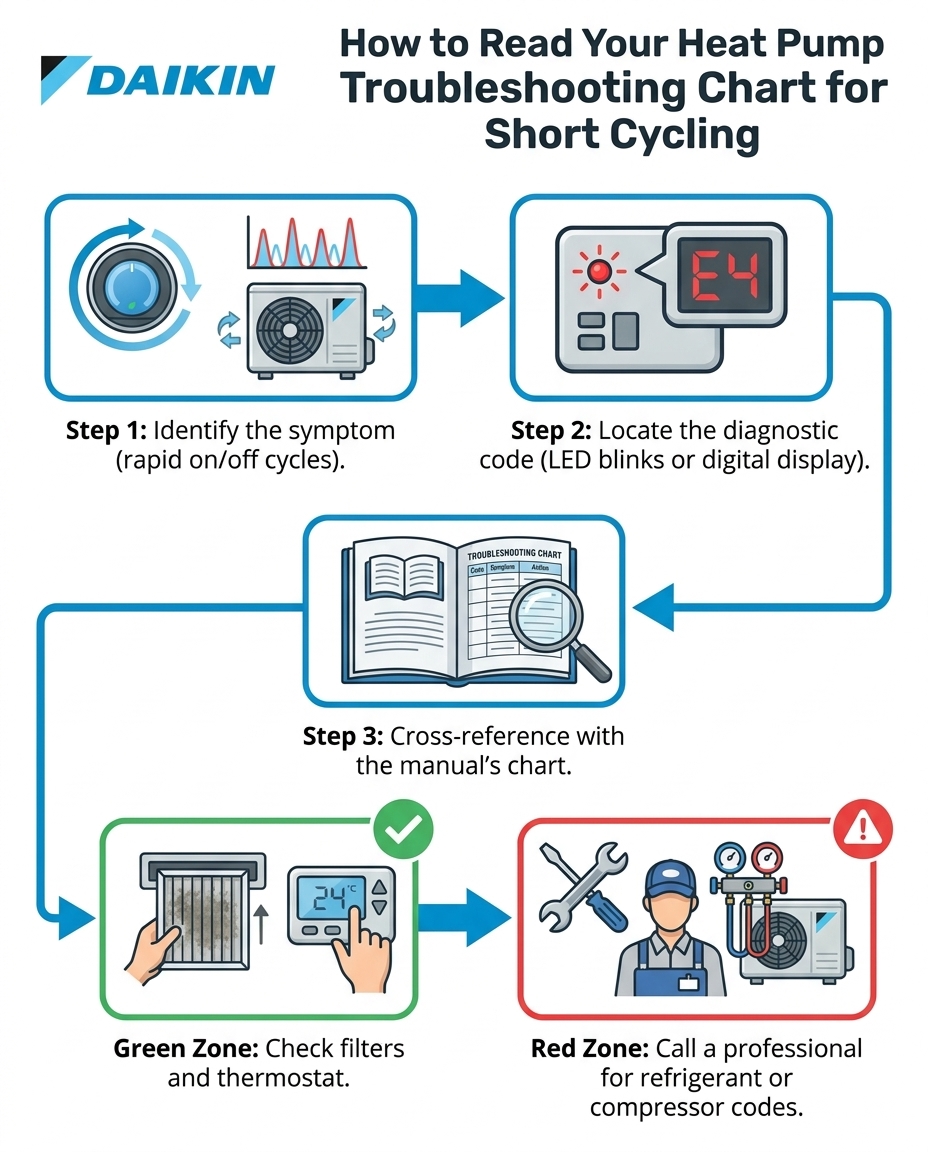
1. Locate the diagnostic chart: You can usually find the troubleshooting chart in your original user manual. If you do not have the manual, look at the inside of the indoor unit access panel or the back of the outdoor unit's service panel.
2. Observe the communication method: Modern systems communicate errors in a few different ways. You might see a specific sequence of blinking LED lights on the indoor air handler, or you might see a digital alphanumeric code displayed directly on your smart thermostat.
3. Write down the exact code: Before you press any buttons, turn off any power, or attempt to reset the system, write down exactly what you see. If it is a blinking light, count the flashes (e.g., three short blinks, two long blinks).
4. Cross-reference your findings: Take your written code and look at the heat pump troubleshooting chart short cycling section. A standard chart is usually structured with three columns: the Code, the Symptom, and the Potential Cause.
By comparing your specific code to the chart, you can quickly determine if you are dealing with a minor airflow issue or something more complex. If you need more help translating what those blinking lights mean, you can review our guide on common heat pump error codes for additional clarity.
Common Short Cycling Codes You Can Safely Investigate
Once you have your heat pump troubleshooting chart short cycling diagnosis in hand, you will likely find that the codes fall into two distinct categories: things you can check yourself, and things that require a professional. It is highly empowering to know the boundaries of safe, tool-free homeowner inspection.
Many codes that point to short cycling are actually indicating an airflow restriction. After a long summer of continuous operation, your system has pulled a massive amount of dust, pollen, and pet dander through its return vents. If the chart indicates a general airflow fault, there are several safe steps you can take:
• Check the air filter: This is the primary culprit for restricted airflow. A severely clogged filter suffocates the system, causing the internal components to overheat or freeze up. The system then shuts down prematurely to protect itself, resulting in a short cycle. Pull the filter out and hold it up to the light; if you cannot see light through it, replace it immediately.
• Inspect supply and return vents: Walk through your home and ensure that rugs, furniture, or heavy curtains are not blocking your vents. Closing too many vents in unused rooms can also increase static pressure and trigger a short cycle.
• Evaluate thermostat placement: Sometimes, the system is perfectly fine, but the thermostat is confused. If your thermostat is located in direct sunlight, near a heat-generating appliance, or close to a drafty door, it will read a false temperature and shut the system down too early.
If you check these basic airflow and thermostat issues and the system continues to short cycle, you have reached the limit of safe homeowner intervention.
When the Chart Indicates a Structural or Refrigerant Issue
If your diagnostic chart points away from simple airflow and instead highlights codes related to low refrigerant levels, compressor malfunctions, or systemic electrical faults, it is time to step back. These are pro-level codes indicating that the system is actively protecting itself from catastrophic failure by shutting down prematurely.
For example, if a system is low on refrigerant due to a leak, it cannot properly absorb heat. The evaporator coil may begin to freeze over, triggering a safety switch that stops the cycle. Once the ice melts, the system tries again, creating that rapid on/off loop. Attempting DIY repairs on high-voltage, pressurized refrigerant systems is incredibly dangerous and should never be attempted by an unlicensed individual.
The Risks of Ignoring Pro-Level Codes
When you see a complex code on the chart, ignoring it or simply resetting the breaker to force the system to run is a major mistake. Here is why you need expert intervention:
• Compressor burnout: Continuous short cycling forces the compressor to start up dozens of times an hour. This will eventually burn out the compressor motor, leading to a massive repair bill.
• Voided warranties: DIY attempts to adjust refrigerant charges or modify internal electrical components will instantly void your manufacturer warranty.
• Long-term energy waste: Ignoring systemic issues, especially those related to oversized equipment, guarantees that you will pay inflated energy bills for a home that never truly feels comfortable.
A trained technician has the specialized tools to diagnose whether a systemic fault is due to a mechanical failure or if the equipment is simply too large for the home's square footage. If you live in Tukwila and Greater Seattle and your chart shows a red-zone code, reaching out for professional heat pump service is the safest and most cost-effective next step.
Empowering Your HVAC Decisions with Hands-On Education
Understanding your HVAC system's technology before an emergency happens is the best way to protect your investment. When you know how to read your diagnostic codes, you are no longer at the mercy of guesswork. However, if your current system is failing due to being oversized or outdated, you might be facing the prospect of a replacement.
This is where the Daikin Experience Center changes the game. We believe in an educational, no-pressure approach that empowers homeowners to truly understand their system's capabilities before calling a technician or signing a contract. A typical pattern we see is homeowners who are shopping for a new heating and cooling system visiting the center to touch, hear, and visualize systems in real settings.
By interacting with working displays and speaking with brand ambassadors, you can see the difference between a clunky, oversized single-stage unit and a modern, inverter-driven system that modulates its capacity to perfectly match your home's needs. This hands-on education prepares you to evaluate contractor proposals with confidence. If you are ready to learn more about how proper sizing and advanced technology eliminate short cycling, plan a visit to the Daikin Experience Center.
Frequently Asked Questions About Short Cycling and Diagnostics
How do I read a heat pump troubleshooting chart?
To read your troubleshooting chart, start by locating it in the user manual or on the inside of the unit's access panel. Match the specific LED blink sequence or digital error code displayed on your equipment to the corresponding code in the left column of the chart. Once you find the match, read across the row to identify the symptom and review the recommended action for either a homeowner or a licensed technician.
Why does my heat pump short cycle in the late summer?
Late summer short cycling is often driven by a combination of high afternoon humidity and oversized equipment. When an oversized system turns on, it cools the air temperature too rapidly and shuts off before it has time to extract the latent moisture from the air. This leaves the home feeling warm and sticky shortly after the cycle ends, prompting the thermostat to rapidly trigger the system to turn on again.
What Daikin heat pump problems cause short cycling?
The most common causes include severely clogged air filters that restrict airflow, improper thermostat placement near heat sources or drafts, and low refrigerant levels causing the system to protect itself. Additionally, if the system is improperly sized for the home's square footage, it will inherently short cycle because it cannot complete a full, steady cooling phase without overshooting the target temperature.
How do I stop my heat pump from short cycling?
The first and easiest step is to check and replace dirty air filters to ensure the system can breathe properly. Next, walk through your home and ensure that all supply and return vents are open and unblocked by furniture. If these basic airflow checks do not resolve the issue, consult your troubleshooting chart and contact a professional to investigate potential refrigerant or mechanical faults.
Can an oversized heat pump be fixed without replacing it?
While you cannot physically shrink the capacity of an oversized single-stage unit, a professional can sometimes make minor adjustments to mitigate the discomfort. A technician might adjust blower motor speeds or recommend adding supplemental dehumidification to handle the latent heat. However, replacement with an appropriately sized, inverter-driven system is ultimately the only permanent fix for an oversized unit.
Take Control of Your Home's Comfort This Season
Navigating the heat pump troubleshooting chart for short cycling in late summer does not have to be an overwhelming experience. By understanding the difference between sensible and latent heat, and recognizing the signs of an oversized system during the late August peak cooling season, you can take control of your home's comfort. Remember that while checking air filters and vents is perfectly safe, complex diagnostic codes require expert eyes. Use your chart to gain peace of mind, and if the codes point to a structural or refrigerant issue, do not hesitate to seek professional guidance to restore your system's efficiency and protect your compressor.
Schedule a Visit

your individual indoor comfort needs
products firsthand
with an authorized Daikin Dealer
.webp)
See why our customers Choose Us

“Jem is very inviting and knowledgeable. She gave us a walk through of the Daikin Experience Center and patiently answered all our questions. Learned a lot about HVAC’s through this visit.”
“Jem did a great job walking us through the various Daikin products and efficiencies of the products. She was very knowledgeable on everything Daikin. Highly recommend coming in for a tour prior to picking out your various AC systems.”
“Great experience at Daikin Seattle Experience Center: pre-purchase demos of home heating system (Daikin Fit), list of HVAC companies, working Daikin staff and external contractors to ensure highest quality. This experience sets the bar of how any home HVAC experience should be. Have got the Daikin Fit installed and so far seems to work very well – quiet, good home heating in peak winter (heat transfer/BTU/air handling); Functionality of Daikin thermostat and the iPhone app makes it very easy to use.”
“This place is awesome! If you are in the market for a new HVAC system, visit the Daikin Experience Center to get educated on the newest technology as well as available rebates and incentives for where you live. They’ll even connect you with local contractors in your area who install Daikin equipment.”
