

.webp)

.svg)


Interpret Air Quality Monitor Readings & Adjust HVAC
Facing August Smoke: Making Sense of Your Air Quality Data
August in the Pacific Northwest brings a familiar and challenging seasonal shift: the arrival of late-summer heat combined with heavy wildfire smoke. Figuring out how to interpret your Seattle air quality monitor readings and adjust your HVAC accordingly is the most important step you can take to protect your home. When the sky over the Puget Sound turns hazy and temperatures rise, simply staying indoors is not enough if your cooling system is actively pulling polluted outdoor air into your living space. At our Daikin Seattle Experience Center, our team often hears from homeowners who watch the numbers on their indoor monitors climb, feeling helpless because they do not know exactly which settings to change to protect both their lungs and their equipment.
This guide maps specific PM2.5 readings to physical thermostat adjustments, ensuring you can keep your home cool without compromising your air. For comprehensive guidance on protecting your home's indoor air quality, you can explore our complete range of indoor environmental quality solutions.
Decoding PM2.5 Thresholds in the Seattle/Tukwila Metro Area
When wildfire smoke blankets the Seattle/Tukwila metro area, the primary threat is fine particulate matter, specifically known as PM2.5. These particles are 2.5 microns or smaller in diameter—so tiny that they can bypass your respiratory system's natural defenses and enter your bloodstream. While generic weather apps might give you a broad overview, we always advise our visitors that understanding the exact PM2.5 thresholds is essential for making informed decisions about your home comfort systems.
During these late-summer smoke events, data from the Puget Sound Clean Air Agency consistently shows that PM2.5 is the dominant pollutant. When you check your local air quality Seattle reports or look up the Seattle AQI online, you are primarily looking at a calculation based on the concentration of these microscopic smoke particles. Knowing how to translate these numbers into action is what separates a safe, comfortable home from one that feels just as smoky as the outdoors.
What PM2.5 Levels Indicate Immediate Danger?
The EPA's AirNow system establishes clear thresholds for when outdoor air becomes hazardous. The critical tipping point occurs when PM2.5 concentrations exceed 35.5 micrograms per cubic meter (µg/m³). At this specific threshold, the overall Air Quality Index (AQI) crosses the 100 mark, moving from the "Moderate" yellow zone into the "Unhealthy for Sensitive Groups" orange zone.
If you have a standard home air quality monitor, this 35.5 µg/m³ threshold is usually the point where the indicator light shifts from green or yellow to orange or red. We frequently remind our Tukwila-area customers that it is at this exact moment that the air outside transitions from being a minor nuisance to a direct threat to your indoor air quality. Once your monitor reads above this level, passive strategies like simply closing the windows are no longer sufficient; you must take active control of your home's mechanical ventilation.
• Good (Green) — AQI Range: 0 - 50 — PM2.5 Level (µg/m³): 0.0 - 12.0 — Action Required: Standard operation
• Moderate (Yellow) — AQI Range: 51 - 100 — PM2.5 Level (µg/m³): 12.1 - 35.4 — Action Required: Monitor closely
• Unhealthy for Sensitive Groups (Orange) — AQI Range: 101 - 150 — PM2.5 Level (µg/m³): 35.5 - 55.4 — Action Required: Adjust HVAC immediately
• Unhealthy (Red) — AQI Range: 151 - 200 — PM2.5 Level (µg/m³): 55.5 - 150.4 — Action Required: Strict recirculation
• Very Unhealthy / Hazardous (Purple/Maroon) — AQI Range: 201+ — PM2.5 Level (µg/m³): 150.5+ — Action Required: Emergency protocols
Why Standard 'Auto' Mode Fails During Late-Summer Smoke Events
A common misconception we encounter among homeowners is that leaving the thermostat set to "Auto" is the safest and most efficient choice year-round. While Auto mode is excellent for standard daily operation, our team sees firsthand how it can become an active liability during severe August late-summer wildfire smoke events. To understand why, you have to look at how modern home comfort systems manage airflow and ventilation.
The Hidden Danger of Fresh Air Intakes
Many newer homes in the Seattle area are built tightly for energy efficiency and include mechanical ventilation systems, such as Heat Recovery Ventilators (HRVs) or Energy Recovery Ventilators (ERVs). Even standard systems often feature a fresh air intake damper. When your thermostat is set to Auto, it is programmed to periodically open these dampers to cycle in "fresh" outside air, preventing the indoor air from becoming stale.
However, when the outdoor PM2.5 levels are spiking, that outside air is anything but fresh. If your system continues its normal automated cycle, it will actively pull concentrated wildfire smoke directly into your ductwork and distribute it throughout your living space. The very feature designed to keep your home healthy ends up doing the exact opposite during a smoke event.
The Strain on Standard Filtration
Furthermore, standard Auto mode places immense strain on your standard air filters when outdoor air quality plummets. Basic fiberglass or low-MERV pleated filters are designed to catch large dust particles and pet hair, not microscopic smoke ash. When the system pulls in heavy particulate matter, these standard filters quickly become overwhelmed. They either allow the smoke to pass right through into your rooms, or they clog up entirely. We often see this choke off airflow and force the blower motor to work twice as hard, risking a complete system breakdown during the hottest, smokiest days of the year.
When to Adjust HVAC for Seattle Wildfire Smoke
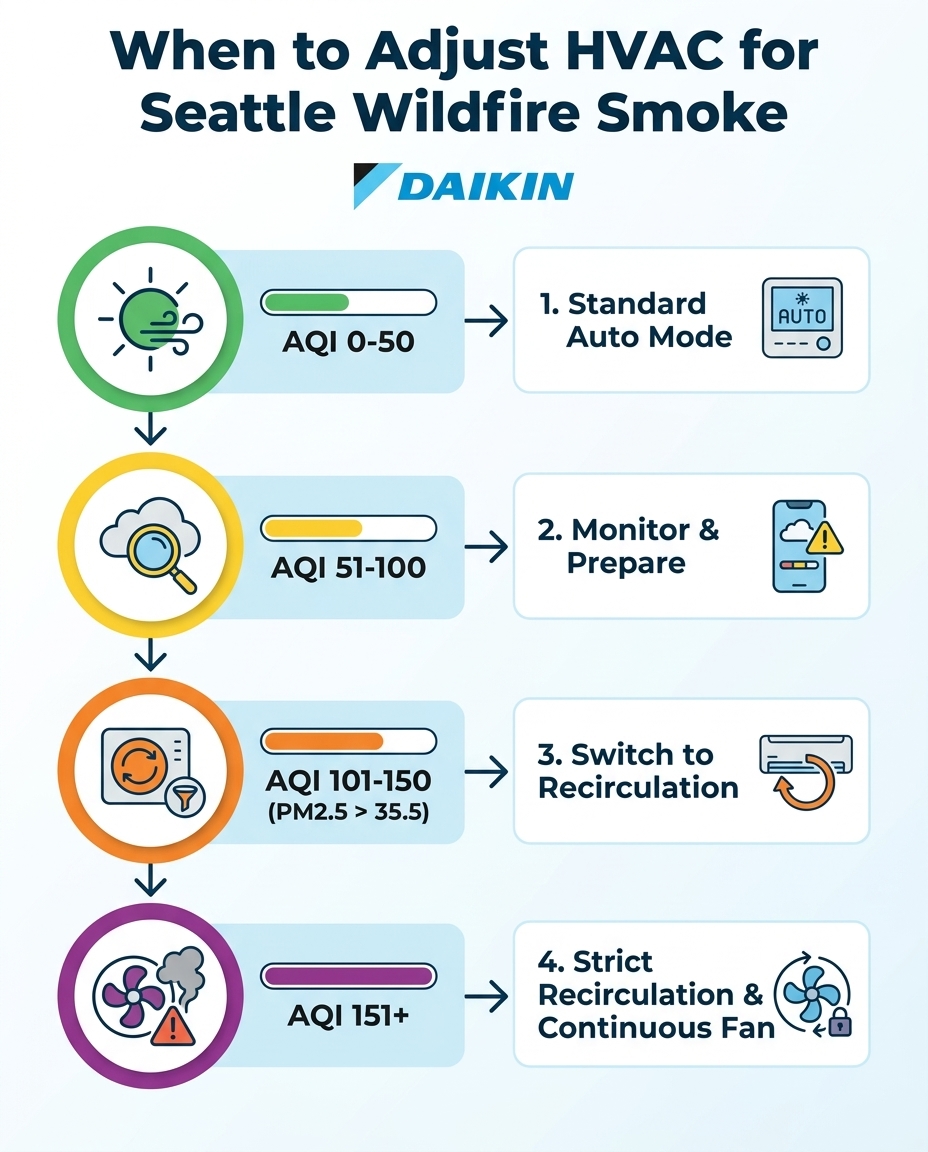
Taking manual control of your HVAC system is the only way to effectively block wildfire smoke from entering your home. By mapping your thermostat actions directly to the PM2.5 thresholds and elevated AQI readings on your monitor, you can create a safe indoor environment. Based on our experience helping homeowners navigate these late-summer transitions, we recommend the following protocol:
• AQI 0-50 (Good): Standard operation is perfectly fine. You can leave your thermostat in Auto mode, and you should utilize your fresh air intakes or open windows to flush the house with clean air while you have the chance.
• AQI 51-100 (Moderate): Begin monitoring your indoor and outdoor levels closely. Ensure all windows and doors are tightly closed. If you can visibly see smoke or smell it in the neighborhood, prepare to adjust your settings, even if the numbers are still technically in the yellow zone.
• AQI 101-150 (Unhealthy for Sensitive Groups / PM2.5 > 35.5 µg/m³): Switch your system to recirculation mode immediately. You must turn off any mechanical fresh air ventilation, ERVs, or HRVs. The goal is to stop pulling in outside air entirely and rely solely on the air already trapped inside your home.
• AQI 151+ (Unhealthy to Hazardous): Keep the system strictly in recirculation mode. Additionally, change your fan setting from "Auto" to "On." Running the indoor fan continuously will force the trapped indoor air to cycle through your internal filter over and over, actively scrubbing the indoor air of any particles that manage to seep in through the cracks of your home.
How Smart Thermostats and Monitors Interact to Protect Your Home
Managing indoor air quality during a rapid environmental shift doesn't have to rely entirely on manual adjustments. Modern technology has evolved to automate these critical threshold responses, taking the guesswork out of protecting your home when PM2.5 thresholds and elevated AQI levels strike unexpectedly.
The Power of Automated Recirculation
Integrated smart air quality monitors can now communicate directly with compatible smart thermostats. When the outdoor or indoor monitor detects that PM2.5 levels have breached the critical 35.5 µg/m³ threshold, it can automatically trigger the thermostat to shut down fresh air intakes and switch exclusively to recirculation mode. This means that if a sudden plume of smoke blows into the Seattle area while you are asleep or away at work, your system will instantly pivot to protect your indoor air without requiring you to push a single button.
Experiencing the Technology Firsthand
Understanding how these components talk to each other on paper is one thing, but seeing it in action provides real confidence. At our Daikin Seattle Experience Center in Tukwila, we invite homeowners to take advantage of a unique "try before you buy" approach. You can physically test how Daikin indoor air quality monitors interact with smart thermostats in a live, hands-on environment without any high-pressure sales tactics.
One local homeowner recently visited our showroom because they wanted to learn about the latest HVAC solutions and current technology before making a major upgrade. They toured the location and received thorough, hands-on education from one of our Brand Ambassadors, who demonstrated exactly how the monitors trigger the thermostat's fan and damper settings. They left the center with a deep understanding of the technology, fully prepared to incorporate that knowledge into their home comfort decisions.
Pairing Recirculation with Proper MERV Filtration
Switching your thermostat to recirculation mode is only half the battle. Recirculation simply means your system is moving the existing indoor air through your ductwork repeatedly. If the internal filter inside that system cannot capture the fine PM2.5 particles that inevitably seep into the house, you are just blowing smoky air from room to room.
Understanding MERV Ratings for Smoke
To actually clean the air while it recirculates, you need the right filtration media. The American Society of Heating, Refrigerating and Air-Conditioning Engineers (ASHRAE) recommends using a filter rated MERV 13 or higher to effectively capture fine smoke particles. Standard filters are usually rated MERV 4 to MERV 8, which are completely ineffective against microscopic wildfire ash.
The Static Pressure Warning
However, a pattern we see often is homeowners simply buying the highest MERV filter on the shelf and sliding it into an older unit. High-efficiency filters are woven much tighter than standard filters, which creates significant air resistance, known in the industry as static pressure. If your system's blower motor is not designed to handle that level of resistance, a MERV 13 filter can choke the airflow, causing the cooling coil to freeze over or the blower motor to burn out entirely.
We strongly recommend verifying that your specific equipment can handle high-efficiency filtration before upgrading. Once you have the right filter in place and the smoke event finally concludes, be sure to check the filter's condition immediately. A multi-day smoke event can turn a brand-new MERV 13 filter pitch black in less than a week, necessitating an immediate replacement to restore proper airflow.
When Is It Safe to Bring Fresh Air Back Inside?
After days of being sealed inside with the system on recirculation, the air in your home will likely feel stale, stuffy, and high in carbon dioxide. Knowing exactly when to transition out of emergency mode is just as important as knowing when to engage it.
Watching for the Marine Push
In the Pacific Northwest, relief often comes in the form of shifting winds—commonly referred to as the marine push—which can rapidly clear smoke out of the Puget Sound region. However, you should not open your windows the moment the sky looks slightly less hazy. You must wait for the outdoor PM2.5 levels to drop consistently below the 35.5 µg/m³ threshold for several continuous hours.
Flushing the Stale Air
We advise relying on high-quality localized data from the best air quality monitors in Seattle rather than generic weather apps to make this decision. Once the outdoor AQI returns firmly to the "Good" range (AQI 0-50), it is time to flush out the stale indoor air. Switch your thermostat back to "Auto," re-engage any fresh air ventilation systems or ERVs, and open your windows to allow clean, fresh air to cycle through your living space.
Frequently Asked Questions About Wildfire Smoke and HVAC Systems
Should I run my HVAC during wildfire smoke?
Yes, you can and should run your system, but only if it is set to recirculation mode so it does not pull in outdoor air. Running your system helps filter the indoor air, provided you have a high-quality filter installed. If you leave it pulling fresh air from outside, you will quickly fill your home with smoke.
When should I use recirculation mode on my thermostat?
Engage recirculation mode immediately when the outdoor AQI exceeds 100 or when PM2.5 levels go above 35.5 µg/m³. This threshold indicates that the air is unhealthy for sensitive groups and should no longer be introduced into your home. Keep it in this mode until the outdoor air quality returns to safe levels for several hours.
How do I read PM2.5 levels on my air monitor?
Look for the micrograms per cubic meter (µg/m³) reading on your monitor's display or companion app. Anything under 12 is considered good and safe for normal operation. When you see spikes over 35, it indicates unhealthy conditions that require immediate adjustments to your thermostat.
Does AC filter out wildfire smoke?
The air conditioning unit sitting outside your house does not filter smoke; it simply compresses refrigerant to cool the indoor coil. However, the system's internal indoor air filter can capture smoke particles if it is rated MERV 13 or higher and the system is actively recirculating indoor air. The cooling process itself does not clean the air.
What AQI is bad for AC?
High AQI doesn't inherently damage the mechanical AC compressor outside, as that unit is sealed and designed to operate in the elements. However, pulling heavy particulate matter into the indoor system can rapidly clog your air filters. This strains the indoor blower motor and restricts airflow, which can cause the indoor coil to freeze and the system to shut down.
How do I put my HVAC in recirculation mode?
Access your thermostat settings and turn off any "fresh air," "ventilation," or "make-up air" options. Ensure the fan setting is switched to "On" rather than "Auto" to keep the air moving through the filter continuously, and make absolutely sure all your doors and windows remain tightly closed.
Take Control of Your Seattle Air Quality Today
Understanding the numbers on your monitor is the very first step to breathing easier during the intense Seattle/Tukwila metro area smoke season. By knowing exactly when to switch to recirculation mode, you can protect your family's health and prevent unnecessary wear and tear on your equipment. Don't wait until the sky turns orange to figure out how your system works. Talk to our local experts at the Daikin Seattle Experience Center to ensure your smart thermostats and filters are properly configured for the next AQI spike, and take the opportunity to see this technology in action before the smoke arrives.
Schedule a Visit

your individual indoor comfort needs
products firsthand
with an authorized Daikin Dealer
.webp)
See why our customers Choose Us

“Jem is very inviting and knowledgeable. She gave us a walk through of the Daikin Experience Center and patiently answered all our questions. Learned a lot about HVAC’s through this visit.”
“Jem did a great job walking us through the various Daikin products and efficiencies of the products. She was very knowledgeable on everything Daikin. Highly recommend coming in for a tour prior to picking out your various AC systems.”
“Great experience at Daikin Seattle Experience Center: pre-purchase demos of home heating system (Daikin Fit), list of HVAC companies, working Daikin staff and external contractors to ensure highest quality. This experience sets the bar of how any home HVAC experience should be. Have got the Daikin Fit installed and so far seems to work very well – quiet, good home heating in peak winter (heat transfer/BTU/air handling); Functionality of Daikin thermostat and the iPhone app makes it very easy to use.”
“This place is awesome! If you are in the market for a new HVAC system, visit the Daikin Experience Center to get educated on the newest technology as well as available rebates and incentives for where you live. They’ll even connect you with local contractors in your area who install Daikin equipment.”
