

.webp)

.svg)


Why Vents Cause Freeze-Ups: Diagnosing a Freezing AC Coil
The Unintended Consequences of Closing Vents During Peak Summer Heat
If you find yourself diagnosing a freezing AC coil in August: why closing your vents is a bad idea is the first hard lesson in airflow dynamics you will likely learn. Here at the Daikin Seattle Experience Center, we see this exact scenario play out constantly as families try to conserve energy during the back-to-school transition. When the late August heat pushes indoor temperatures up, many homeowners instinctively shut the vents in unused guest rooms or dining areas. The logic seems sound: by blocking off empty spaces, you force more cold air into the living room or master bedroom, right? Unfortunately, this common energy-saving myth achieves the exact opposite result. Instead of redirecting cooling power, closing vents starves your equipment of the vital airflow it needs to function.
In the Pacific Northwest, late-summer heatwaves force continuous AC operation. When your system runs for hours on end without adequate airflow, a dangerous chain reaction begins inside the ductwork. Understanding this counterintuitive relationship is the key to restoring comfort. The solution is rarely to turn the thermostat down further; instead, a pattern we see often is that the most effective fix is simply opening those vents back up to let your HVAC systems breathe the way they were engineered to.
Understanding Static Pressure in Modern Cooling Systems
To grasp why closing a simple piece of metal in your ceiling can shut down an entire cooling system, you have to look at the invisible forces at work inside your ductwork. Our team frequently explains to homeowners that modern ducted split systems and central air conditioning units operate on a delicate mathematical balance of air entering and air leaving.
The Problem: Misunderstanding Airflow Distribution
A central cooling system does not consume less energy when you close a vent. The blower motor is still attempting to push the exact same volume of air through the house. When you block an exit path, that air does not magically route itself efficiently to other rooms. Instead, it backs up inside the ductwork, creating a bottleneck.
The Cause: Rising Static Pressure in the Ductwork
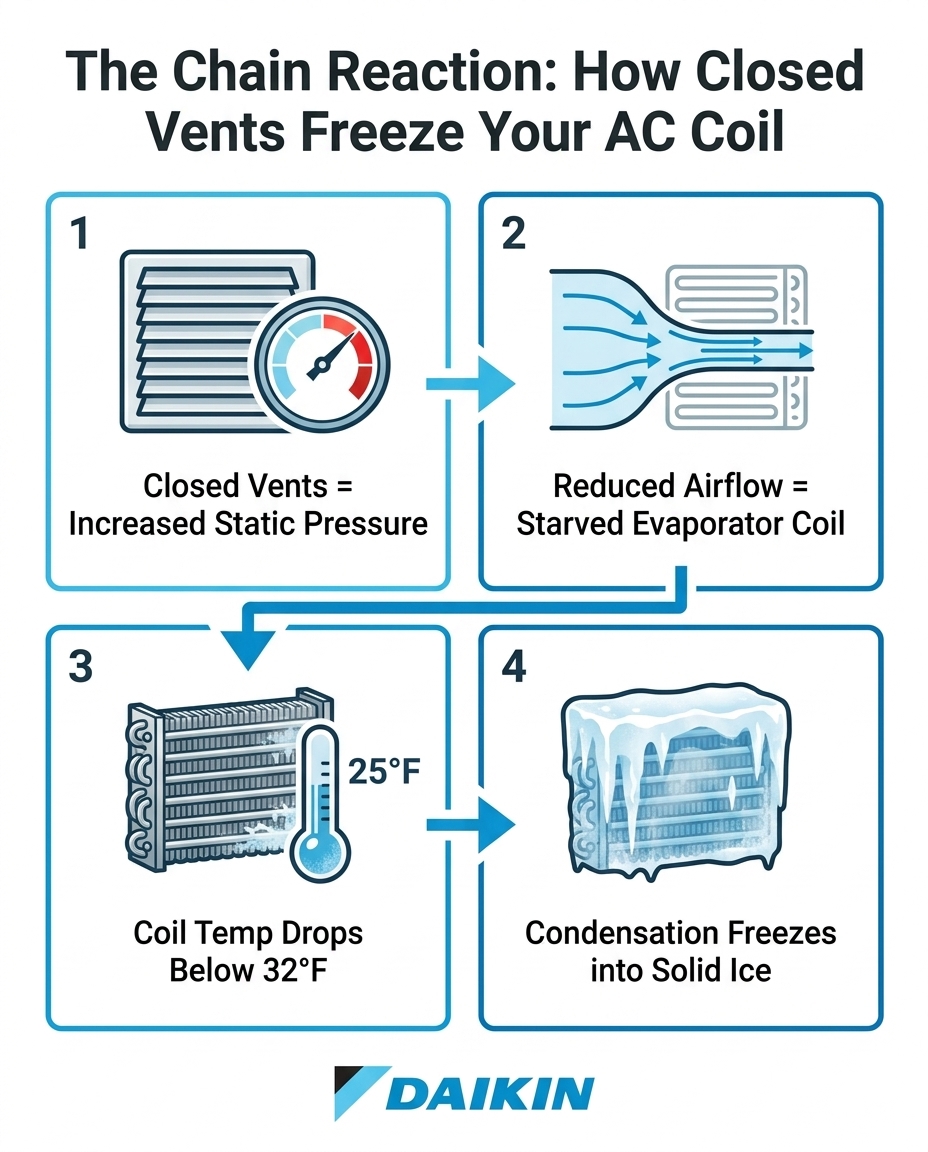
This bottleneck is known in our industry as static pressure. Think of static pressure as the resistance to airflow within the ductwork. Your system's blower motor is calibrated to push against a very specific amount of resistance. When you close vents, you increase that resistance significantly. The blower motor has to work much harder, straining its components, while the total volume of air moving through the system drops drastically. This reduction in total air volume is what sets the stage for a mechanical failure.
The Solution: Maintaining System Equilibrium
Your home's ductwork was sized and balanced for the entire square footage of the property. For whole-house HVAC solutions to operate efficiently, every supply vent and return grille must remain open and unobstructed. Maintaining this equilibrium ensures that the correct volume of air passes over the indoor components, keeping temperatures stable and preventing equipment strain.
• All Vents Open — Static Pressure: Normal / Balanced — Airflow Volume: Optimal (100%) — Blower Motor Strain: Normal Operation — Freezing Risk: Low
• 1-2 Vents Closed — Static Pressure: Slightly Elevated — Airflow Volume: Reduced (80-90%) — Blower Motor Strain: Increased Wear — Freezing Risk: Moderate
• Multiple Vents Closed — Static Pressure: Dangerously High — Airflow Volume: Severely Restricted — Blower Motor Strain: High Risk of Failure — Freezing Risk: Extremely High
The Physics of Heat Exchange: How Airflow Starvation Leads to Ice
Air conditioning does not actually create cold air; it removes heat from the existing air inside your home. This process of heat exchange relies entirely on a steady, unrestricted flow of warm indoor air passing over a component called the evaporator coil. When you close vents and restrict airflow, you disrupt the physics of this heat exchange.
Inside the indoor air handler, the evaporator coil is filled with extremely cold liquid refrigerant. As warm air from your home blows across the metallic fins of the coil, the refrigerant absorbs that heat, boiling into a gas and carrying the heat outside. However, if closed vents have reduced the airflow, there is simply not enough warm air crossing the coil to transfer heat into the refrigerant.
Without that steady supply of heat, the temperature of the refrigerant plummets. In the relentless late August heat, when kids are heading back to school and your system is likely running long, continuous cycles, this becomes a major issue. As the coil's temperature drops below 32 degrees Fahrenheit, the normal condensation that forms on the metal fins (similar to a cold glass of water on a summer day) begins to freeze.
What starts as a thin, barely visible layer of frost quickly compounds. Because ice acts as an insulator, it further blocks whatever little airflow was left. The system continues to run, the temperature continues to drop, and within a few hours, the entire evaporator coil can become encased in a solid block of ice, halting the cooling process entirely.
Identifying the Symptoms of a Frozen Evaporator Coil
If you suspect that closing vents has compromised your system, you need to know what to look for. In our years of diagnosing cooling failures across Tukwila, we've found that ducted split systems and central air conditioning units exhibit very specific warning signs when they are suffocating from restricted airflow. By checking these symptoms early, you can stop the system before permanent compressor damage occurs.
1. Evaluate the airflow volume at the open vents: Place your hand over a vent that is still open. If the system is running but you feel only a weak, trickling breeze instead of a strong push of air, ice has likely blocked the passage of air through the indoor coil.
2. Check the temperature of the air being supplied: Is the air coming out of the vents warm or room-temperature? When the evaporator coil is encased in ice, the heat exchange process stops completely, meaning the system will blow unconditioned air back into the house despite the thermostat setting.
3. Inspect the outdoor copper refrigerant lines: Walk outside to your condenser unit. Look at the larger of the two copper pipes connecting the outdoor unit to the house (the suction line). If you see a thick buildup of white frost or solid ice on this line, the indoor coil is almost certainly frozen as well.
4. Listen for unusual hissing or bubbling noises: Stand near the indoor air handler. A frozen system often produces strange sounds as the refrigerant struggles to flow through restricted, ice-covered pathways, indicating severe pressure changes.
If you observe these signs, you are dealing with a frozen system. While restoring airflow is the first step, repeated freezing may require professional AC repair in Tukwila to evaluate potential damage to the blower motor or compressor.
Safe, Non-DIY Steps to Thaw Your System
Discovering a block of ice inside your HVAC equipment can be alarming, especially during the late August heat when you need end-of-season cooling the most. However, how you handle the thawing process is critical. Our technicians strongly advise that taking the wrong approach can destroy expensive components and void your warranties. Here are the safe, homeowner-approved steps to thaw your system that do not require opening the equipment cabinet.
1. Step 1: Turn the cooling function OFF at the thermostat immediately. Do not simply lower the temperature setting. You must switch the system mode from "Cool" to "Off." If the compressor continues to run while the coil is frozen, it can draw liquid refrigerant back into the compressor motor, causing catastrophic failure.
2. Step 2: Switch the fan setting from 'Auto' to 'ON'. By forcing the indoor blower fan to run continuously without the cooling cycle engaged, you circulate warm indoor air directly over the frozen coil. This is the safest and most effective way to accelerate the melting process.
3. Step 3: Open all previously closed vents throughout the house. Walk through every room and ensure every supply register and return grille is fully open and unobstructed by furniture or rugs. This restores the proper static pressure the system requires to operate.
4. Step 4: Monitor the condensate drain line. As the ice melts, it will produce a significant amount of water. Ensure your drain pan is not overflowing and that water is successfully draining outside.
CRITICAL WARNING: Never attempt to manually chip away ice from the evaporator coil, and never use a hairdryer, heat gun, or sharp tools inside the air handler cabinet. The copper coils and aluminum fins are incredibly fragile. Puncturing a line will release refrigerant and require a highly expensive repair. Accessing the internal cabinet requires a licensed professional. If the system freezes again after thawing and opening all vents, schedule professional Daikin AC maintenance to check for deeper issues like refrigerant leaks.
Smarter Alternatives for Managing Temperature in Unused Rooms
It is entirely understandable to want different temperatures in different areas of your home. However, manually closing vents on standard ducted split systems and central air conditioning units is not the way to achieve it. Fortunately, modern HVAC technology offers legitimate, safe ways to control room temperatures without compromising the health of the equipment.
If you want precise control over specific areas, true HVAC zoning systems are the answer. Zoning utilizes motorized dampers installed deep within the ductwork, paired with multiple thermostats and a bypass duct. When a zone does not need cooling, the system safely redirects the air and manages the static pressure automatically, ensuring the evaporator coil always receives the exact volume of air it needs to prevent freezing.
Furthermore, modern variable-speed equipment adjusts its cooling capacity dynamically. Instead of blasting at maximum power and overcooling unused rooms, variable-speed compressors can ramp down to run at lower capacities, providing gentle, even cooling throughout the entire house and eliminating the urge to micromanage individual vents. As a bonus, upgrading to these high-efficiency systems can be financially advantageous, as qualifying heat pump installations may be eligible for generic federal tax credits or local utility incentive programs (always verify current programs with your utility or tax professional).
Understanding these capabilities is vital before attempting manual workarounds. The Daikin Seattle Experience Center operates on a philosophy of prioritizing customer education, empowering homeowners to see live equipment displays and understand the "why" behind system efficiency. For example, one local homeowner who wanted to understand Daikin heat pump products better recently visited our Tukwila facility. After receiving a comprehensive education from our team on how these systems operate, they came away with a much better understanding of how modern equipment manages airflow safely. By exploring proper heat pump solutions and zoning, you can achieve the room-by-room comfort you want without ever putting your system at risk of freezing.
Frequently Asked Questions
Does closing vents cause AC to freeze?
Yes, closing vents is a primary cause of frozen AC coils. When you shut vents, you increase the static pressure inside the ductwork, which severely reduces the volume of warm air blowing over the indoor evaporator coil. Without enough warm air to absorb, the refrigerant temperature drops below freezing, turning normal condensation into solid ice.
Why is my AC freezing up in August?
During peak August heat, your AC system runs for extended, continuous cycles to keep up with the high temperatures. If there is any airflow restriction—such as closed vents, a dirty air filter, or blocked return grilles—the long run times give the coil ample opportunity to drop below freezing. The relentless demand compounds minor airflow issues into major freeze-ups.
Is it bad to close vents in unused rooms?
Closing vents in unused rooms is highly detrimental to central HVAC systems. Your ductwork and blower motor are mathematically balanced to push air through the entire square footage of the home. Blocking those pathways causes pressure to build up, strains the blower motor, reduces efficiency, and dramatically increases the risk of mechanical failure.
How long does it take for a frozen AC coil to thaw?
A severely frozen AC coil can take anywhere from 12 to 24 hours to thaw completely. You can safely speed up this process by turning the cooling function "Off" at the thermostat and switching the fan setting to "On," which blows warm indoor air over the ice. Never try to scrape the ice off manually.
Can I run my AC while the coil is frozen?
You should never run the cooling function while the coil is frozen. Continuing to demand cold air from a frozen system forces the compressor to work against extreme pressure and can cause liquid refrigerant to flood back into the outdoor unit. This will quickly destroy the compressor, leading to a total system replacement.
How does static pressure affect central air conditioning?
Static pressure is the resistance to airflow within your duct system. Central air conditioners are designed to operate within a very narrow range of static pressure to maintain efficiency. When static pressure rises too high—often due to closed vents or dirty filters—the system cannot move enough air, leading to poor cooling, frozen coils, and premature motor burnout.
When you are diagnosing a freezing AC coil in August: why closing your vents is a bad idea is a lesson that saves you from unnecessary breakdowns. A clear understanding of airflow prevents user-induced freezing and keeps your equipment running smoothly. If you have opened all your vents, safely thawed the system, and are still experiencing issues, it is time to have our professional team evaluate your system's performance.
Schedule a Visit

your individual indoor comfort needs
products firsthand
with an authorized Daikin Dealer
.webp)
See why our customers Choose Us

“Jem is very inviting and knowledgeable. She gave us a walk through of the Daikin Experience Center and patiently answered all our questions. Learned a lot about HVAC’s through this visit.”
“Jem did a great job walking us through the various Daikin products and efficiencies of the products. She was very knowledgeable on everything Daikin. Highly recommend coming in for a tour prior to picking out your various AC systems.”
“Great experience at Daikin Seattle Experience Center: pre-purchase demos of home heating system (Daikin Fit), list of HVAC companies, working Daikin staff and external contractors to ensure highest quality. This experience sets the bar of how any home HVAC experience should be. Have got the Daikin Fit installed and so far seems to work very well – quiet, good home heating in peak winter (heat transfer/BTU/air handling); Functionality of Daikin thermostat and the iPhone app makes it very easy to use.”
“This place is awesome! If you are in the market for a new HVAC system, visit the Daikin Experience Center to get educated on the newest technology as well as available rebates and incentives for where you live. They’ll even connect you with local contractors in your area who install Daikin equipment.”
