

.webp)

.svg)


Skip High SEER Ratings if Moving Soon in Tukwila, WA
The Pressure of End-of-Summer Cooling Failures
Your air conditioning system has just failed in the middle of a late-August heat wave, and now you are facing an unexpected replacement. In the rush to restore comfort to your home, the immediate reflex is often to buy the absolute most advanced equipment available. However, why we tell Tukwila homeowners to skip the highest SEER rating if they plan to move soon comes down to simple math and realistic timelines.
To explore your options without the high-pressure sales tactics, learn more about our comprehensive HVAC systems and discover heat pump solutions designed for your specific needs.
Late-summer August cooling replacements carry a unique kind of stress. The house is uncomfortably warm, patience is running thin, and the urgency to get a new system installed can cloud long-term financial judgment. During these peak breakdown periods, a common industry pattern we see is contractors pushing homeowners toward the absolute highest efficiency equipment available on the market. The pitch usually revolves around maximizing monthly utility savings and securing top-tier technology.
While ultra-high efficiency systems are engineering marvels, maximizing efficiency is not always the smartest financial move. If you do not plan to stay in your current home for the next decade, the financial equation changes entirely. Our sales team frequently observes homeowners nearly committing to premium units that their living timeline simply does not support. We step in to provide a necessary reality check: a higher rating only pays off if you remain in the home long enough to collect the savings.
The industry default: Many heating and cooling companies operate on the assumption that a bigger sale is always a better sale. They highlight the impressive specifications of premium models while glossing over the lengthy payback periods required to justify the initial investment.
The realistic approach: We believe that an equipment recommendation must align with your actual life plans. If a career change, downsizing, or a growing family means you will be listing your property in the near future, over-investing in a cooling system can result in a net financial loss. Navigating this decision requires looking past the glossy brochures and focusing on the practical timeline of your homeownership.
Running the Math on a Short-Term Relocation
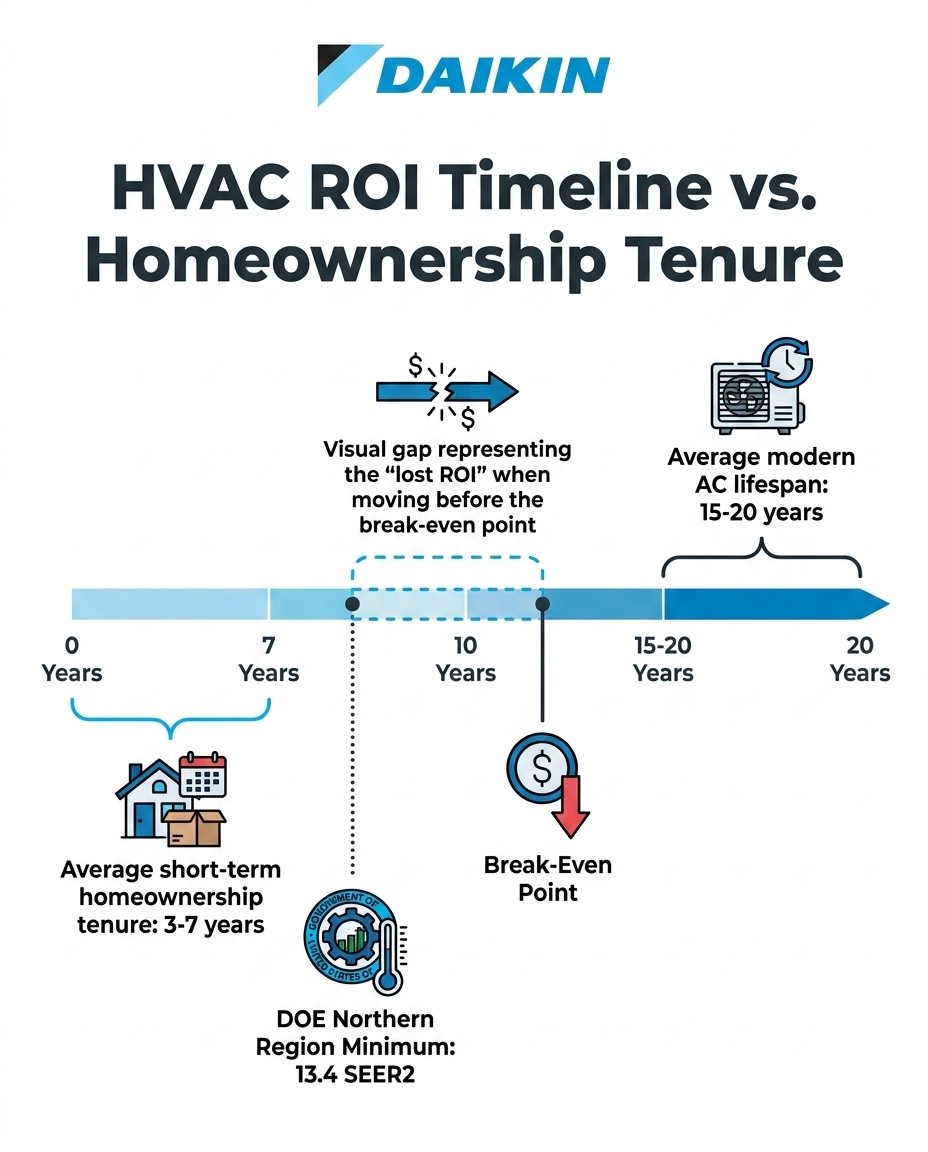
Understanding the relationship between equipment lifespan and your time in the home is critical before signing any installation contract. The typical lifespan of modern cooling equipment ranges from 15 to 20 years. However, the reality of average homeownership tenure is often much shorter. Many families relocate long before their mechanical systems reach the end of their operational lives.
One local homeowner recently visited us to understand product efficiencies before selecting AC systems. By receiving a thorough walkthrough of Daikin products and their respective efficiencies, they gained the critical knowledge needed prior to selecting their equipment. This educational step is vital because the upfront premium paid for ultra-high efficiency is explicitly designed to be recouped through monthly energy savings over a decade or more.
When you are looking at a 3-5 year home sale timeline, that long-term payback period is abruptly truncated. Here is how a short-term relocation impacts your return on investment:
1. The Initial Premium: Ultra-high efficiency units carry a significantly higher initial purchase cost compared to reliable standard models.
2. The Accumulation Phase: Every month the system runs, it uses less electricity, slowly paying back that initial premium through lower utility bills.
3. The Truncated Timeline: If you sell the house in year four, you have only collected four years of monthly savings—leaving the majority of the initial premium unrecovered.
4. The Lost Value: The original buyer takes a net loss, while the new homeowner inherits the long-term energy savings for free.
This dynamic is a frequent conversation our team has with homeowners who are just starting to gather quotes and evaluate their options. By mapping out the timeline, the decision shifts from "What is the best system on the market?" to "What is the best system for my specific timeline?"
Calculating Your True Payback Window
Identifying the break-even point is the most important step in this process. The break-even point is the exact moment where your accumulated monthly energy savings finally surpass the initial upgrade cost of the premium unit. If that break-even point lands in year eight, but you plan to move in year five, the investment does not make financial sense.
Factoring in your anticipated move date is the most critical step before selecting equipment. It protects you from over-leveraging your home improvement budget on mechanical upgrades that will not yield a proportional return before you hand over the keys.
How the Pacific Northwest Climate Alters Efficiency Gains
The speed at which you accumulate energy savings is entirely dependent on how often your cooling system runs. This is where regional weather patterns specifically impact the financial equation. The cooling demands of the Pacific Northwest stand in stark contrast to southern climates, where air conditioners run non-stop for eight or nine months out of the year.
In Tukwila, we experience mild summers where extreme heat waves are relatively brief. Because our region lacks prolonged, extreme summer heat, your system logs significantly fewer annual cooling degree days. Fewer cooling degree days mean the system runs for fewer hours overall. This directly slows down the rate at which you accumulate energy savings. If an ultra-high efficiency unit runs for 2,000 hours a year in a southern state, it pays for itself quickly. If that same unit runs for only a few hundred hours a year in the Pacific Northwest, the payback period stretches out considerably.
To provide authoritative context, the Department of Energy sets specific regional standards for cooling equipment. For the Northern region, which includes Washington state, the minimum standard is 13.4 SEER2. This regulation acknowledges that northern climates do not require the same massive efficiency benchmarks as hotter southern states to maintain reasonable energy consumption.
When planning whole-house HVAC upgrades, it is vital to remember that in a milder climate, the gap in actual energy usage between a reliable standard unit and an ultra-premium unit is narrower than national marketing materials suggest. The SEER2 efficiency ratings (mid-tier vs. ultra-high) look vastly different on a spec sheet, but in a climate with brief cooling seasons, the real-world difference in monthly utility costs is much smaller.
Mid-Tier vs. Ultra-High Efficiency: Finding the Sweet Spot
To make an informed decision, it helps to compare the two tiers conceptually. Understanding what constitutes a mid-tier system versus an ultra-high efficiency system in today's market reveals why stepping down a tier is often the most logical choice for a short-term homeowner.
Another homeowner shopping for HVAC replacements recently visited the Experience Center to see Daikin products in operation and hear their quietness firsthand. This visit directly influenced their decision on equipment purchase and contractor selection, proving the value of experiencing the technology rather than just reading a brochure.
Mid-tier systems today are remarkably advanced. They still offer exceptional reliability, incredibly quiet operation, and significant performance upgrades over older, failing equipment. You do not have to sacrifice comfort to stick to a reasonable budget. For a deeper dive into how these systems operate, you can review our heat pump efficiency guide.
• Initial Investment — Mid-Tier SEER2 Systems: Moderate and accessible — Ultra-High Efficiency SEER2 Systems: Premium upfront cost
• ROI Timeline — Mid-Tier SEER2 Systems: Shorter break-even period — Ultra-High Efficiency SEER2 Systems: Extended break-even period (10+ years)
• Climate Suitability — Mid-Tier SEER2 Systems: Excellent for mild Pacific Northwest summers — Ultra-High Efficiency SEER2 Systems: Best for extreme, prolonged southern heat
• Short-Term Relocation — Mid-Tier SEER2 Systems: Smart financial balance — Ultra-High Efficiency SEER2 Systems: High risk of unrecovered investment
Chasing the highest possible rating results in diminishing returns when the operational hours do not support the investment. Comparing SEER2 efficiency ratings (mid-tier vs. ultra-high) side-by-side allows you to make a choice based on actual household needs rather than just a spec sheet. Key benefits of the mid-tier sweet spot include:
• Immediate Comfort: You get reliable, consistent cooling during August heat waves without overspending.
• Warranty Protection: Mid-tier systems come with robust manufacturer warranties that provide peace of mind.
• Modern Technology: Even standard systems today utilize advanced refrigerants and superior airflow designs compared to units built fifteen years ago.
• Financial Flexibility: Keeping your initial investment reasonable frees up capital for other home staging or moving expenses.
Will a Maximum SEER2 Rating Increase Resale Value?
A common misconception during the replacement process is the belief that ultra-high efficiency systems will translate to a massive premium when selling the house. Homeowners often convince themselves that overspending on the AC unit is actually an investment in their property value. The data tells a different story.
While energy efficiency is certainly a positive selling feature, prospective buyers rarely pay a premium for the absolute highest rating on the market. When buyers walk through a home, they are looking at a multitude of factors. Regarding mechanical systems, home buyers primarily care that the equipment is new, reliable, and under warranty. They want the assurance that they will not have to replace the air conditioner immediately after moving in.
A high-quality, mid-tier system checks all the necessary boxes for a home inspection. It provides buyer peace of mind without over-leveraging the seller. If you are operating on a 3-5 year home sale timeline, installing a reliable mid-tier unit ensures the home passes inspection with flying colors while protecting your own wallet.
Furthermore, generic energy rebates or federal tax credits may apply to qualifying mid-tier upgrades as well, further improving the short-term financial picture. While you should always consult a tax professional to verify current programs and eligibility, it is important to know that financial incentives are not exclusively reserved for the most expensive equipment on the market. A well-chosen mid-tier system can often benefit from these programs, making the ROI timeline even more favorable for a homeowner planning an upcoming move.
Why We Actively Advise Against Overspending
At the core of our philosophy is a commitment to transparency. Our sales team's primary goal is to align the equipment recommendation with the homeowner's actual life plans, rather than maximizing a single sale. We believe that an educated customer is a satisfied customer, which is why our consultation process looks different than the industry standard.
A recent visitor educating themselves on HVAC received a complete walkthrough of the Daikin Experience Center, had their questions patiently answered, and learned a great deal about HVAC technology through the visit. This educational, anti-upsell approach demonstrates our integrity. We prioritize your ROI timeline over pushing a premium product.
Our consultation process involves:
• Asking about future plans: We want to know if you are staying in the home for three years or thirty years.
• Evaluating the home: We assess your ductwork, insulation, and layout to ensure the system is properly sized.
• Providing transparent education: We explain the technology, SEER2 ratings, and generic incentives without the high-pressure tactics.
Talking a customer down from an unnecessarily expensive unit builds long-term trust. We know that late-summer August cooling replacements are stressful enough without the added anxiety of buyer's remorse. A well-informed decision prevents that remorse. When you understand exactly why a mid-tier system is the smartest choice for your specific timeline, you can proceed with confidence, knowing your investment is sound and your home will remain comfortable.
Make a Confident, Financially Sound Choice for Your Home
Matching your system's efficiency tier to your expected time in the home is the smartest investment strategy you can employ during a sudden equipment failure. If you are operating on a 3-5 year home sale timeline, the mild Pacific Northwest climate simply does not provide enough operational hours to offset the premium cost of an ultra-high efficiency unit before you move.
We encourage all Tukwila residents to seek out honest evaluations rather than accepting high-pressure sales pitches that ignore their future plans. You deserve a solution that restores your comfort without compromising your financial goals. Reach out to our local experts today for a transparent consultation that respects your timeline and protects your investment.
Frequently Asked Questions
Is a higher SEER rating worth it if I plan to move?
The short answer is no, a higher SEER rating is usually not worth the premium if you plan to move soon. The upfront cost of an ultra-high efficiency system takes many years to recoup through monthly energy savings. If you relocate before reaching that break-even point, you will not recover your initial investment.
What SEER rating is best for Washington state climates?
For Washington state climates, a reliable mid-tier SEER2 rating is often the most cost-effective choice. The Department of Energy requires a minimum of 13.4 SEER2 for our northern region. Because our summers are mild and cooling degree days are lower, investing in standard or mid-tier efficiency provides excellent comfort without an unnecessary premium.
Will an ultra-high efficiency AC increase my home's resale value?
An ultra-high efficiency AC rarely increases a home's resale value enough to cover its initial cost. Most prospective buyers simply want to see that the mechanical systems are new, functional, and under warranty. A high-quality mid-tier system satisfies home inspections and buyer expectations just as effectively.
How long does it take to see a return on a high SEER AC?
Seeing a return on a high SEER AC typically takes a decade or more, depending on your local climate and usage. In areas with mild summers, the system runs fewer hours, which stretches the payback period even further. Homeowners must compare this extended timeline against their expected tenure in the house.
Does the Department of Energy require a specific SEER2 rating in Tukwila?
Yes, the Department of Energy requires all new residential air conditioners installed in Tukwila to meet the Northern region minimum standard. Currently, that minimum is set at 13.4 SEER2. Any system you choose, whether mid-tier or premium, will meet or exceed this baseline requirement.
Should I factor generic energy rebates into my short-term HVAC ROI?
Generic energy rebates and tax credits should absolutely be factored into your short-term ROI calculations. These incentives can lower the initial purchase cost, which shortens your break-even timeline. Always consult with a tax professional to confirm which generic programs apply to the specific equipment tier you select.

Schedule a Visit

your individual indoor comfort needs
products firsthand
with an authorized Daikin Dealer
.webp)
See why our customers Choose Us

“Jem is very inviting and knowledgeable. She gave us a walk through of the Daikin Experience Center and patiently answered all our questions. Learned a lot about HVAC’s through this visit.”
“Jem did a great job walking us through the various Daikin products and efficiencies of the products. She was very knowledgeable on everything Daikin. Highly recommend coming in for a tour prior to picking out your various AC systems.”
“Great experience at Daikin Seattle Experience Center: pre-purchase demos of home heating system (Daikin Fit), list of HVAC companies, working Daikin staff and external contractors to ensure highest quality. This experience sets the bar of how any home HVAC experience should be. Have got the Daikin Fit installed and so far seems to work very well – quiet, good home heating in peak winter (heat transfer/BTU/air handling); Functionality of Daikin thermostat and the iPhone app makes it very easy to use.”
“This place is awesome! If you are in the market for a new HVAC system, visit the Daikin Experience Center to get educated on the newest technology as well as available rebates and incentives for where you live. They’ll even connect you with local contractors in your area who install Daikin equipment.”
