

.webp)

.svg)


How Daikin Inverters Adapt to Late Summer
The Late Summer Strain on Traditional HVAC Systems
As August arrives in the Pacific Northwest, visitors to our Tukwila showroom often ask us exactly how Daikin's inverter technology adapts to the chaotic weather patterns of late summer. The back-to-school transition into late summer brings unpredictable and drastic daily temperature variations that push traditional air conditioning systems to their absolute limits. Your home might feel perfectly comfortable in the morning, only to become uncomfortably hot by mid-afternoon. When this happens, traditional single-stage HVAC systems struggle to adapt, leading to a constant, punishing cycle of turning on and off.
This constant cycling causes severe mechanical strain on your equipment. Specifically, it wears out vital electrical components like contactors as the system tries in vain to keep up with the shifting climate. The core problem is that a traditional air conditioner only knows one speed: full blast. When it tries to manage a rapidly changing outdoor temperature, it repeatedly hard-starts, runs for a short burst, and shuts down again. To understand why this happens, it helps to look at the mechanics of inverter technology and how an advanced single zone mini split provides a much-needed mechanical safeguard for your home.
The mechanical reality: Every time a traditional compressor kicks on, it draws a massive surge of electricity and puts physical stress on the system's internal parts. Over a long, unpredictable August season, those harsh stop-start cycles compound. By understanding the mechanical difference between a traditional system's aggressive operation and a modern variable-speed alternative, you can protect your equipment from premature failure while maintaining consistent indoor comfort.
Why 30-Degree Temperature Swings Punish Single-Stage Compressors
The late summer climate in the Pacific Northwest is uniquely demanding on mechanical cooling equipment. It is incredibly common to experience a 55°F to 85°F daily temperature swing during this time of year. You might wake up to a chilly, damp morning, only to face intense, baking heat by 3:00 PM. This chaotic 30-degree variance forces traditional single-stage compressors into a damaging operational loop.
In our years of helping Pacific Northwest residents upgrade their systems, we see firsthand how a traditional single-stage compressor only has two modes—100% ON or 100% OFF—and cannot gently adjust to a rising temperature. Instead, it waits until the house gets too warm, blasts cold air at maximum capacity, overshoots the target temperature, and abruptly shuts down. A few hours later, as the afternoon heat peaks, the cycle repeats. This is exactly why inverter air conditioners manage afternoon temperature spikes far more effectively, as they avoid this violent cycling entirely.
The Anatomy of a Short Cycle
When dealing with drastic temperature shifts, traditional systems often fall into a pattern known as short cycling. Here is exactly how a 30-degree daily variance forces your system into this damaging loop:
1. The morning lull: At 55°F, your home requires zero cooling. The system sits idle, and the mechanical components remain cold and dormant.
2. The sudden afternoon spike: As the outdoor temperature rapidly climbs toward 85°F, the indoor temperature begins to rise. The thermostat misreads this rapid afternoon warming as a massive cooling load.
3. The aggressive overcorrection: The single-stage system violently kicks on at 100% capacity. Because it is blowing maximum cold air, it cools the immediate area around the thermostat too quickly.
4. The premature shutdown: The thermostat registers that the target temperature has been reached and abruptly cuts power to the system, even though the rest of the house might still be warm.
5. The rapid restart: Minutes later, the heat permeates the house again, and the system is forced to perform another harsh startup.
This constant, aggressive cycling does more than just waste electricity. It actively destroys the mechanical integrity of the air conditioning unit.
The Hidden Mechanics of Contactor Wear and Hard Starts
If you live in the Seattle and Tukwila area, you have likely heard the loud "clunk" sound when a traditional air conditioner kicks on during a hot afternoon. That sound is a hard start, and it represents a significant, hidden mechanical toll on your system. Our team frequently explains to homeowners that a hard start is not just noisy; it is a violent electrical event.
The Problem: When a single-stage system powers up, it can draw anywhere from 3 to 5 times its normal running current just to get the heavy compressor motor turning. This massive surge of electricity has to pass through a specific component called a contactor. The contactor is an electromechanical switch that physically snaps shut to send high-voltage power to the compressor.
The Cause: Because a single-stage unit cannot ramp up slowly, the contactor takes the absolute brunt of this massive electrical surge every single time the system turns on. When you factor in the chaotic weather of late summer, a traditional system might turn on and off dozens of times a day. Every time that switch snaps shut under a heavy electrical load, a tiny electrical arc occurs. Over time, these repeated arcs cause the metal surfaces of the contactor to pit, burn, and degrade.
The Solution: Eliminating the hard start is the only way to prevent this specific type of mechanical failure. By avoiding the massive inrush of startup current, you preserve the contactor and extend the life of the entire outdoor unit.
Electrical Surges vs. Mechanical Integrity
To truly understand the stress placed on your system, it helps to compare the electrical demands of a traditional startup versus a modern variable-speed approach.
• Startup Current — Traditional Single-Stage System: Draws 300% to 500% of running amps instantly. — Variable-Speed Inverter System: Draws less than 50% of running amps, ramping up slowly.
• Contactor Stress — Traditional Single-Stage System: Severe arcing and physical pitting upon closure. — Variable-Speed Inverter System: Minimal electrical load during the switching process.
• Mechanical Wear — Traditional Single-Stage System: High torque stress on compressor bearings. — Variable-Speed Inverter System: Gentle rotation that preserves lubrication and bearings.
• Temperature Adaptation — Traditional Single-Stage System: Shuts down completely when target is met. — Variable-Speed Inverter System: Slows down to a low-speed cruise to maintain target.
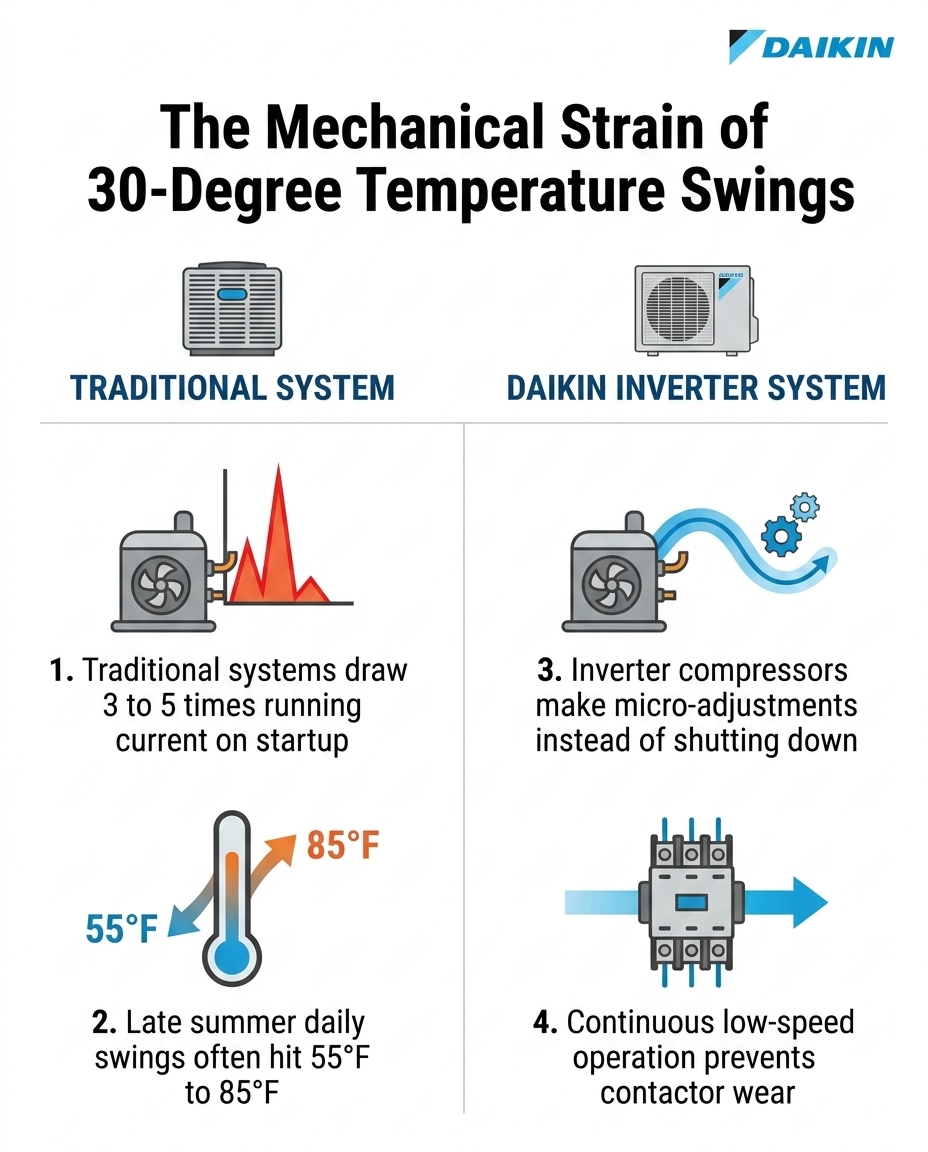
How Daikin's Variable-Speed Adjustments Eliminate the 'Clunk'
The mechanical solution to the chaotic 55°F to 85°F daily temperature swing lies in variable-speed adjustments. Daikin's inverter technology completely eliminates the harsh single-stage startup by smoothly ramping capacity up and down to match the exact cooling load required. Instead of a loud "clunk" and a massive electrical surge, an inverter compressor starts slowly, drawing minimal power, and gradually increases its speed.
One local homeowner who wanted to learn more about home comfort solutions recently visited our Tukwila educational center to explore this exact issue. After our team demonstrated how inverter technology works in real-time, they gained a much better understanding of heat pumps and we helped connect them with local contractors for a quality installation. The key takeaway from that kind of hands-on education is realizing that a system does not need to shut down to save energy.
In fact, continuous low-speed operation is mechanically healthier for the system than constant on/off cycling. As the day transitions from a cool morning to a hot afternoon, the inverter simply increases its speed in micro-increments. It perfectly matches the heat coming into the home. This technology scales perfectly, whether you are cooling a single room or expanding into multi-zone mini split systems.
Continuous Operation as a Mechanical Safeguard
There is a persistent myth that an air conditioner "always running" is a bad thing. In the context of older, single-stage equipment, a system that never shuts off usually indicates a breakdown or a severe lack of refrigerant. However, with inverter technology, continuous operation is the intended design.
• Cruising prevents cold starts: By maintaining a steady, low-speed rotation, the compressor never has to overcome the massive inertia of a dead stop.
• Consistent lubrication: Continuous operation keeps the internal refrigerant and lubricating oils flowing over the mechanical bearings, preventing dry starts.
• Eliminating the electrical spike: Because the system never fully powers down during the heat of the day, the contactor is not forced to repeatedly open and close under heavy electrical loads.
Are Inverter Air Conditioners Better for Pacific Northwest Climates?
When evaluating HVAC options for the unique weather patterns of the Pacific Northwest, the short answer our specialists give is yes: inverter air conditioners are significantly better. They are better because they smoothly ramp up and down to match exact temperature needs without the harsh stop-start cycles that plague traditional units.
During the unpredictable days of August and late summer, a traditional system is constantly fighting the environment. It waits for the house to get hot, blasts it with cold air, and shuts down. An inverter system works with the environment. It senses the subtle rise in indoor temperature as the afternoon sun hits the house and gently increases its cooling output to compensate. This continuous, variable operation specifically prevents mechanical wear.
Beyond protecting the contactor and the compressor bearings, this technology offers several secondary benefits that directly impact your daily comfort:
• Total elimination of temperature swings: You will no longer experience a house that feels freezing one minute and stuffy the next.
• Significantly quieter operation: Because the system rarely runs at 100% capacity, the outdoor unit hums quietly in the background rather than roaring to life.
• Enhanced moisture removal: Long, slow cooling cycles pull far more humidity out of the indoor air, making the home feel cooler even at higher thermostat settings.
The unique late summer climate of the region makes this technology not just a luxury, but a mechanical necessity for long-term system longevity.
Hearing the Difference: The Value of a Physical Demonstration
Reading about a "smooth ramp-up" and "variable-speed operation" is entirely different from actually hearing it in person. It is easy to understand the theory of how a contactor wears out, but it is much more impactful to stand next to an operating unit and realize you can barely hear it running.
This is where our team at the Daikin Seattle Experience Center provides a tangible proof point for homeowners in the Seattle and Tukwila area. Rather than guessing how loud a new system might be, visitors can physically hear the difference between a harsh single-stage startup and the whisper-quiet operation of an inverter. Another homeowner shopping for a new heating and cooling system recently visited our showroom to check out the products in person. After we helped them hear the quiet operation for themselves and lined them up with local contractors, the visit directly influenced their final decision on both the equipment and their chosen installation team.
What you can experience firsthand:
• The startup sequence: Listen to an inverter compressor slowly ramp up from a dead stop, noting the complete absence of the traditional "clunk."
• The low-speed cruise: Feel the gentle, consistent airflow that a variable-speed system provides when maintaining a target temperature.
• The physical footprint: See how compact side-discharge inverter units compare to massive, traditional cube-style air conditioners.
Embracing this hands-on education helps you make confident, informed decisions about your home comfort, ensuring you choose a system built to handle the region's specific weather challenges.
Frequently Asked Questions About Inverter Technology and System Wear
Are inverter air conditioners better?
Yes, inverter air conditioners are vastly superior because they can adjust their cooling output in real-time to match the exact needs of your home. Instead of blasting cold air and shutting off, they smoothly ramp up and down to maintain a precise temperature. This continuous, low-speed operation eliminates the harsh electrical spikes that wear out traditional components. Ultimately, they provide better comfort, quieter operation, and a longer mechanical lifespan.
Why does my AC turn on and off so much in the summer?
Your AC turns on and off frequently because traditional single-stage systems only operate at 100% capacity. When the late summer weather brings chaotic temperature swings, the system quickly cools the house, overshoots the thermostat setting, and shuts down, only to restart minutes later when the heat returns. This process, known as short cycling, is highly inefficient and places immense physical strain on the compressor and electrical contactors.
Do inverter ACs run constantly?
Yes, inverter ACs are designed to run almost constantly at a very low, efficient speed. By cruising continuously, they avoid the massive energy draw required to start a heavy compressor from a dead stop. This steady operation keeps the internal components lubricated and prevents the severe wear and tear associated with constant on-and-off cycling. While it sounds counterintuitive, running constantly at a low speed uses far less electricity than repeatedly hard-starting.
What is the disadvantage of inverter AC?
The primary disadvantage of an inverter AC is the initial complexity of the technology, which requires specialized training to install and service correctly. Because these systems use advanced circuit boards and variable-frequency drives, repairs can be more highly technical than swapping a basic part on a traditional unit. However, because the technology reduces mechanical wear, overall breakdown rates are often lower when the system is properly maintained.
How do 30-degree temperature swings affect HVAC contactors?
A 55°F to 85°F daily temperature swing forces a traditional HVAC system to start and stop dozens of times throughout the afternoon as it fights the rising heat. Every time the system starts, a massive surge of electricity arcs across the contactor, an electromechanical switch. Over a chaotic late summer season, these repeated electrical arcs cause the metal on the contactor to pit and burn, eventually leading to complete component failure.
Protect Your Comfort as the Seasons Shift
Surviving chaotic late summer weather shouldn't require sacrificing the lifespan of your HVAC equipment. A clear, mechanical understanding of how Daikin's inverter technology eliminates the hard starts that wear out contactors during massive temperature swings ensures you can make the right choice for your home. By moving away from the harsh stop-start cycles of traditional units, you guarantee smoother operation and long-term reliability.
As August brings its unpredictable heat, now is the time to evaluate how your current system is handling the strain. If you are tired of the loud clunks, the constant cycling, and the uneven temperatures, take the time to explore our educational resources or visit our local Tukwila showroom. Seeing and hearing modern climate solutions in action is the best way to protect your comfort and your investment for years to come.
Schedule a Visit

your individual indoor comfort needs
products firsthand
with an authorized Daikin Dealer
.webp)
See why our customers Choose Us

“Jem is very inviting and knowledgeable. She gave us a walk through of the Daikin Experience Center and patiently answered all our questions. Learned a lot about HVAC’s through this visit.”
“Jem did a great job walking us through the various Daikin products and efficiencies of the products. She was very knowledgeable on everything Daikin. Highly recommend coming in for a tour prior to picking out your various AC systems.”
“Great experience at Daikin Seattle Experience Center: pre-purchase demos of home heating system (Daikin Fit), list of HVAC companies, working Daikin staff and external contractors to ensure highest quality. This experience sets the bar of how any home HVAC experience should be. Have got the Daikin Fit installed and so far seems to work very well – quiet, good home heating in peak winter (heat transfer/BTU/air handling); Functionality of Daikin thermostat and the iPhone app makes it very easy to use.”
“This place is awesome! If you are in the market for a new HVAC system, visit the Daikin Experience Center to get educated on the newest technology as well as available rebates and incentives for where you live. They’ll even connect you with local contractors in your area who install Daikin equipment.”
