

.webp)

.svg)


How the Daikin Fit Balances Unpredictable Fall Temperatures
The Frustration of the September Shoulder Season
If you wake up shivering, bump the thermostat up to knock the chill out of the house, and return home at 4 p.m. to a stifling living room, you are experiencing the exact problem that shows how the Daikin Fit balances unpredictable fall temperatures in the Pacific Northwest. The early fall weather pattern in this region is notoriously volatile. When you are dealing with the September shoulder season, the daily temperature swing can easily span thirty degrees between dawn and late afternoon. For homeowners relying on older, conventional heating and cooling equipment, this means engaging in a daily battle with the thermostat just to maintain a baseline level of indoor comfort.
If you are tired of fighting your thermostat every autumn, upgrading to a Daikin heat pump offers one of the most effective heat pump solutions in Seattle.
The core issue during this transitional time of year is the highly variable demand placed on your home's mechanical systems. In the early morning hours, temperatures frequently dip into the upper 40s or low 50s, requiring a quick, efficient burst of heat to make the home livable before you start your day. However, as the marine layer burns off and the afternoon sun begins baking your windows, the outdoor temperature can easily climb into the mid-70s. Suddenly, the heat your system worked so hard to generate in the morning becomes a liability, and the house feels oppressively warm.
The burden of manual intervention is the most common complaint our team at the Daikin Seattle Experience Center hears during the early fall. Traditional systems require constant babysitting. You are forced to manually switch the system from heating mode to cooling mode, adjust the set points, or turn the system off entirely in hopes that opening a window will suffice. This constant micromanagement is not only frustrating but also highly inefficient. The mechanical solution to this specific regional challenge is the Daikin Fit side-discharge inverter, a system engineered to completely eliminate the need for manual thermostat adjustments by automatically adapting to whatever the Pacific Northwest climate throws at it.
Moving Beyond Traditional On/Off HVAC Cycles
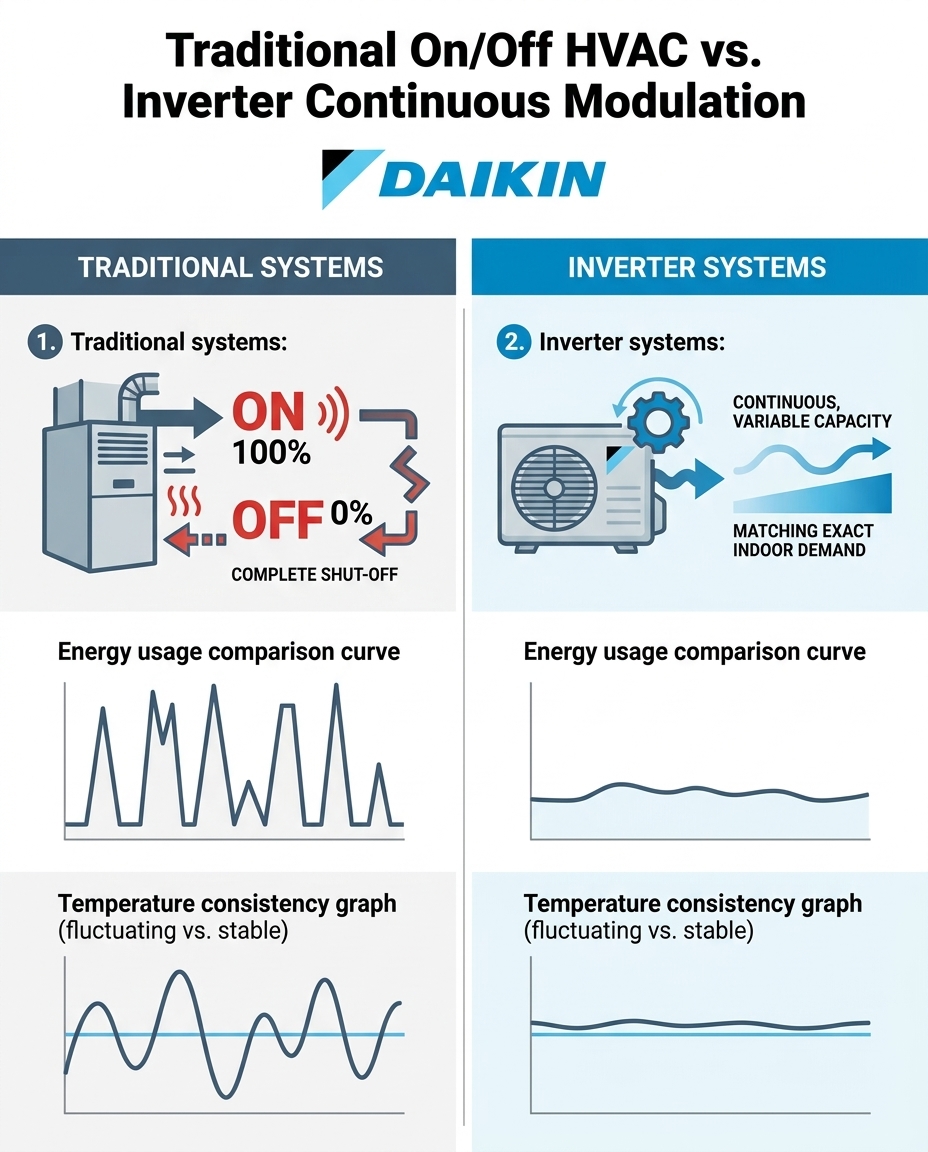
To understand why the September shoulder season is so difficult to manage, you have to look at the mechanical limitations of traditional heating and cooling equipment. Most legacy systems operate on a single-stage compressor. This means they only have two speeds: zero percent capacity (off) and one hundred percent capacity (on). When you upgrade to inverter technology, you are fundamentally changing how your home manages thermal energy.
The Problem with Short-Cycling
When a traditional system turns on to address a mild morning chill, it blasts air at maximum capacity. Because the heating demand is relatively low during the early fall, the system quickly overshoots the target temperature and abruptly shuts down. A few minutes later, as the house naturally cools again, the system kicks back on with another full-power blast. This rapid on-and-off sequence is known as short-cycling.
The hidden costs of short-cycling are significant. In our experience helping Tukwila homeowners transition to modern systems, we've seen how it not only creates uncomfortable temperature swings—where you feel hot one minute and cold the next—but it also puts immense wear and tear on the mechanical components. Every time a traditional compressor hard-starts, it draws a massive surge of electricity. Over time, this constant starting and stopping degrades the equipment and drives up utility consumption, all while failing to provide a consistent level of comfort.
Continuous Modulation Explained
The Daikin Fit side-discharge inverter solves this mechanical flaw through continuous modulation. Instead of acting like a simple light switch that is either completely on or completely off, an inverter-driven compressor acts more like the accelerator pedal in a car. It can precisely ramp its output up or down to match the exact indoor demand at any given moment.
If your home only needs a tiny amount of heat to maintain a comfortable 68 degrees on a crisp fall morning, the inverter compressor will operate at a very low, steady speed to provide exactly that amount of thermal energy. As the outdoor temperature rises and the need for heat diminishes, the system seamlessly dials back its output. This continuous, variable-capacity operation eliminates the hard starts, stops, and temperature fluctuations that plague traditional units, providing a seamless transition throughout the day.
Managing Rapid Daily Temperature Swings Automatically
The true value of the Daikin Fit side-discharge inverter becomes apparent when you connect its mechanical capabilities directly to the specific climate challenges of the region. When our team consults with homeowners in neighborhoods across Seattle and Tukwila WA, we frequently see how the rapid transition from a chilly morning to a warm afternoon catches legacy systems off guard. Managing this swing requires a system that is intelligent enough to pivot without waiting for a homeowner to intervene.
Seamless transitions from heating to cooling are the hallmark of advanced inverter systems. Because the system is constantly monitoring both the indoor temperature and the set point on the thermostat, it knows exactly when the heating load has been satisfied and when a cooling load is beginning to emerge. As the afternoon sun warms the living space, the system automatically scales back its heating output, eventually transitioning smoothly into cooling mode if the indoor temperature exceeds your desired comfort level.
• 6:00 AM — Typical PNW Fall Weather: Upper 40s, damp and chilly — Traditional HVAC Response: Blasts 100% heat, overshoots target, shuts off — Daikin Fit Inverter Response: Ramps up smoothly to provide steady, gentle warmth
• 11:00 AM — Typical PNW Fall Weather: Mid 50s, overcast clearing — Traditional HVAC Response: Short-cycles repeatedly to maintain temperature — Daikin Fit Inverter Response: Modulates down to a low-speed crawl, sipping energy
• 3:00 PM — Typical PNW Fall Weather: Mid 70s, direct sun on windows — Traditional HVAC Response: Requires manual switch to AC; blasts cold air — Daikin Fit Inverter Response: Automatically transitions to low-speed cooling
• 8:00 PM — Typical PNW Fall Weather: Low 60s, rapid cooling — Traditional HVAC Response: Requires manual switch back to heat — Daikin Fit Inverter Response: Seamlessly dials cooling back and prepares to heat
This automatic scaling of output matches shifting daily temperatures perfectly. By the time you return home from work, the house is exactly the temperature you set it to in the morning, regardless of what the weather did outside during the day. The comfort consistency achieved through this seamless transition completely changes how you interact with your home's climate control. You simply set your preferred temperature once, and the system handles the complex thermodynamics required to maintain it.
Why the Side-Discharge Design Fits Urban Environments
Beyond the internal mechanics of the compressor, the physical design of the equipment plays a crucial role in its suitability for the region. Homeowners in Seattle and Tukwila WA often face spatial constraints that make traditional HVAC installations difficult. The Daikin Fit was engineered specifically to address these architectural realities.
1. Ultra-compact physical footprint: Traditional cube-style air conditioners and heat pumps are massive, requiring significant clearance on all sides to function properly. The side-discharge design of the Daikin Fit is incredibly slim, resembling a large suitcase rather than a bulky cube. This allows it to be installed in spaces where legacy units simply cannot fit.
2. Perfect for tight lot lines: In dense urban neighborhoods, homes are often built very close together. Finding a location for a traditional outdoor unit that meets municipal setback requirements and doesn't encroach on walkways can be nearly impossible. The slim profile of the side-discharge unit makes it ideal for narrow side yards, zero-lot-line properties, and outdoor patios.
3. Whisper-quiet operation: Because the inverter compressor rarely runs at maximum capacity, the outdoor unit produces a fraction of the noise associated with traditional systems. You can comfortably host a fall barbecue or enjoy a quiet evening on your patio without a roaring fan motor interrupting your conversations.
4. Aesthetic integration: The sleek, modern casing of the side-discharge unit blends seamlessly into contemporary architectural designs. It can be mounted on wall brackets to keep it off the ground, saving valuable landscaping space and contributing to broader property aesthetic goals while delivering comprehensive whole-house HVAC solutions.
By solving both the climate challenge and the spatial challenge simultaneously, this specific form factor has become the premier choice for modernizing home comfort in densely populated Pacific Northwest neighborhoods.
The Efficiency of Continuous Operation
One of the most common misconceptions homeowners have when upgrading to a Daikin Fit side-discharge inverter is the operational runtime. Because traditional systems are designed to turn on, blast air, and shut off, we have been conditioned to believe that an HVAC system should only run intermittently. When our Tukwila customers first notice their new inverter system running for hours at a time, they often ask us if they should worry about their utility bills.
The reality of low-capacity runtime is highly counterintuitive but mechanically sound. Running continuously at a low capacity uses significantly less energy than frequent hard starts. Think of it like driving a car on the highway. Maintaining a steady speed of 60 miles per hour over a long distance is far more fuel-efficient than driving in stop-and-go city traffic, where you are constantly accelerating from a dead stop. The continuous modulation of the inverter compressor operates on the exact same principle, adapting to chaotic late summer weather without the massive electrical surges required to overcome resting inertia.
• Elimination of power spikes: By avoiding the massive amp draw required to start a traditional compressor, the inverter system keeps your overall electrical consumption remarkably low.
• Improved air circulation: Because the system runs continuously at low speeds, air is constantly moving through your return vents and filters. This prevents stagnant air pockets and significantly improves indoor air quality by capturing more dust and allergens.
• Even temperature distribution: Continuous gentle airflow eliminates the hot and cold spots that often plague multi-level homes, ensuring that the upstairs bedrooms and downstairs living areas remain uniformly comfortable.
• Reduced mechanical wear: The friction and stress placed on belts, bearings, and motors are highest during the startup phase. By running steadily, the system reduces long-term wear and tear, extending the overall lifespan of the mechanical components.
Experiencing Inverter Technology Before You Upgrade
Reading about the mechanical advantages of continuous modulation and automatic temperature transitions is helpful, but it is entirely different from feeling that seamless comfort in person. Because inverter technology represents such a fundamental shift in how a home is heated and cooled, having the opportunity to experience it firsthand is invaluable. This is where the Daikin Seattle Experience Center provides a unique advantage for homeowners in Seattle and Tukwila WA.
The value of a physical, no-pressure educational environment cannot be overstated when making a major investment in your home's infrastructure. One local homeowner shopping for a new heating and cooling system recently visited our team at the Daikin Experience Center to see, hear, and visualize the systems in real settings before getting final quotes. By interacting with the working displays, they were able to verify the whisper-quiet operation of the side-discharge unit and feel exactly how the system modulates airflow. This hands-on learning experience gave them complete confidence in their choice before any equipment was ever ordered.
The facility features state-of-the-art working displays, including a cold room that physically demonstrates the exact transition from heating to cooling. You can watch the thermostat interact with the equipment in real-time, observing how the inverter compressor scales its output without any loud clanking or rushing air. Visualizing these systems in a real-world setting demystifies the technology and ensures you are fully prepared to make an informed decision about upgrading your home comfort.
Reclaiming Your Comfort This Fall
The September shoulder season does not have to be a month of constant frustration and manual thermostat adjustments. By understanding how modern mechanical systems interact with the specific climate patterns of the Pacific Northwest, you can take control of your indoor environment. The technology exists to automatically scale output to match shifting daily temperatures, completely eliminating the inefficient cycle of blasting heat in the morning and scrambling for cooling in the afternoon.
Ending the thermostat battle is entirely possible when you move away from legacy single-stage equipment. We encourage you to explore your options and learn more about managing your home's comfort in a way that prioritizes stability, efficiency, and quiet operation. Taking the time to understand exactly how the Daikin Fit's inverter technology automatically scales its output to match shifting daily temperatures without requiring constant manual intervention is the first step toward reclaiming your comfort this fall.
Frequently Asked Questions
Does the Daikin Fit run all the time?
Yes, the Daikin Fit is designed to run nearly continuously, but at very low speeds. This continuous operation is actually what makes the system so energy-efficient, as it avoids the massive power surges required to constantly start and stop a traditional compressor. By running steadily at a low capacity, it maintains a perfectly even temperature and improves indoor air filtration without driving up your utility bills.
How does an inverter heat pump handle temperature swings?
An inverter heat pump handles temperature swings by continuously monitoring the indoor demand and modulating its compressor speed in real-time. If the morning is cold, it ramps up to provide necessary heat, and as the afternoon warms up, it seamlessly dials back that output or switches to cooling mode. This automatic scaling ensures the indoor temperature remains stable regardless of how drastically the outdoor weather changes.
Is the Daikin Fit a heat pump or an air conditioner?
The Daikin Fit is available as a highly advanced heat pump, meaning it provides both high-efficiency heating and cooling from a single piece of equipment. It utilizes a reversing valve to extract heat from the outdoor air during the winter to warm your home, and reverses the process in the summer to act as a powerful air conditioner. This dual functionality makes it a complete year-round climate solution.
At what temperature does a Daikin heat pump lose efficiency?
Modern Daikin inverter heat pumps maintain high efficiency even in sub-freezing temperatures, often operating effectively down to 5 degrees Fahrenheit or lower. Unlike older heat pumps that struggled when the temperature dropped below freezing, advanced inverter technology can extract thermal energy from incredibly cold air. In the mild Pacific Northwest climate, a Daikin heat pump will operate at peak efficiency throughout the entire winter.
How does a side-discharge design benefit homes with tight lot lines?
A side-discharge design features a slim, suitcase-like profile that blows exhaust air horizontally rather than vertically. This compact footprint requires significantly less clearance space than a traditional bulky cube unit, allowing it to be installed in narrow side yards, under decks, or close to property lines. It is the ideal solution for urban environments where outdoor space is strictly limited by municipal setback rules.
Can I see a Daikin Fit operating before installing one?
Yes, homeowners can visit our team at the Daikin Seattle Experience Center to see, hear, and feel the equipment operating in a real-world setting. The facility features working displays and interactive rooms that demonstrate the system's quiet operation and seamless temperature modulation. This hands-on, no-pressure environment is designed to educate you on the technology before you make any decisions about upgrading your home.
Schedule a Visit

your individual indoor comfort needs
products firsthand
with an authorized Daikin Dealer
.webp)
See why our customers Choose Us

“Jem is very inviting and knowledgeable. She gave us a walk through of the Daikin Experience Center and patiently answered all our questions. Learned a lot about HVAC’s through this visit.”
“Jem did a great job walking us through the various Daikin products and efficiencies of the products. She was very knowledgeable on everything Daikin. Highly recommend coming in for a tour prior to picking out your various AC systems.”
“Great experience at Daikin Seattle Experience Center: pre-purchase demos of home heating system (Daikin Fit), list of HVAC companies, working Daikin staff and external contractors to ensure highest quality. This experience sets the bar of how any home HVAC experience should be. Have got the Daikin Fit installed and so far seems to work very well – quiet, good home heating in peak winter (heat transfer/BTU/air handling); Functionality of Daikin thermostat and the iPhone app makes it very easy to use.”
“This place is awesome! If you are in the market for a new HVAC system, visit the Daikin Experience Center to get educated on the newest technology as well as available rebates and incentives for where you live. They’ll even connect you with local contractors in your area who install Daikin equipment.”
