

.webp)

.svg)


September: Test Your Daikin Heat Pump's Heating Mode
The Hidden Risk of Waiting for the First Freeze
Understanding Why September is the Critical Window to Test Your Daikin Heat Pump's Heating Mode is essential for homeowners in the Pacific Northwest as summer fades fast. While early fall still offers plenty of mild, sunny afternoons, that familiar autumn chill is already creeping into the evening air. Many homeowners assume their heating system is good to go simply because the air conditioner ran flawlessly all summer long. However, assuming your system will seamlessly transition to heating can leave you shivering in November. Taking action now isn't just about crossing a chore off your seasonal checklist—it is about avoiding a freezing weekend wait when the weather abruptly turns hostile and local technicians are fully booked.
To ensure your home stays comfortable year-round, familiarize yourself with your Daikin heat pump and schedule professional service before the seasonal rush begins.
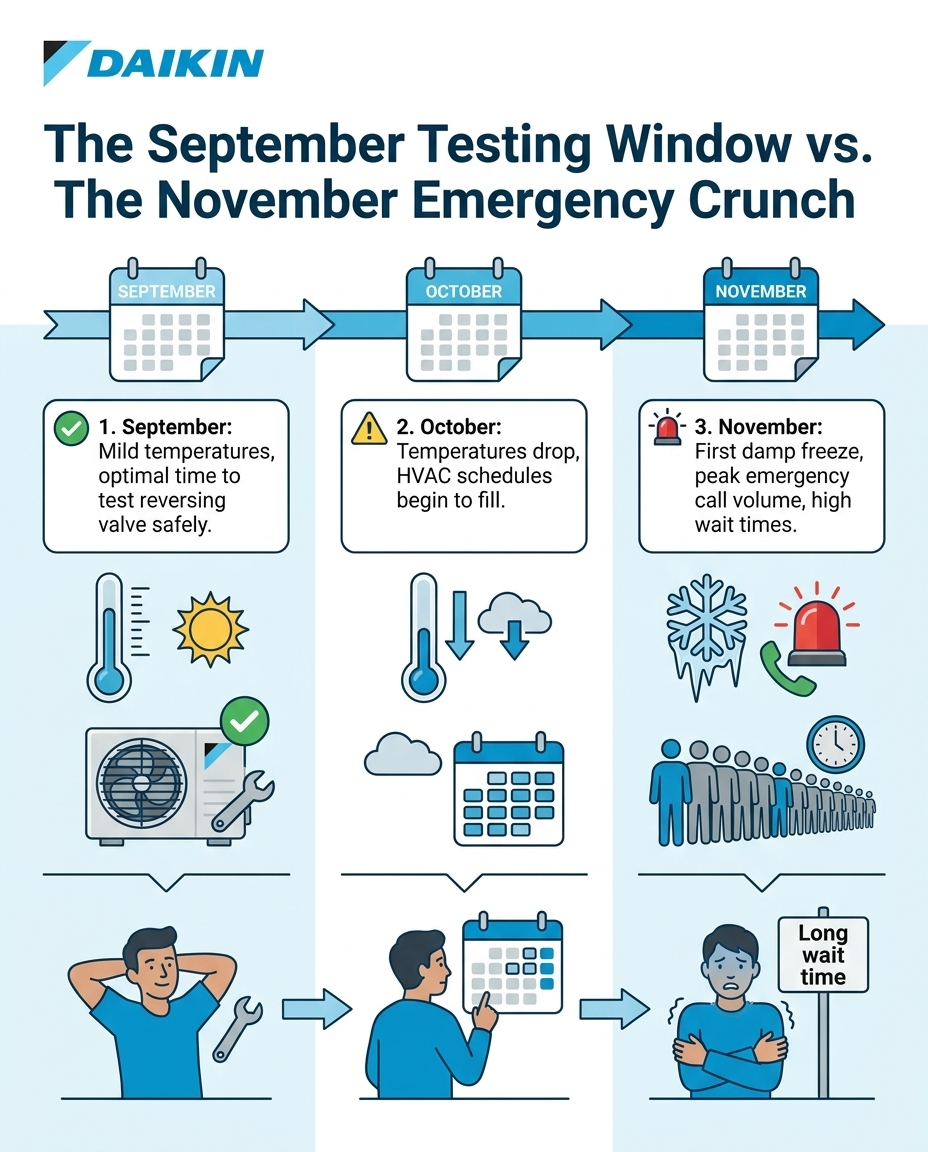
The deceptive nature of early fall: The September transition to a damp Seattle fall often catches homeowners off guard. Right now, the weather is forgiving. You might only need a light sweater in the morning, and the house warms up naturally by noon. But this mild stretch is a brief window. In our region, the shift from late summer to a freezing, damp autumn doesn't happen gradually—it usually hits overnight.
The trap of the successful summer: At the Daikin Seattle Experience Center, one of the most common patterns our team sees is homeowners feeling a false sense of security. Because your system kept you perfectly cool through July and August, you naturally expect it to keep you warm in November. But a heat pump operates differently than a standard air conditioner or a standalone gas furnace. It uses the exact same equipment to cool and heat your home, relying on a specific internal mechanism to change directions.
The hidden vulnerability: That mechanism is a mechanical valve that physically shifts the flow of refrigerant. When you wait until the first true freeze to demand heat from your system, you are asking a part that has been sitting in one position for months to suddenly snap into action. If it hesitates or sticks, your house stays cold. Proactively testing your system right now, while the weather is still pleasant, completely changes the dynamic. It transforms a potential midnight emergency into a minor, easily managed maintenance task.
Understanding the Mechanics Behind the Switch
The Problem: Blowing Cold Air When You Need Heat
You walk over to your thermostat on a chilly evening, switch the system from "cool" to "heat," and wait for that comforting wave of warm air. Instead, ten minutes go by, and the vents are still blasting cold air into your living room. This is one of the most frequent emergency calls our local technicians receive during the fall transition. The immediate assumption is that the entire system has failed, but our experience shows the reality is usually much more focused on a single component.
The Cause: How the Daikin Heat Pump Reversing Valve Works
To understand why this happens, you have to look at how your system operates. Heat pumps do not generate heat the way a traditional furnace burns fuel. Instead, they move heat from one place to another. In the summer, they absorb heat from inside your house and pump it outside. In the winter, they absorb ambient heat from the outdoor air and pump it inside.
The role of the reversing valve: The component responsible for this magic trick is the Daikin heat pump reversing valve. This heavy-duty mechanical valve physically shifts back and forth to change the direction of the refrigerant flow. Think of it like a railroad switch that changes the track for a train.
Why it gets stuck: When your system runs in cooling mode from May through August, that valve stays locked in the cooling position. After months of continuous operation in one direction, the internal sliding mechanism can become stiff or stuck. When you finally ask it to move in late fall, it might stubbornly stay exactly where it is.
The Solution: Routine Mechanical Exercise
A stuck valve does not mean you have a "bad" system or that you need a total replacement. It is simply a mechanical reality of seasonal transitions. The solution is proactive testing.
• Warm air flows after 10-15 minutes — What It Means: The reversing valve successfully shifted into heating mode. — Next Step: You are ready for winter.
• System runs but blows cold air — What It Means: The valve is likely stuck in the summer cooling position. — Next Step: Schedule a professional diagnostic.
• System does not turn on at all — What It Means: Possible thermostat, breaker, or electrical communication issue. — Next Step: Check breakers and thermostat batteries before calling.
By understanding this mechanical shift, you can see why running a quick test while the weather is mild is so important.
The Regional HVAC Schedule Crunch
The morning after the freeze: Having served the Tukwila and Greater Seattle area through countless seasonal transitions, our team knows the weather follows a predictable pattern. We enjoy a mild, drawn-out late summer, and then suddenly, a damp, freezing cold front moves in overnight. The very next morning, thousands of homeowners walk to their thermostats and switch them to "heat" for the first time in six months.
When a percentage of those systems fail to switch over due to a stuck reversing valve, local HVAC companies experience an immediate, massive surge in service requests. The phone lines light up simultaneously across the entire region.
The Reality of Peak Demand
A bottleneck of epic proportions: During this November crunch, a simple, non-emergency checkup rapidly turns into a high-stress situation. Because so many people are calling at once, schedules fill up instantly. What would have been a quick next-day appointment in September can easily turn into a multi-day wait in November.
The toll on your household: Living in a freezing house while waiting for a technician is deeply uncomfortable. You find yourself layering up in heavy coats indoors, dragging space heaters into bedrooms, and worrying about your family's comfort. The damp chill of a Seattle fall penetrates quickly when a home has no active heating.
This is precisely why early testing is so valuable. If you discover a sticking valve in September, you have a comfortable buffer. You can call for emergency heat pump service or standard maintenance without the panic of freezing temperatures. You get on the schedule on your own terms, completely bypassing the regional bottleneck that traps so many other homeowners.
How to Perform a Safe September Heating Test Run
You do not need to be an HVAC technician to verify that your system is ready for the colder months. Running a basic functional test is straightforward and perfectly safe for any homeowner to do. The goal is simply to confirm that the equipment can successfully make the mechanical shift before the September transition to a damp Seattle fall gives way to freezing temperatures.
Your Step-by-Step Testing Guide
1. Choose the right time of day: Pick a mild September morning or evening when the outdoor temperatures are naturally cooler. You want the house to be slightly chilly so the system has a reason to run a full heating cycle.
2. Adjust your thermostat: Switch your thermostat from "cool" or "auto" directly to "heat" mode. Then, manually adjust the temperature setting so it is three to four degrees higher than the current room temperature.
3. Listen for the shift: Head toward your indoor air handler or stand near your outdoor compressor. When the system kicks on, you should hear a distinct sound—often described as a subtle "whoosh" or a brief mechanical shifting noise. This is the sound of the reversing valve sliding into the heating position.
4. Verify the airflow: Give the system 10 to 15 minutes to fully ramp up. Then, place your hand over the nearest supply register (vent). You should feel a steady stream of distinctly warm air pushing into the room.
A critical safety warning: If you follow these steps and the system continues to blow cold air, do not panic, but also do not pull out your toolbox. Never attempt DIY repairs on internal components like the reversing valve or the high-voltage electrical boards. These parts operate under intense pressure and require a licensed professional to diagnose and service safely. Instead, focus on preparing your Daikin heat pump for the shift from cooling to heating by documenting what you observed and calling an expert.
What to Do If Your Daikin Heat Pump is Not Turning On in Heat Mode
If you run your September test and find yourself searching "Daikin heat pump not turning on in heat mode," you are not alone. It is one of the most common seasonal troubleshooting queries our support staff fields. Before you assume the worst, there are a few basic, homeowner-safe checks you can perform to rule out simple operational hiccups.
Rule Out the Basics First
• Verify thermostat power: If the screen is blank or flashing, swap out the batteries. A weak battery can cause communication failures between the thermostat and the actual heat pump.
• Check your electrical panels: Inspect both the main breaker panel inside your home and the dedicated disconnect box near the outdoor unit. A tripped breaker will stop the system in its tracks.
• Inspect the air filter: A completely clogged air filter restricts airflow so severely that the system's internal safety sensors might shut the unit down to prevent overheating. Slide the filter out and hold it up to a light; if you cannot see light through it, replace it immediately.
When to Call for Backup
If the thermostat is powered, the breakers are set, and the filter is clean, but the system still misbehaves, pay attention to how it acts. If the outdoor unit fires up and the indoor fan blows, but the air coming out of your vents remains stubbornly cold, the Daikin heat pump reversing valve is the most likely culprit. It is probably stuck in the summer cooling position.
Protect your equipment: If this happens, do not leave the system running in a futile attempt to "force" it to warm up. Leaving a struggling system running places unnecessary strain on the compressor. Instead, turn the thermostat to the "off" position. Because you tested early, you now have the luxury of exploring professional Seattle heat pump solutions while the weather outside is still perfectly manageable.
Empowering Homeowners Through Education, Not Emergency Sales
The HVAC industry has historically relied heavily on fear-based, emergency sales tactics. When a homeowner's heat fails on the coldest night of the year, they are vulnerable. They often feel pressured into making rushed decisions about expensive repairs or full system replacements simply because they are desperate to get the heat back on.
A Different Approach to Home Comfort
At the Daikin Seattle Experience Center, we believe there is a better way. Our mission as your local Tukwila heat pump experts is to replace that traditional panic with proactive education. When you understand how your equipment actually works—like knowing that a stuck reversing valve is a common mechanical issue rather than a catastrophic failure—you are firmly in control of your home comfort.
The value of firsthand experience: This educational philosophy is exactly why a physical Experience Center matters. Instead of looking at glossy brochures or listening to high-pressure sales pitches in your living room, you can visit a dedicated facility to touch, hear, and visualize these systems in real, working settings. You can hear exactly what a reversing valve sounds like when it shifts, and feel the quiet efficiency of modern inverter technology for yourself.
Real confidence in your decisions: Our team sees the impact of this approach every day on our showroom floor. For example, one local homeowner recently visited our Tukwila facility while shopping for a new heating and cooling system. Rather than just handing them a quote, our staff walked them through working displays, providing expert, plain-English explanations of how the equipment operates. Experiencing the systems firsthand turned what is usually a stressful purchasing process into a highly positive learning experience, leaving them with complete confidence in their final decision.
Informed homeowners make better decisions about maintenance, timing, and upgrades. By taking the time to test your system in September and learning about its mechanics, you completely eliminate the stress of the winter panic. You empower yourself to make smart, pressure-free choices about your home's comfort.
Secure Your Winter Comfort While the Weather is Mild
By understanding why your reversing valve needs a September test run, you have a safe, non-technical way to verify your system is ready for winter. Don't wait for the first damp freeze to discover an issue. Take control of your comfort today and schedule professional service before the seasonal emergency rush begins.
Frequently Asked Questions
At what temperature should I switch my heat pump to heat?
You should generally switch your heat pump to heat mode when indoor temperatures consistently drop below 68°F. During the early fall, this often means turning the heat on in the evening while leaving it off during warmer afternoons. Modern thermostats can handle this automatically if set to "auto," but manually switching it during a mild September evening is the best way to run a seasonal test.
How do I test my heat pump heating mode safely?
To safely test your heating mode, choose a mild day and switch your thermostat from cool to heat. Set the temperature three to four degrees above the current room temperature so the system is forced to cycle on. Wait about 10 to 15 minutes, listen for the mechanical shift, and then check your vents to confirm steady, warm airflow is entering the room.
Why is my Daikin heat pump not turning on in heat mode?
If your Daikin heat pump is not turning on at all, the issue is often electrical, such as a dead thermostat battery, a tripped breaker, or a blown fuse. However, if the unit turns on but fails to produce warm air, the internal reversing valve is likely stuck in the cooling position. Always check your basic power sources and air filters before calling a professional for a diagnostic.
How do I know if my reversing valve is stuck?
The most obvious sign of a stuck reversing valve is a system that runs normally but blows cold air when set to heat mode. You might also notice the absence of the distinct "whoosh" sound the valve makes when transitioning between heating and cooling cycles. Because this is a sealed mechanical component, a technician must physically inspect the pressures and voltages to confirm it has seized.
Can a stuck reversing valve fix itself?
A stuck reversing valve rarely fixes itself without intervention. While it might occasionally jiggle loose during a cycle, the underlying stiffness caused by months of remaining in one position usually persists. Ignoring a sticking valve often leads to a complete failure right when you need the heat the most, requiring professional replacement.
Why does my heat pump blow cold air when first turned on in fall?
A heat pump blowing cold air during its first fall run is typically caused by a reversing valve that has locked up after a long summer of continuous cooling. It can also happen briefly during a normal defrost cycle, though this is more common in deep winter. If the cold air persists for more than 15 minutes during your initial fall test, it indicates the system failed to mechanically shift into heating mode.
Schedule a Visit

your individual indoor comfort needs
products firsthand
with an authorized Daikin Dealer
.webp)
See why our customers Choose Us

“Jem is very inviting and knowledgeable. She gave us a walk through of the Daikin Experience Center and patiently answered all our questions. Learned a lot about HVAC’s through this visit.”
“Jem did a great job walking us through the various Daikin products and efficiencies of the products. She was very knowledgeable on everything Daikin. Highly recommend coming in for a tour prior to picking out your various AC systems.”
“Great experience at Daikin Seattle Experience Center: pre-purchase demos of home heating system (Daikin Fit), list of HVAC companies, working Daikin staff and external contractors to ensure highest quality. This experience sets the bar of how any home HVAC experience should be. Have got the Daikin Fit installed and so far seems to work very well – quiet, good home heating in peak winter (heat transfer/BTU/air handling); Functionality of Daikin thermostat and the iPhone app makes it very easy to use.”
“This place is awesome! If you are in the market for a new HVAC system, visit the Daikin Experience Center to get educated on the newest technology as well as available rebates and incentives for where you live. They’ll even connect you with local contractors in your area who install Daikin equipment.”
