

.webp)

.svg)


Why Seattle, WA Air Quality is Bad Today: Fall Inversions
Waking Up to Hazy Skies: The September Air Quality Mystery
When you wake up to hazy skies and find yourself searching for the real reason why Seattle air quality is bad today: fall inversions and wood smoke are usually the hidden culprits. You check your weather app on a crisp morning, expecting a clear forecast, only to be greeted by a stark "Poor Air Quality" alert. There are no active wildfires nearby, and the weather feels relatively mild. At the Daikin Seattle Experience Center, we hear this exact confusion from Puget Sound homeowners every September. You might even assume the app is glitching. However, this is a highly specific, recurring regional phenomenon that severely impacts the breathable air inside your living spaces.
If you are tired of battling poor indoor air quality during these seasonal shifts, upgrading your indoor air quality defenses is the first step toward breathing easier.
This recurring issue highlights a core conflict we see residents face: relying on temporary fixes like closing windows versus upgrading to permanent, whole-home defenses. When trending local queries about 'why is Seattle air quality bad today' spike, it is almost always tied to a meteorological shift that catches people off guard. Understanding these local weather patterns is the first step toward effective mitigation. You cannot control the atmosphere outside, but by understanding exactly what is happening above your roof, you can make informed decisions about how to protect the environment inside your home.
The Science of Fall Temperature Inversions in the Pacific Northwest
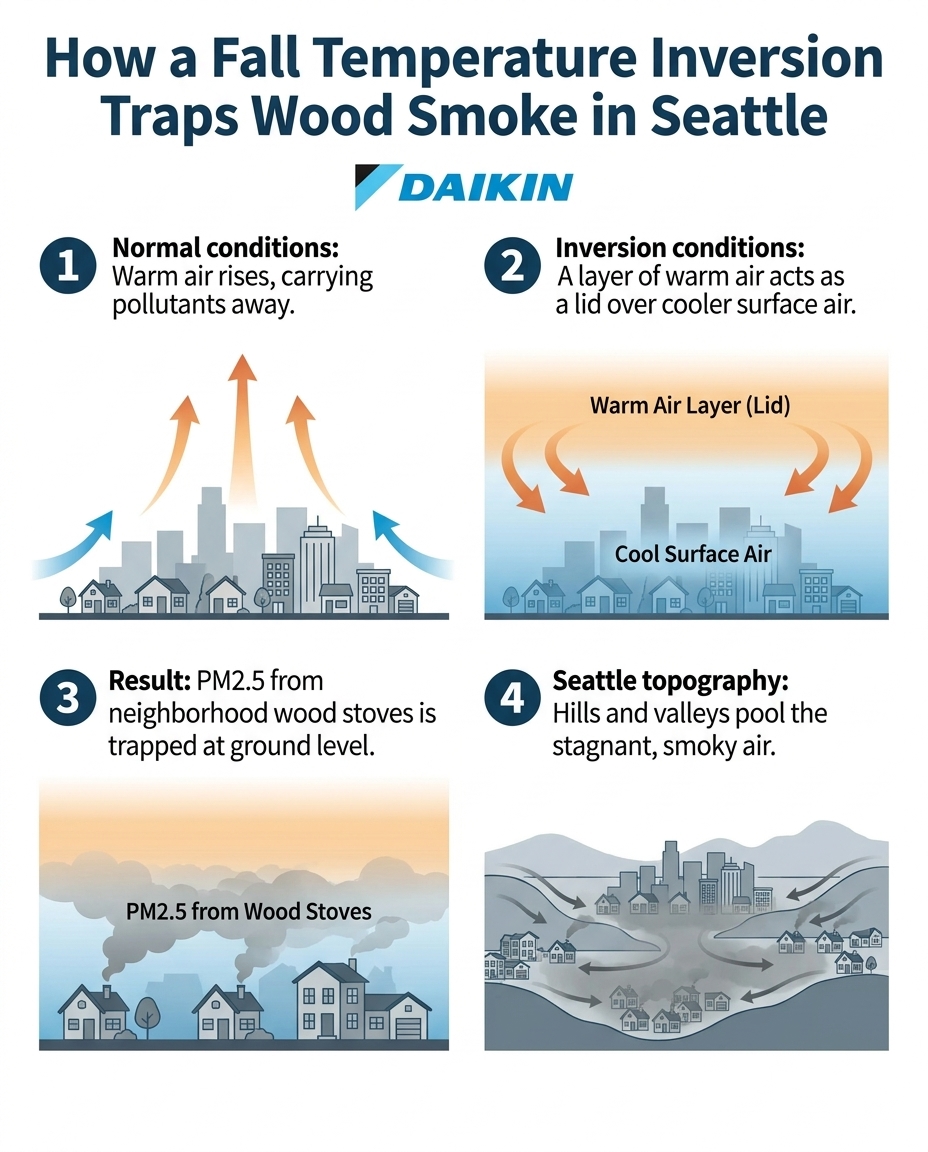
To understand why the air suddenly turns hazardous, you have to look at the meteorological shifts that occur during the September early fall transition. Under normal conditions, warm air sits near the surface of the earth and naturally rises, carrying pollutants up and away into the upper atmosphere. However, during a temperature inversion, this natural process flips upside down. A layer of warmer air moves in and sits on top of cooler surface air, acting like a heavy, invisible lid.
High-pressure systems, which are incredibly common in the early fall transition, trigger these stagnation events. When the high pressure settles in, it prevents natural atmospheric mixing. Ground-level pollutants have nowhere to go. They hit the warm air "lid" and bounce right back down to the surface where we live and breathe.
The Anatomy of an Inversion Event:
• Normal atmospheric mixing: Warm air at ground level rises, dispersing everyday pollutants safely into the upper atmosphere.
• The high-pressure lid: A high-pressure system traps a layer of warm air high above the ground, while cool air remains trapped below.
• The stagnation trap: Because the cool air cannot rise through the warm layer, pollutants accumulate rapidly at ground level.
Working in Tukwila, our team sees firsthand how this phenomenon is severely exacerbated by local geography. Seattle and Tukwila's unique topography, surrounded by the towering Cascades, the Olympic Mountains, and numerous local hills, naturally pools this cooler, stagnant air in lower elevations. According to National Weather Service data, these geographic bowls become holding tanks for trapped air. When the September early fall transition brings chilly nights and high-pressure days, the "lid" seals tight over the Puget Sound region, setting the stage for a massive drop in air quality.
Why Neighborhood Wood Smoke is the Hidden Culprit
When the inversion lid drops over the Seattle metro and Tukwila suburbs, the trapped air needs a pollutant to turn it hazardous. While summer brings the distant threat of massive wildfire smoke, the early fall brings a hyper-local threat: neighborhood wood stove emissions. As mornings get chilly, residents naturally begin using wood stoves and fireplaces to take the edge off the cold. Because the inversion layer is blocking atmospheric mixing, every plume of smoke coming out of a local chimney stays trapped right in the neighborhood.
This localized emission source is why air quality can plummet even when regional forests are perfectly safe. The Puget Sound Clean Air Agency closely monitors these specific stagnation events. When fine particle pollution reaches unhealthy levels due to trapped wood smoke, they issue stage 1 or 2 burn bans to curb the emissions at their source. However, by the time a ban is issued, the smoke has often already infiltrated your home.
Tracking these levels accurately inside your home is critical during these events. We always recommend installing the best air quality monitors in Seattle so you can see exactly when outdoor wood smoke begins compromising your indoor environment, giving you the real-time data you need to take action.
The Danger of PM2.5 Particles
The primary threat hidden within wood smoke is fine particulate matter, commonly known as PM2.5. These particles are incredibly small—measuring 2.5 micrometers in diameter or less, which is about 30 times smaller than a single strand of human hair. Because they are so microscopic, they easily bypass standard human respiratory defenses. When you breathe in PM2.5, it doesn't just irritate your throat; it travels deep into your lungs and can even enter your bloodstream. In the Seattle metro and Tukwila suburbs, dense residential areas using wood heat can generate staggering amounts of PM2.5 during an inversion, turning your neighborhood into a localized pollution hotspot.
• Wildfire Smoke — Origin: Distant forests and regional fires — Primary Season: Mid to Late Summer — Impact Under Inversion: Can be trapped, but often blows in from hundreds of miles away.
• Neighborhood Wood Smoke — Origin: Local chimneys and wood stoves — Primary Season: Early Fall through Winter — Impact Under Inversion: Highly concentrated locally; traps emissions directly in the immediate residential area.
The Health Impact: Why Standard Filters Fail Against PM2.5
One of the most common misconceptions our team encounters is that running a central air system with a standard 1-inch fiberglass filter will protect the home from outdoor smoke. Unfortunately, this is a dangerous assumption during the September early fall transition. Standard fiberglass filters are designed with one primary purpose: to protect the internal mechanical components of your HVAC systems from large debris, pet hair, and heavy dust. They are simply not engineered to protect human lungs from microscopic PM2.5.
In our experience evaluating residential systems, the mechanical limitations of basic filters mean that fine particulate matter passes right through the fiberglass weave. Furthermore, microscopic wood smoke particles constantly infiltrate the home through natural ventilation, opening doors, and microscopic drafts around windows and foundations. Once inside, if your system lacks advanced filtration, the blower motor merely circulates the PM2.5 from room to room.
The Reality of Basic Filtration:
• Fiberglass filters: Catch less than 20% of particles in the 3.0 to 10.0 micrometer range, and are virtually useless against PM2.5.
• Pleated 1-inch filters: Offer slightly better surface area but still struggle to capture the ultra-fine particulates found in wood smoke without restricting airflow.
• Infiltration points: Smoke enters through bathroom exhaust vents, range hoods, and tiny gaps in weatherstripping, demanding a proactive interior defense.
This sets the stage for why advanced filtration is absolutely necessary during these seasonal transitions. We continually remind our clients that you cannot rely on a piece of cardboard and fiberglass to defend your respiratory health when an inversion traps concentrated wood smoke directly outside your front door.
Moving Beyond Temporary Fixes to Whole-Home Purification
When the air quality drops, the most common reactions are temporary fixes: shutting all the windows tightly and turning on a portable HEPA filter in the bedroom. While these steps are better than nothing, they are ultimately insufficient for protecting an entire household. Portable units only clean the air in their immediate vicinity, leaving the rest of the house vulnerable. To truly combat the effects of an inversion in the Seattle metro and Tukwila suburbs, you must look toward integrated, permanent solutions.
Whole-home purification systems integrate directly into your central air ductwork. Instead of trying to clean one room at a time, these systems utilize continuous air circulation to actively pull air from every room, push it through advanced media or electronic air cleaners, and return scrubbed, clean air back into the living space. This actively removes trapped PM2.5 from every room simultaneously.
By exploring the advanced indoor environmental quality solutions we showcase at our center, you transform your existing ductwork into a comprehensive defense network. Preparing your home now, during the early fall, not only mitigates the immediate threat of inversion-trapped wood smoke but also protects your family against the entire upcoming winter heating season.
• Portable HEPA Filter — Coverage Area: Single room (typically 150-300 sq ft) — Effectiveness Against PM2.5: High in immediate area, low for whole house — System Integration: None (standalone plug-in unit)
• Standard 1-Inch Filter — Coverage Area: Whole house — Effectiveness Against PM2.5: Very Low (passes through) — System Integration: Basic mechanical protection
• Whole-Home Purifier — Coverage Area: Entire conditioned space — Effectiveness Against PM2.5: Extremely High (captures microscopic particles) — System Integration: Fully integrated into central ductwork
Smart Monitoring and Proactive Indoor Defense
Modern technology removes the guesswork from managing indoor air quality during an inversion. In the past, homeowners only knew the air was bad when they smelled smoke or felt their eyes watering. Today, integrated sensors can detect microscopic spikes in PM2.5 long before physical symptoms appear. When these sensors detect a drop in air quality, they can automatically trigger the home's purification cycle, ramping up the blower motor to scrub the air without you ever having to lift a finger.
This level of automation is often managed through smart thermostats and cloud services, which provide the peace of mind that comes from viewing real-time data on a digital interface. When trending local queries about 'why is Seattle air quality bad today' start popping up on your social feeds, you can simply glance at your wall control or smartphone app to confirm that your indoor environment remains pristine.
Education and visibility are key to maintaining a healthy home environment. Recently, a local homeowner who was considering HVAC replacements visited our Tukwila showroom to understand their options. By showcasing our products in active operation side-by-side, answering their questions, and helping line up qualified contractors, our team directly influenced their decision on the right equipment for their home. Seeing the smart monitoring respond to air quality changes in real-time proved exactly how proactive these systems can be.
See the Science in Action Before You Upgrade
Understanding the science of temperature inversions and PM2.5 is one thing; seeing the solutions actively eliminate these threats is another. In the HVAC industry, many companies push blind, over-the-phone sales of air scrubbers, expecting homeowners to make significant investments without ever seeing the technology work. We find this often leads to mismatched equipment and lingering air quality issues in the Seattle metro and Tukwila suburbs.
At the Daikin Seattle Experience Center, we operate entirely differently. We've built a no-pressure, hands-on educational hub where homeowners can physically interact with IAQ monitors and see whole-home purifiers combat particulates in real-time. There is immense value in physically interacting with the equipment. You can hear how quiet the variable-speed blowers are, see the density of the advanced media filters, and watch digital monitors react to air quality changes.
We recently had another customer who was gathering quotes for heating and cooling upgrades visit the experience center before making a final decision. That hands-on visit prompted them to learn exactly what the technology promised before they committed to a system. Understanding the technology in a no-pressure environment ensures you get the right solution for your home's specific needs. We strongly encourage homeowners to explore these solutions in person to truly grasp the difference they make.
Frequently Asked Questions About Seattle Air Quality and Inversions
Why is the air quality bad in Seattle when there are no wildfires?
The short answer is that localized wood smoke gets trapped near the ground by a temperature inversion, causing spikes in PM2.5 without a wildfire. During the early fall, high-pressure systems create a "lid" of warm air over the city. When residents light their wood stoves on chilly mornings, that smoke cannot disperse upwards, leading to hazardous conditions right in your neighborhood.
What is a fall temperature inversion?
A fall temperature inversion is a meteorological event where a layer of warm air traps cooler air and pollutants close to the surface. Normally, warm air rises and carries pollutants away, but an inversion flips this process. This atmospheric "lid" is especially common in the Pacific Northwest during the transition from summer to fall, leading to sudden stagnation events.
Is wood smoke worse than wildfire smoke?
Both contain harmful PM2.5 particles, but wood smoke is often hyper-local and highly concentrated in residential neighborhoods during inversions. While wildfire smoke travels hundreds of miles and dilutes somewhat in the upper atmosphere, wood smoke originates right next door. This proximity makes wood smoke exceptionally dangerous when trapped by an inversion layer.
How do you get rid of wood smoke in your house?
The most effective strategy is keeping windows closed and utilizing a whole-home purification system with advanced media filtration to actively scrub PM2.5. Standard 1-inch filters will not catch microscopic smoke particles. You must rely on integrated HEPA-grade media or electronic air cleaners that circulate and filter the air throughout your entire ductwork system.
What triggers a Puget Sound Clean Air Agency burn ban?
Burn bans are issued during stagnation events when fine particle pollution reaches unhealthy levels. The agency monitors real-time air quality data, and when inversions trap excessive wood smoke, they mandate stage 1 or stage 2 bans to legally limit further emissions. These bans are critical protective measures during prolonged high-pressure weather systems.
Take Control of Your Home's Air This Fall
While you cannot control Seattle's fall weather patterns or stop a high-pressure system from creating a temperature inversion, you have complete control over your indoor environment. The September early fall transition doesn't have to mean waking up to coughing fits and hazy indoor air. By moving past temporary fixes and investing in integrated purification, you can protect your family from the microscopic threats of neighborhood wood smoke.
Our team at the Daikin Seattle Experience Center encourages you to seek expert guidance on integrated purification systems before the deep winter sets in. Visit our local educational center in Tukwila to see this technology in action, ask questions in a no-pressure environment, and take the first step toward securing a healthier, cleaner home for the seasons ahead.
Schedule a Visit

your individual indoor comfort needs
products firsthand
with an authorized Daikin Dealer
.webp)
See why our customers Choose Us

“Jem is very inviting and knowledgeable. She gave us a walk through of the Daikin Experience Center and patiently answered all our questions. Learned a lot about HVAC’s through this visit.”
“Jem did a great job walking us through the various Daikin products and efficiencies of the products. She was very knowledgeable on everything Daikin. Highly recommend coming in for a tour prior to picking out your various AC systems.”
“Great experience at Daikin Seattle Experience Center: pre-purchase demos of home heating system (Daikin Fit), list of HVAC companies, working Daikin staff and external contractors to ensure highest quality. This experience sets the bar of how any home HVAC experience should be. Have got the Daikin Fit installed and so far seems to work very well – quiet, good home heating in peak winter (heat transfer/BTU/air handling); Functionality of Daikin thermostat and the iPhone app makes it very easy to use.”
“This place is awesome! If you are in the market for a new HVAC system, visit the Daikin Experience Center to get educated on the newest technology as well as available rebates and incentives for where you live. They’ll even connect you with local contractors in your area who install Daikin equipment.”
