

What the Daikin VRV LIFE Residential System Is — and Why Seattle Homeowners Are Choosing It
The Daikin VRV LIFE residential system explained simply: it is a whole-home heating and cooling system that uses Variable Refrigerant Volume (VRV) technology to deliver precise, zoned comfort from a single compact outdoor unit. Here is a quick overview:
- What it is: A multi-zone inverter-driven heat pump system designed specifically for homes
- How it works: One outdoor unit connects to up to 9 indoor units, sending only the exact amount of refrigerant each zone needs
- Key advantage: Up to 30% energy savings over traditional systems, with consistent temperatures and far less wasted energy
- Unique feature: The first residential VRV heat pump that can pair with a gas furnace for dual-fuel operation
- Sound level: Runs at approximately 57 decibels — up to 16 decibels quieter than traditional outdoor units
- Operating range: Heats down to -4°F and cools up to 122°F
If you are tired of hot and cold spots in your Seattle home, watching energy bills climb every month, and running a system that heats or cools rooms nobody is using — you are not alone. Most traditional HVAC systems in the Pacific Northwest were simply not built for the kind of precise, room-by-room control that modern homeowners expect.
Daikin first invented VRV technology back in 1982, and it quickly earned a reputation as the gold standard for commercial buildings. Now, that same technology has been reimagined for residential use — bringing commercial-grade efficiency, quiet operation, and intelligent zoning to homes right here in Seattle.
This guide walks you through everything you need to know, from how the system works to whether it is the right fit for your home.
How the Daikin VRV LIFE Residential System Explained Works
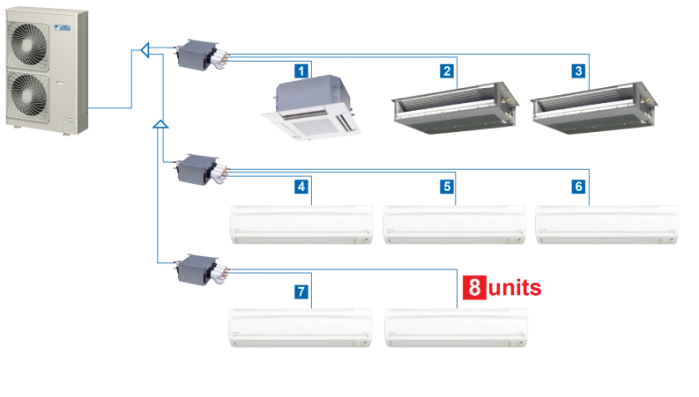
At its core, VRV means Variable Refrigerant Volume. That sounds technical, but the idea is straightforward: the system moves only as much refrigerant as each room or zone actually needs at that moment.
In a traditional residential HVAC setup, the equipment usually works in broad strokes. It turns on, runs hard, shuts off, and repeats. That can create temperature swings, uneven comfort, and wasted energy. VRV LIFE takes a smarter approach. It continuously adjusts output to match the real load in the home.
A VRV LIFE system typically includes:
- One compact outdoor heat pump unit
- Multiple indoor units, up to 9 on a single outdoor unit
- Refrigerant piping instead of large new duct runs everywhere
- Intelligent controls that tell the system what each zone needs
- Electronic expansion valves that meter refrigerant precisely
Because most homes do not need full heating or cooling output all day, this matters a lot. Research on VRV systems shows they often run about three-quarters of their operating hours at less than 70% of full capacity. That is exactly where inverter-driven systems shine.
If you want a broader primer on the technology behind it, our guide to the Daikin VRV system is a helpful next read.
| Feature | Daikin VRV LIFE | Traditional Split System |
|---|---|---|
| Compressor operation | Variable speed, modulates continuously | Usually on/off or staged |
| Zoning | Up to 9 zones | Often 1 to 2 zones |
| Comfort control | Room-by-room precision | Whole-home average |
| Outdoor unit size | Compact side-discharge design | Larger top-discharge footprint |
| Existing ductwork options | Can work with ducted and ductless combinations | Usually tied to one duct layout |
| Furnace integration | Can pair with compatible gas furnace | Common in standard ducted systems |
| Efficiency at part load | Strong | Typically lower |
| Sound levels | Approximately 57 dB | Often louder |
Daikin VRV LIFE Residential System Explained: Inverter Precision
The inverter is one of the biggest reasons VRV LIFE feels different in daily use.
Instead of blasting at full power and then shutting off, the swing inverter compressor adjusts speed in real time. Think of it like cruise control instead of stop-and-go traffic. That smoother operation helps the system maintain more even indoor temperatures and avoid the big swings many homeowners dislike.
Daikin research shows inverter systems can use about 30% less energy than non-inverter air conditioners while maintaining steadier comfort. That is not magic. It is simply a better match between system output and the actual needs of the house.
This also means:
- Faster pull-down or warm-up when conditions change
- Less overshooting the thermostat setting
- Fewer hard starts and stops
- Better part-load performance during the mild, variable weather we often see in the Seattle area
We cover similar comfort and efficiency ideas in our Daikin HVAC Seattle solutions guide.
Daikin VRV LIFE Residential System Explained: Zoning Intelligence
Zoning is where VRV LIFE really starts to make homeowners smile.
With up to 9 indoor units connected to one outdoor unit, different rooms or areas can have different temperature settings. That means your primary bedroom does not have to feel like the kitchen, and the home office does not need to match the guest room nobody has entered since last Thanksgiving.
Each indoor unit receives the amount of refrigerant it needs, based on demand in that zone. Electronic controls and valves constantly coordinate this. The result is more personalized comfort and less wasted conditioning in unused spaces.
This zoning flexibility is especially useful for:
- Two-story homes with uneven temperatures
- Homes with finished basements or bonus rooms
- Remodels and additions
- Houses with some rooms that run warm from sun exposure
- Families who do not agree on the thermostat, which is a very normal and ancient domestic tradition
For more on how this works in practice, see our article on how multi zone HVAC systems work.
Main Benefits for Seattle Homeowners
For homes in Seattle, Tukwila, and across the Pacific Northwest, VRV LIFE solves several real-world problems at once: comfort imbalance, limited yard space, noise concerns, and the need for efficient year-round operation.
Here are the biggest benefits.
- More precise comfort in more parts of the home
- Better energy performance during part-load operation
- Smaller outdoor footprint for tighter installations
- Quieter operation near patios, windows, and lot lines
- Flexibility to mix ducted and ductless indoor units
- Dual-fuel capability for homes that want heat pump efficiency plus gas backup
The outdoor unit is a major practical advantage. Daikin indicates VRV LIFE can reduce installation space requirements by up to 75% compared with similar-capacity top-discharge unitary condensing equipment. For homes with limited exterior space, that is a meaningful design benefit.
The sound profile matters too. With operating sound around 57 decibels, VRV LIFE can be up to 16 decibels quieter than some traditional outdoor units. In dense Seattle neighborhoods, that can be a big plus.
You can explore broader whole-home options on our Daikin HVAC solutions Seattle page.
Energy Efficiency and Performance Metrics
VRV LIFE is designed for the way homes actually operate: not at full blast every hour of every day, but at changing loads throughout the year.
Published performance figures for VRV LIFE include:
- Up to 18.6 SEER2 cooling efficiency
- Up to 9.0 HSPF2 heating efficiency
- Heat pump operation down to -4°F
- Cooling operation up to 122°F
It also uses inverter technology and Variable Refrigerant Temperature logic to improve part-load efficiency. In simple terms, the system does not just vary compressor speed. It also optimizes how refrigerant conditions are managed so the equipment is not doing more work than necessary.
Why does that matter in the Pacific Northwest?
Because our weather is often moderate, damp, and variable rather than extreme all day long. Systems that can modulate gently and accurately tend to perform better in those conditions than systems that are built around repeated full-power cycling.
For homeowners in South King County, our Daikin HVAC Solutions Tukwila guide offers related insights on efficient system planning.
Indoor Air Quality and Comfort Features
VRV LIFE is primarily a heating and cooling platform, but it can also support broader comfort goals when paired with the right indoor components and accessories.
Depending on system design, homeowners may incorporate:
- Improved filtration
- Humidity management
- Ventilation options
- Air cleaning modules
- Smart controls that reduce conditioning in unoccupied spaces
This matters because comfort is not just temperature. If a room is the right temperature but feels muggy, stale, or stuffy, nobody calls that a win.
For Seattle-area homes, indoor air quality can be especially important during damp seasons, allergy periods, and times when outdoor air events affect ventilation choices. A properly designed system can help support cleaner, more balanced indoor conditions alongside temperature control.
For more on whole-home HVAC planning, see our Daikin HVAC Solutions Renton WA Guide.
Dual-Fuel Capability and Gas Furnace Integration
One of the most distinctive features of VRV LIFE is that it can pair with a compatible gas furnace. This is a major reason the system gets attention from homeowners exploring a retrofit rather than a full tear-out of everything they already own.
In dual-fuel operation, the heat pump handles heating when outdoor conditions are favorable. If temperatures drop to a point where gas heat makes more sense, the system can switch over automatically based on programmed settings and system design.
That gives homeowners a hybrid approach:
- Efficient heat pump heating during much of the heating season
- Gas furnace backup or changeover when needed
- More flexibility for comfort planning in colder weather
- A path to modern zoning while keeping compatible forced-air infrastructure
VRV LIFE supports heat pump heating down to -4°F, which gives it solid low-ambient capability. For many Pacific Northwest homes, that means the heat pump can cover a substantial portion of the heating season before backup heat becomes part of the strategy.
This kind of setup can be especially appealing in larger homes or homes with existing gas infrastructure where homeowners want the benefits of inverter heat pump technology without giving up furnace support.
Our Multi Zone HVAC System Bellevue page explains more about zoning-focused system design.
Integration with Existing Ductwork
Yes, VRV LIFE can integrate with existing ductwork in many homes.
This is often done using compatible A-coils and communicating gas furnaces. Research indicates compatibility with Daikin communicating gas furnaces in the 80% to 97% AFUE range, depending on system design. In practical terms, that means some homes can keep portions of their existing ducted delivery setup while upgrading the outdoor equipment and controls.
Potential retrofit advantages include:
- Reusing existing ductwork where it is in good condition and properly sized
- Combining ducted zones with ductless zones in the same home
- Reducing disruption during certain remodel or replacement projects
- Serving additions, garages, or difficult rooms without rebuilding the whole house around ducts
Some applications may also allow reuse of existing refrigerant piping, depending on condition, sizing, and design rules. That decision should always be based on a proper evaluation, not wishful thinking and optimism.
If your home already has forced air, this flexibility can make VRV LIFE much more practical than many homeowners first assume.
Related reading: Multi Zone HVAC System Tukwila WA
Smart Controls and Connectivity
A high-performance zoning system needs equally capable controls. VRV LIFE supports a range of control options that help homeowners manage comfort without turning their living room into a cockpit.
Available control options may include:
- Daikin One+ smart thermostat
- Wired navigation controller
- Wireless handheld controllers for some indoor units
- Wi-Fi adapter connectivity
- Cloud-based monitoring and service support features
These controls can support:
- Scheduling by time of day
- Zone-by-zone temperature adjustment
- Auto changeover logic in dual-fuel applications
- Remote access from compatible devices
- Maintenance alerts and service visibility when enabled
Another important detail is control priority. In systems with multiple controllers, commands are managed according to system logic so that operation stays coordinated rather than chaotic.
For homeowners who want app-based control and smart-home-friendly convenience, this is one of the strongest day-to-day advantages of the platform.
Learn more about zoning applications here: Multi Zone HVAC System Mercer Island WA
Indoor Unit Options and Installation Considerations
One outdoor unit does not mean one style of indoor comfort. VRV LIFE can connect to a broad mix of indoor unit types, which is a big part of why it fits so many home layouts.
Common indoor unit options include:
- Wall-mounted ductless units
- Slim concealed duct units
- Floor-standing or concealed floor units
- Ceiling-mounted cassette units
- Ducted fan coil configurations
- A-coil and furnace combinations for traditional ducted spaces
This variety lets us match the equipment to the room instead of forcing every room into the same solution.
Examples:
- A primary suite might use a quiet wall-mounted indoor unit
- Main living areas might use concealed ducted units
- An upstairs level could stay on ductwork
- A garage or bonus room might get its own ductless zone
- A remodel could blend old and new spaces without rebuilding the entire HVAC system
If you are considering mixed-zone design, our Multi Zone Mini Split Seattle page is a useful companion resource.
Before installation, homeowners should know a few practical limitations:
- Load calculations should be done first, typically with Manual J methods
- Indoor and outdoor unit matching must follow approved combinations
- Refrigerant piping length and vertical separation limits matter
- Existing ducts, if reused, must still be appropriate for airflow and static pressure
- Condensate routing, line insulation, and controller placement all affect performance
- Not every home needs 9 zones; good design matters more than simply adding equipment
In other words, VRV LIFE is flexible, but it is not random. Good results come from good design.
Piping Flexibility and Space Requirements
VRV LIFE is built to handle residential layouts that are not simple rectangles.
Published design allowances include:
- Up to 492 feet of total piping on larger model configurations
- Up to 98 feet of vertical separation between outdoor and indoor units
- Communication wiring lengths up to 984 feet in linear runs
These allowances help in:
- Multi-story homes
- Homes with detached or difficult-to-reach spaces
- Remodels where routing must work around finished areas
- Tight urban lots where outdoor placement options are limited
The side-discharge outdoor design is especially valuable for zero-lot-line conditions and narrower side yards common in parts of Seattle. Compared with bulkier top-discharge equipment, the footprint can be significantly smaller, with cited reductions in installation space up to 75%.
That does not mean every placement is automatically easy. Outdoor clearances, service access, drainage, line-set routing, and local code requirements still matter. But VRV LIFE gives designers more room to work with.
See our broader overview of Daikin HVAC solutions Seattle for more planning guidance.
Frequently Asked Questions about VRV LIFE
Can VRV LIFE connect to my existing gas furnace?
In many cases, yes. VRV LIFE is designed to work with compatible communicating gas furnaces and A-coils, creating a dual-fuel system. Whether your current setup can be integrated depends on equipment compatibility, ductwork condition, controls, and overall system design.
How many zones can I have in my home?
A single VRV LIFE outdoor unit can connect to up to 9 indoor units. That means up to 9 independently controlled zones, depending on the layout and equipment selection. Not every home needs the maximum. The right number depends on how the house is used and where comfort problems exist.
How quiet is the outdoor unit compared to traditional systems?
VRV LIFE outdoor units operate at about 57 decibels, with some published information describing sound levels under 58 dBA. Daikin also notes that this can be up to 16 decibels quieter than traditional outdoor units. In practical terms, that is a meaningful reduction for homeowners concerned about patios, windows, or nearby property lines.
Conclusion
Daikin VRV LIFE brings commercial-grade VRV technology into a residential format that makes sense for Seattle-area homes: compact outdoor equipment, flexible zoning, high-efficiency inverter performance, and the option to integrate with compatible gas furnaces for dual-fuel comfort.
For many homeowners, the real value is simple. You get better control over where heating and cooling go, less wasted energy, quieter operation, and more flexibility than a conventional one-size-fits-all system.
At Daikin Seattle, we believe informed homeowners make better comfort decisions. That is why we encourage people to explore solutions at our Pacific Northwest Daikin Experience Center in Seattle, where you can interact with heat pumps, inverter technology, and whole-home comfort options in person.
VRV LIFE systems also come with strong reliability backing, including a 12-year limited parts warranty on qualifying installations and registration terms. Combined with efficient operation and flexible design, that makes VRV LIFE a strong long-term comfort option for homes across Seattle, Tukwila, and the surrounding Pacific Northwest.
If you are ready to explore whether this system fits your home, start here: Daikin HVAC Solutions Seattle