

.webp)

.svg)


How Inverter Technology Reduces Compressor Wear
Why Compressor Wear Is the Biggest Hidden Cost in Your HVAC System
How inverter technology reduces wear on your compressor comes down to one core difference: instead of forcing the compressor to slam on and off at full power all day, inverter systems let it run continuously at whatever speed the moment actually demands.
Here is a quick summary of how it works:
- No hard starts - the compressor ramps up gradually, not at full torque
- No abrupt stops - speed slows down rather than cutting out completely
- Lower mechanical stress - fewer inrush current spikes mean less strain on motor windings and bearings
- Continuous lubrication - oil circulates steadily instead of in bursts, protecting internal seals
- Reduced vibration - smooth, variable-speed operation limits the rattling that wears down components over time
Traditional HVAC systems work like a car that only has two settings: full throttle or completely off. Every time the compressor kicks back on, it draws a surge of electricity and puts the entire mechanical assembly under sudden stress. Do that hundreds of times a day, and the wear adds up fast.
Inverter-driven systems, by contrast, behave more like cruise control. They match output to what your home actually needs, running at 25%, 50%, or 80% capacity depending on conditions. The compressor never has to fight its way back from a dead stop.
For Seattle homeowners already dealing with the region's damp, variable climate, this difference is not just about energy savings. It is about whether your system is quietly destroying itself every time it cycles — or built to last.
Key how inverter technology reduces wear on your compressor vocabulary:
- Daikin Inverter vs Traditional HVAC Technology
- How Daikin Inverter Systems Outperform Single-Stage Equipment
Understanding Inverter Technology vs. Traditional On/Off Operation
To understand why your compressor is under so much pressure, we have to look at the "brain" of the system. In a traditional HVAC setup, the compressor is a fixed-speed motor. When the thermostat calls for cooling, the system sends 100% power to the motor instantly. It stays at 100% until the room reaches the target temperature, then it cuts out completely.
Inverter technology introduces a Variable-Frequency Drive (VFD). Think of this as a smart translator between your home’s power outlet and the compressor motor. Instead of a simple "on" or "off" signal, the inverter converts incoming AC power to DC, and then back to a specialized AC signal with a frequency that can be adjusted.
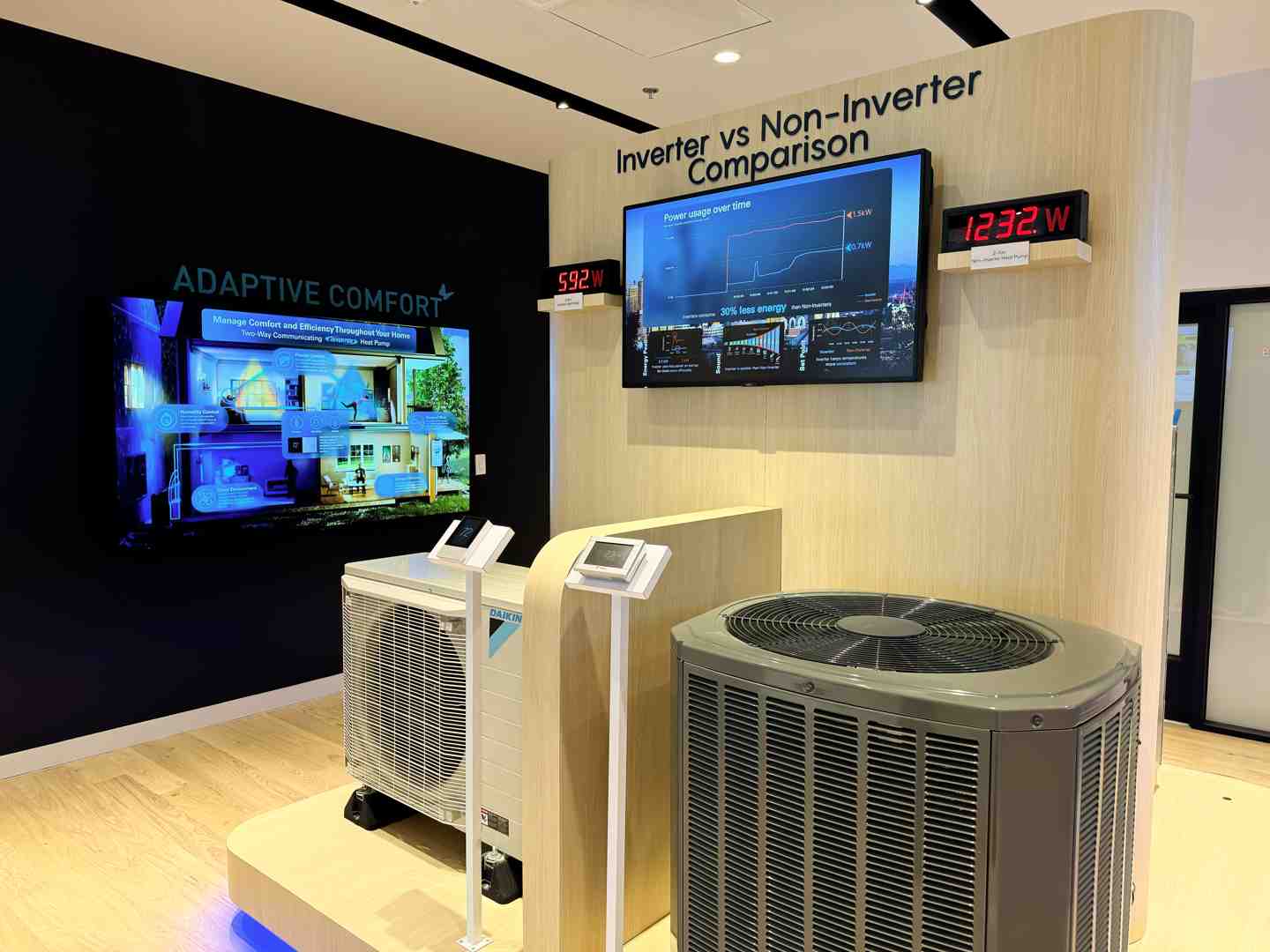
By changing the frequency of the electricity, we can change the RPM (revolutions per minute) of the motor. This is why we often use the cruise control analogy. While a traditional system "drag races" to the finish line and then slams on the brakes, an inverter system finds the perfect speed to maintain a steady pace. In May 2026, as efficiency standards continue to tighten in Washington, this ability to modulate motor speed is no longer just a luxury—it is the gold standard for mechanical durability.
How Inverter Technology Reduces Wear on Your Compressor
The most dangerous moment for any mechanical part is the moment it starts moving. In a traditional compressor, the "inrush current"—the initial surge of electricity needed to break the motor’s inertia—can be five to six times higher than the current used during normal operation. This creates a massive spike in heat and torque.
How inverter technology reduces wear on your compressor is primarily through the "soft start" process. Instead of an explosive burst of energy, the inverter gently ramps up the motor speed over several seconds. This eliminates the violent "clunk" you often hear from older outdoor units.
The Benefits of Continuous Operation
It might seem counterintuitive, but running a motor longer at a lower speed is actually better for it than turning it on and off repeatedly. Continuous operation ensures that:
- Vibration is controlled: High-speed starts create harmonic vibrations that can loosen refrigerant lines and fatigue metal brackets.
- Thermal stability: Frequent cycling causes components to heat up and cool down rapidly. This "thermal cycling" causes materials to expand and contract, eventually leading to cracks in seals or solder joints.
- Consistent Load: By matching the cooling load of your Seattle home in real-time, the compressor operates within its "sweet spot" rather than at its absolute mechanical limit.
| Feature | Traditional Fixed-Speed | Daikin Inverter Technology |
|---|---|---|
| Startup Torque | Extremely High (Instant) | Low (Gradual Ramp) |
| Vibration Levels | High during cycles | Minimal and steady |
| Motor RPM | 3,500 (Fixed) | Variable (e.g., 700 to 4,000) |
| Cycle Frequency | Frequent On/Off | Continuous/Modulated |
Why Traditional Compressors Experience Faster Mechanical Fatigue
Mechanical fatigue is the silent killer of HVAC systems. In the Pacific Northwest, where temperatures can fluctuate significantly between a sunny afternoon and a misty evening, a traditional system might cycle on and off 50 to 100 times a day. Each of those cycles is a mini-trauma for the hardware.
The abrupt halts are just as bad as the hard starts. When a traditional compressor shuts off, the high-pressure refrigerant in the system wants to equalize. This can cause the internal scroll or piston to "kick back" momentarily, putting reverse stress on the drive shaft. Inverter Technology Air Conditioners avoid this by slowing down gracefully, allowing pressures to stabilize before the motor stops entirely.
How inverter technology reduces wear on your compressor by eliminating cycling spikes
When a system cycles, it isn't just the motor that suffers. The entire electrical system experiences "cycling spikes." These are 100% capacity surges that strain the capacitors, contactors, and relays. Over time, these surges "pitting" the electrical contacts, leading to a system that eventually refuses to start at all. By operating at partial loads—often as low as 25% capacity—inverter systems keep the electrical current smooth and predictable, significantly extending the life of the control board and the motor windings themselves.
Protecting Critical Components with Variable Speed Control
The compressor is often called the "heart" of the HVAC system, but it relies on a complex network of "arteries" and "joints." Variable speed control provides a protective umbrella over these critical parts.
One of the biggest winners in an inverter system is the lubrication system. In a compressor, oil is mixed with the refrigerant to keep the bearings and seals lubricated. In a traditional system that shuts off frequently, the oil can settle in the bottom of the unit or get trapped in the refrigerant lines. When the system kicks back on, there is a split second where the bearings are moving without full oil pressure. Because an inverter system runs continuously, it maintains a steady flow of oil, ensuring that the "heart" is never running dry.
Furthermore, Daikin systems often pair inverter compressors with Electronic Expansion Valves (EEVs). Unlike older mechanical valves that are either open or closed, EEVs work in tandem with the inverter to meter refrigerant flow with surgical precision. This prevents "liquid slugging"—a dangerous condition where liquid refrigerant enters the compressor and causes immediate, catastrophic damage.
How inverter technology reduces wear on your compressor and internal seals
The internal seals of a compressor are designed to hold back high-pressure refrigerant. In a traditional system, the pressure ratio (the difference between the low-pressure and high-pressure sides) swings wildly every time the unit cycles. This puts constant "flex" stress on the seals. By maintaining a steady-state operation, inverter technology keeps these pressure ratios stable. This stability prevents the seals from hardening or cracking prematurely, which is a major factor in why Inverter systems outperform single-stage equipment.
Maximizing Durability in the Seattle Climate
In the Pacific Northwest, we don't just deal with heat; we deal with moisture. Seattle's humidity and the salt air near Puget Sound can be brutal on outdoor machinery. Traditional systems that cycle frequently tend to stay "cold" for longer periods during their off-cycles, which can lead to condensation building up on the compressor housing, inviting rust and corrosion.
Because inverter systems run for longer durations at lower speeds, they keep the internal components at a more consistent temperature. This helps evaporate surface moisture and keeps the internal cabinet drier. At our Daikin Experience Center in Seattle, we often show homeowners how Daikin’s specialized coatings and inverter logic work together to combat the unique environmental factors of King County.
Environmental Factors in Seattle Affecting Lifespan:
- High Humidity: Leads to corrosion on electrical contacts in cycling systems.
- Salt Air: Accelerates metal fatigue in units that vibrate excessively.
- Mild Shoulders Seasons: Causes "short-cycling" in traditional units, which is the fastest way to kill a compressor.
- Damp Winters: Inverter heat pumps provide much smoother defrost cycles, reducing the mechanical shock of switching between heating and cooling modes.
Frequently Asked Questions about Compressor Longevity
Can I retrofit an inverter to my existing non-inverter system?
Unfortunately, no. How inverter technology reduces wear on your compressor is integrated into the very design of the motor and the electronics. An inverter system requires a specialized Inverter Drive PCB (Printed Circuit Board) module, high-tech sensors to monitor pressure and temperature in real-time, and a motor specifically wound to handle variable frequencies. Attempting to "add" an inverter to a standard motor would likely cause the motor to overheat and fail almost instantly.
What are the common signs of compressor wear in traditional systems?
If you have a traditional unit in Tukwila or Seattle, watch for these "red flags":
- Hard Starting: If your lights flicker or you hear a loud "thump" when the AC kicks on, the compressor is struggling with inrush current.
- Frequent Breaker Trips: This often indicates that the motor windings are degrading and drawing too much power.
- Loud Vibrations: Rattling or buzzing usually means the internal mounts or bearings are wearing down from years of cycling.
Do inverter systems require different maintenance?
While the mechanical parts last longer, the electronics are more sophisticated. Maintenance for an inverter system focuses on ensuring electrical connections are tight and the heat sinks for the inverter board are clean. Because these systems are "smart," they can often provide error codes that allow a technician to fix a small electrical issue before it ever becomes a mechanical problem.
Conclusion
Choosing an HVAC system for your home in the Pacific Northwest is an investment in your future comfort and your property's value. By understanding how inverter technology reduces wear on your compressor, it becomes clear that the "old way" of heating and cooling—the constant hammering of on/off cycles—is simply not sustainable for long-term reliability.
Daikin inverter systems are engineered to provide a smoother, quieter, and more durable experience. By eliminating the violence of hard starts and the stress of constant cycling, these systems ensure that the "heart" of your home stays beating for years to come.
If you are ready to see the difference for yourself, visit us at our Tukwila location or Learn more about decarbonization and inverter technology to discover how we are bringing the next generation of comfort to Washington.
Schedule a Visit

your individual indoor comfort needs
products firsthand
with an authorized Daikin Dealer
.webp)
See why our customers Choose Us

“Jem is very inviting and knowledgeable. She gave us a walk through of the Daikin Experience Center and patiently answered all our questions. Learned a lot about HVAC’s through this visit.”
“Jem did a great job walking us through the various Daikin products and efficiencies of the products. She was very knowledgeable on everything Daikin. Highly recommend coming in for a tour prior to picking out your various AC systems.”
“Great experience at Daikin Seattle Experience Center: pre-purchase demos of home heating system (Daikin Fit), list of HVAC companies, working Daikin staff and external contractors to ensure highest quality. This experience sets the bar of how any home HVAC experience should be. Have got the Daikin Fit installed and so far seems to work very well – quiet, good home heating in peak winter (heat transfer/BTU/air handling); Functionality of Daikin thermostat and the iPhone app makes it very easy to use.”
“This place is awesome! If you are in the market for a new HVAC system, visit the Daikin Experience Center to get educated on the newest technology as well as available rebates and incentives for where you live. They’ll even connect you with local contractors in your area who install Daikin equipment.”
