

.webp)

.svg)


Ultimate Guide: How Daikin VRV Life Connects Multiple Indoor Units
How the Daikin VRV Life Connects Multiple Indoor Units to One Outdoor Unit — and Why It Matters for Seattle Homeowners
How the Daikin VRV Life connects multiple indoor units to one outdoor unit is simpler than it sounds: a single outdoor heat pump uses a network of refrigerant piping and smart communication wiring to independently control up to nine indoor zones — all at once, all from one compact unit in your yard.
Here is the quick version:
- One outdoor unit contains an inverter-driven compressor that varies refrigerant flow on demand
- Refrigerant lines branch out through RefNet joints to reach each indoor unit
- Electronic expansion valves at each indoor unit regulate exactly how much refrigerant enters that zone
- DIII-Net communication wiring daisy-chains all units together so each zone can call for heating or cooling independently
- Up to 9 indoor units — ducted, ductless, or a mix of both — can connect to a single outdoor unit
If you live in Seattle or the greater Pacific Northwest and you are tired of fighting over the thermostat, paying for conditioned air in empty rooms, or cramming multiple bulky outdoor condensers into a small yard, the Daikin VRV Life system was built to solve exactly those problems.
Traditional central air systems treat your whole home as one zone. That means one temperature for everyone, everywhere — and a lot of wasted energy heating or cooling rooms nobody is using. The VRV Life system changes that equation entirely by bringing commercial-grade Variable Refrigerant Volume (VRV) technology into residential homes, giving each room its own precise control without requiring multiple outdoor units or extensive new ductwork.
The sections below walk through exactly how the system works — from the refrigerant piping and wiring limits to the indoor unit options and dual-fuel flexibility that makes it especially well-suited to Seattle's climate.
What is the Daikin VRV Life System?
To understand how this system achieves its incredible flexibility, we first have to understand the technology behind it. VRV stands for Variable Refrigerant Volume. Developed and pioneered by Daikin in 1982, this technology allows an HVAC system to continuously vary the amount of refrigerant flowing to different indoor units based on the real-time heating or cooling needs of each individual room.
Traditional heat pumps and air conditioners operate on a simple, binary ON/OFF cycle. When the thermostat calls for cooling, the compressor kicks on at 100% capacity. Once the target temperature is reached, it shuts off completely. This constant starting and stopping consumes a massive amount of electricity, creates noticeable temperature swings, and places unnecessary wear and tear on the system.
For a deeper dive into how this commercial-grade technology was adapted for residential homes, you can read our guide on the Daikin VRV Life Residential System Explained.
At the heart of the VRV Life system is an advanced inverter-driven compressor. Think of an inverter compressor like the cruise control on your car. Instead of stomping on the gas pedal and then slamming on the brakes, the inverter adjusts its motor speed continuously to maintain a steady, highly efficient output. Because the system runs mostly at lower speeds (part-load conditions) rather than cycling on and off, it uses up to 30% less energy than standard non-inverter systems.
To learn more about the engineering principles of this technology, explore the Daikin VRV System overview.
Key Features of the Daikin VRV Life System:
- Multi-Zone Connectivity: Connects up to 9 indoor units to a single outdoor unit.
- Inverter Efficiency: Delivers exceptional seasonal efficiency with ratings up to 18.6 SEER.
- Quiet Operation: Runs at sound levels as low as 57 dB(A)—quieter than a standard household washing machine.
- Dual-Fuel Capability: The industry's first residential VRV system that can pair with a high-efficiency gas furnace.
- Wide Operating Range: Provides dependable heat pump operation in heating mode down to -4°F and cooling mode up to 122°F.
- Outstanding Warranty Protection: Backed by a 12-Year Parts Limited Warranty and a 12-Year Replacement Compressor Limited Warranty (requires online registration within 60 days of installation and annual professional maintenance).
How the Daikin VRV Life Connects Multiple Indoor Units to One Outdoor Unit
The physical and electronic connection between the outdoor condenser and your indoor units is where the magic of the VRV Life system happens. Instead of running a completely separate pair of refrigerant lines from the outdoor unit to every single indoor unit (which would require a massive, messy bundle of pipes running along the side of your home), the VRV Life system utilizes a highly streamlined, branching piping network.
For a comprehensive overview of how these physical connections are laid out, check out our article on How the Daikin Indoor and Outdoor Units Are Connected.
The system begins with a single main liquid line and a single main gas line leaving the outdoor unit. As these lines travel into your home, they are split into branches using precision-engineered RefNet joints. These Y-shaped branching joints are aerodynamically designed to distribute the liquid and gas refrigerant evenly and quietly, preventing the oil traps and refrigerant noise often associated with standard plumbing T-joints.
In some configurations, the refrigerant lines run through a branch provider (BP) box. The BP box acts as a central distribution hub, taking the main refrigerant lines and splitting them into individual runs that head directly to nearby indoor units. This branching architecture keeps your home’s exterior exceptionally clean, organized, and free of unnecessary pipe clutter.
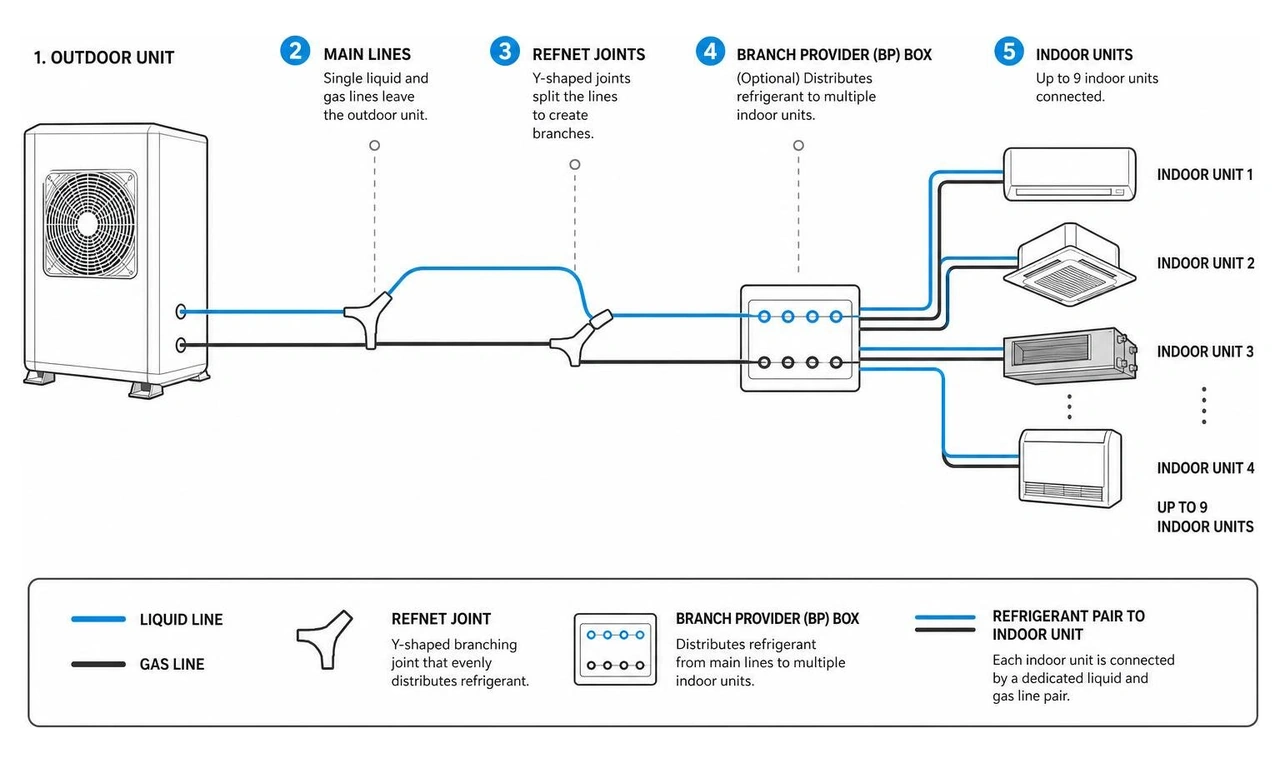
The Mechanics of How the Daikin VRV Life Connects Multiple Indoor Units to One Outdoor Unit
Connecting the refrigerant pipes is only half of the equation. To make sure the right amount of heating or cooling goes to the right room, the system relies on a sophisticated communication network and precise control valves.
1. DIII-Net Communication Wiring
Every indoor unit in a VRV Life system is linked back to the outdoor unit via a specialized, low-voltage control network called DIII-Net. This communication network uses a simple, 2-wire, 18 AWG, non-shielded, non-polarized cable. Instead of running separate wires from every single room thermostat all the way back to the outdoor unit, the control wiring is "daisy-chained" from one indoor unit to the next. This drastically simplifies the installation process and reduces wire clutter in your walls.
2. Electronic Expansion Valves (EEVs)
Inside every compatible Daikin indoor unit is an Electronic Expansion Valve (EEV). The EEV acts as a highly precise, electronically controlled gatekeeper. When you adjust the thermostat in your master bedroom, the indoor unit communicates its exact thermal load over the DIII-Net wire to the outdoor compressor. The outdoor unit instantly adjusts its inverter speed to supply the correct amount of refrigerant, while the EEV in your bedroom unit opens or closes in tiny increments to let in the exact amount of refrigerant needed to hit your target temperature. Meanwhile, the EEVs in unoccupied rooms remain closed or barely open, ensuring no energy is wasted on empty spaces.
Piping and Wiring Limits for Multi-Zone Connections
Because the VRV Life system uses a shared piping network, proper design and installation are critical to ensuring that refrigerant and compressor oil flow smoothly throughout the entire system. Daikin has established generous piping and wiring limits that make the VRV Life system incredibly versatile, even for multi-story homes or properties with unique layouts in Seattle.
| System Specification | Limit / Requirement |
|---|---|
| Maximum Number of Connected Indoor Units | Up to 9 units (depending on outdoor unit tonnage) |
| Connectible Indoor Unit Capacity Ratio | 50% to 130% of outdoor unit capacity |
| Maximum Total Network Piping Length | Up to 492 feet |
| Maximum Linear Piping Length (First Branch to Furthest IDU) | Up to 131 feet |
| Maximum Vertical Separation (Outdoor Unit Above Indoor Units) | Up to 98 feet |
| Maximum Vertical Separation (Indoor Unit to Indoor Unit) | 33 to 49 feet (depending on model) |
| Control Wiring Specification | 18 AWG, 2-conductor, stranded, non-shielded, non-polarized |
| Maximum Control Wiring Length | 984 feet (linear distance from outdoor unit to furthest indoor unit) |
By keeping the sum of the capacity indexes of the connected indoor units between 50% and 130% of the outdoor unit's capacity (known as the Connection Ratio), we can design a system that is perfectly optimized for your home's actual heating and cooling loads.
Benefits of Connecting Multiple Indoor Units to One Outdoor Unit
Consolidating your home's entire climate control network into a single outdoor unit offers massive advantages over traditional multi-split systems or multiple single-zone systems.
To understand how these advantages translate to daily comfort, read our detailed breakdown of How Multi-Zone HVAC Systems Work.
- Reclaim Your Outdoor Living Space: Traditional multi-zone setups often require installing three, four, or even more outdoor condensing units. This clutters your yard, ruins your landscaping, and creates a wall of noise. The VRV Life system replaces up to 75% of that outdoor footprint with a single, slim-profile, side-discharge outdoor unit that can be tucked away neatly against an exterior wall or on a side path.
- Peace and Quiet: Traditional top-discharge condensers can run at sound levels up to 73 dB(A)—loud enough to disrupt a backyard barbecue or annoy your neighbors. Because the VRV Life outdoor unit utilizes a highly efficient swing compressor and runs mostly at whisper-quiet part-load speeds, it operates as low as 57 dB(A). That is quieter than a normal conversation!
To explore how these benefits create a more peaceful home, see how the Daikin Multi-Zone Ductless System for Whole-Home Comfort elevates residential living.

Individual Zone Control and Energy Savings
Perhaps the greatest benefit of the VRV Life system is its ability to put an end to "thermostat wars" once and for all. Because each indoor unit operates on its own dedicated zone with its own thermostat or remote controller, family members can customize the temperature in their own spaces without affecting the rest of the house.
This level of zoning control leads to incredible energy savings. In a typical household, several rooms—such as guest bedrooms, formal dining rooms, or home offices—sit empty for hours at a time. With VRV Life, you can simply set those unoccupied zones to an energy-saving setback temperature, or turn them off entirely.
Furthermore, because up to 75% to 80% of the energy used to heat your home is extracted from the ambient outdoor air (consuming just 1 kW of electricity for every 4 kW of heat generated), the system is remarkably sustainable. You can also integrate optional intelligent presence and floor sensors that automatically switch an indoor unit to an energy-saving mode if a room remains unoccupied for more than 20 minutes, ensuring you never pay to condition empty air.
Compatible Indoor Units and Dual-Fuel Integration
The VRV Life system is compatible with 12 different types and over 65 models of Daikin indoor units, allowing us to mix and match styles to fit the exact aesthetic and structural layout of your home.
Compatible Indoor Unit Types Include:
- Wall-Mounted Units: The most popular and economical option, ideal for rooms without ceiling space or existing ductwork.
- Slim Duct (Concealed Ducted) Units: Hidden entirely within ceiling voids or closets, delivering air through subtle grilles to preserve your interior design.
- Vista Cassette Units: Fit flush into a standard ceiling grid, offering multi-directional airflow and a clean, modern look.
- Floor-Standing Units: Perfect for attic spaces with low knee-walls or rooms with large windows where wall space is limited.
- Multi-Position Air Handlers: Ideal for replacing an existing central furnace while utilizing your home's current ductwork.
Understanding How the Daikin VRV Life Connects Multiple Indoor Units to One Outdoor Unit with Dual-Fuel Systems
One of the most aspects of the VRV Life system is its ability to operate as a dual-fuel hybrid system. In the Pacific Northwest, winter temperatures can occasionally drop below freezing. While Daikin's heat pumps are incredibly efficient down to -4°F, burning natural gas can sometimes be more cost-effective during extreme cold snaps.
The VRV Life system allows us to pair the outdoor heat pump with a highly efficient (80% to 97% AFUE) Daikin communicating gas furnace and a compatible A-coil.
During mild winter days, the system runs in highly efficient heat pump mode, extracting heat from the outdoor air. If the outdoor temperature drops below a specific, user-configurable changeover point, the system automatically switches to gas furnace heating to keep your home cozy and warm.
When configuring a dual-fuel setup alongside traditional ductless VRV indoor units, we install a specialized liquid receiver tank (model BHL-02A) to manage the refrigerant volume properly, ensuring seamless operation across both ducted and ductless zones.
Frequently Asked Questions About VRV Life Connections
How many indoor units can be connected to one VRV Life outdoor unit?
Depending on the size and capacity of your outdoor unit (available in 2, 3, 4, and 5-ton models), you can connect between 4 and 9 indoor units. The total capacity of all connected indoor units must fall between 50% and 130% of the outdoor unit's nominal capacity, allowing for excellent design diversity based on how you use your home.
What is the role of the branch selector or branch provider box?
The branch provider (BP) box acts as an intermediate refrigerant distribution hub. It receives the main liquid and gas lines from the outdoor unit and splits them into individual runs that connect directly to nearby indoor units. The BP box contains electronic expansion valves that regulate the flow of refrigerant to each connected zone based on thermostat demands, ensuring quiet and balanced distribution.
Can I reuse existing refrigerant piping for a VRV Life installation?
Yes! The VRV Life system is uniquely designed with retrofit flexibility in mind. In many cases, it can be configured to reuse existing main liquid and gas line sets from a previous HVAC system, provided they are thoroughly cleaned, pressure-tested, and meet the specific sizing and insulation criteria outlined in the technical manual. This can save a significant amount of time and labor during a home renovation.
Conclusion
The Daikin VRV Life system completely redefines home comfort by bringing commercial-grade multi-zone technology, whisper-quiet operation, and dual-fuel flexibility to residential properties. By connecting up to nine diverse indoor units to a single, compact outdoor unit, it eliminates backyard clutter, puts an end to thermostat wars, and slashes your monthly energy bills.
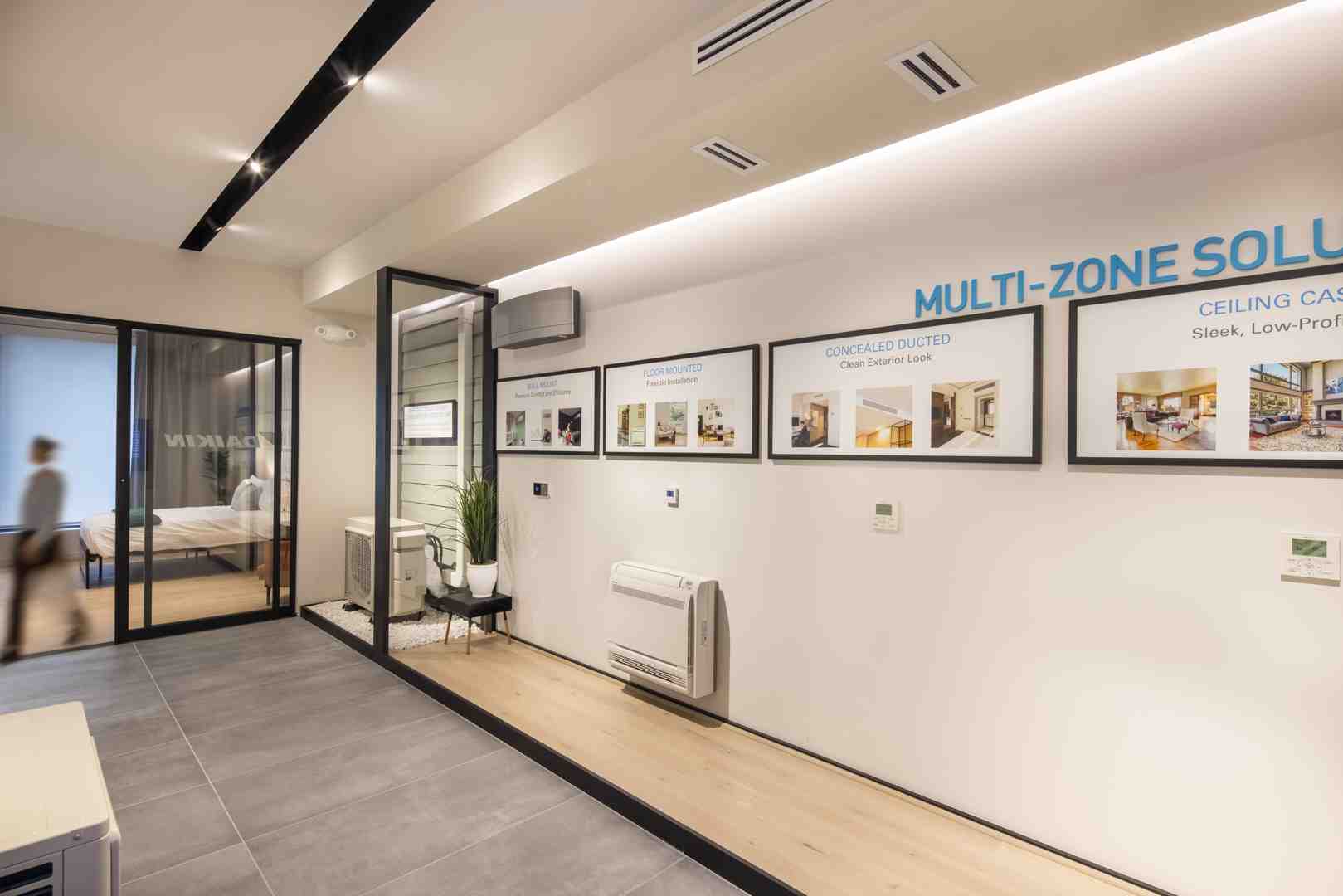
At Daikin (Seattle), we specialize in designing and installing custom VRV Life systems tailored perfectly to the unique climate of Washington and the Pacific Northwest. If you are ready to see this technology in action, we invite you to visit our unique Pacific Northwest Daikin Experience Center in Seattle. Here, you can interact with working models, experience the whisper-quiet decibel levels firsthand, and speak with our local experts to design the ultimate climate control system for your home.
Ready to transform your home's comfort? Explore Daikin Solutions with us today!
Schedule a Visit

your individual indoor comfort needs
products firsthand
with an authorized Daikin Dealer
.webp)
See why our customers Choose Us

“Jem is very inviting and knowledgeable. She gave us a walk through of the Daikin Experience Center and patiently answered all our questions. Learned a lot about HVAC’s through this visit.”
“Jem did a great job walking us through the various Daikin products and efficiencies of the products. She was very knowledgeable on everything Daikin. Highly recommend coming in for a tour prior to picking out your various AC systems.”
“Great experience at Daikin Seattle Experience Center: pre-purchase demos of home heating system (Daikin Fit), list of HVAC companies, working Daikin staff and external contractors to ensure highest quality. This experience sets the bar of how any home HVAC experience should be. Have got the Daikin Fit installed and so far seems to work very well – quiet, good home heating in peak winter (heat transfer/BTU/air handling); Functionality of Daikin thermostat and the iPhone app makes it very easy to use.”
“This place is awesome! If you are in the market for a new HVAC system, visit the Daikin Experience Center to get educated on the newest technology as well as available rebates and incentives for where you live. They’ll even connect you with local contractors in your area who install Daikin equipment.”
