

.webp)

.svg)


Seattle, WA Air Quality in July & Your Daikin
The Sudden Shift: Navigating Seattle's Mid-Summer Air Quality Plunge
Your air conditioner is running nonstop to beat the Pacific Northwest heat, but the air inside your home suddenly feels heavy, stale, and difficult to breathe. In our years of serving the Tukwila and greater Seattle area, our team at Daikin Seattle has learned that understanding exactly why Seattle air quality plummets in July and how your Daikin system responds is critical for maintaining a healthy home environment during peak summer. Peak July heat frequently brings sudden, unexpected drops in outdoor air quality across the Puget Sound, leaving many homeowners wondering why their indoor air triggers allergies despite keeping all the windows tightly shut.
To combat these invisible airborne threats, you need a comprehensive approach to indoor air quality. Relying on advanced, automated technology like Daikin indoor environmental quality solutions takes the guesswork out of managing your home's envelope during these severe meteorological shifts.
The stagnation problem: The solution to this mid-summer discomfort lies in understanding local meteorology and relying on automated smart sensor technology to manage the air you breathe. When July summer inversion layers settle over the region, the atmospheric stagnation traps pollutants close to the ground. Modern, high-efficiency HVAC systems are engineered to detect these invisible threats instantaneously. Instead of requiring the homeowner to constantly monitor outdoor conditions and guess the correct fan settings, intelligent systems actively monitor the indoor environment, scrubbing the air before particulate matter can compromise your family's comfort.
Why Is Seattle Air Quality Bad Today? The Anatomy of a Summer Inversion
When you check your local weather app on a hot July afternoon and see a sudden spike in the Air Quality Index (AQI), you might assume a distant fire has started. However, our technicians frequently explain to homeowners that the true culprit is often a localized meteorological event. High-pressure ridges in July trap cooler air at the surface, acting as an atmospheric lid over the Seattle/Tukwila WA region. Because the Cascade and Olympic mountain ranges create a natural geographical basin, this high-pressure lid effectively prevents normal wind dispersion from clearing the air.
The accumulation of pollutants: Under this atmospheric lid, everyday emissions have nowhere to go. Ground-level ozone, vehicle exhaust from the I-5 corridor, and early-season particulate matter accumulate rapidly. Unlike the thick, visible late-summer wildfire smoke that arrives in August or September, these July inversions are driven purely by regional heat and topography. They catch many residents completely off guard because the sky may still look relatively clear, even as the air becomes increasingly toxic to breathe.
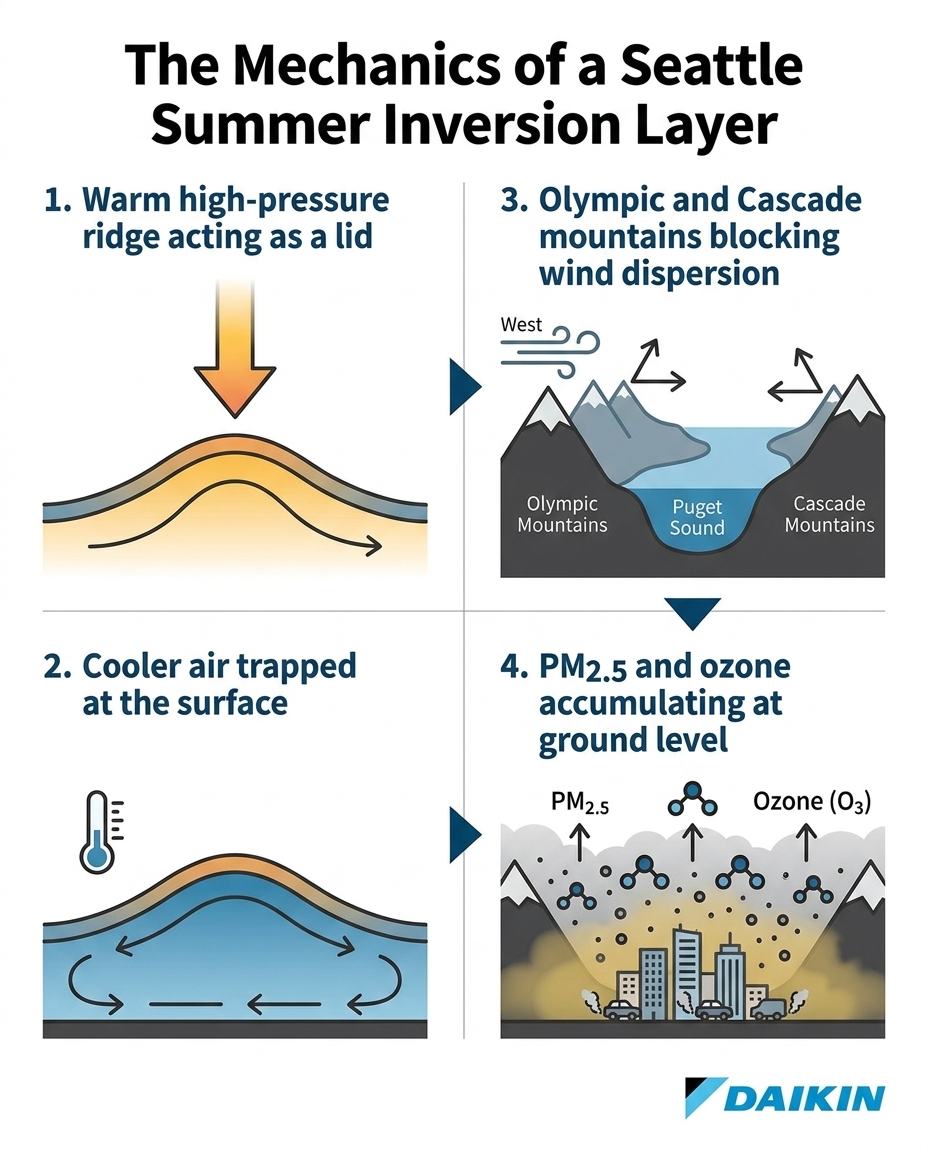
The Puget Sound "Lid" Effect
Warm air aloft creates an impenetrable barrier for surface emissions. Local Puget Sound Clean Air Agency data consistently shows how quickly the AQI can degrade during these specific high-pressure windows. Within a matter of hours, a perfectly healthy morning can turn into an afternoon where sensitive groups are advised to stay indoors.
• Primary Cause — July Summer Inversion: High-pressure heat ridges trapping daily local emissions — Late-Summer Wildfire Smoke: Distant or regional forest fires blowing into the basin
• Visibility — July Summer Inversion: Often clear or slightly hazy; invisible ground-level ozone — Late-Summer Wildfire Smoke: Thick, visible gray or orange smoke blocking the sun
• Onset Speed — July Summer Inversion: Gradual buildup over a few hot days — Late-Summer Wildfire Smoke: Can roll in suddenly with shifting wind patterns
• Primary Pollutants — July Summer Inversion: VOCs, ground-level ozone, trapped vehicle exhaust — Late-Summer Wildfire Smoke: Heavy PM2.5 (fine particulate matter) and ash
How Outdoor Stagnation Penetrates Your Home's Envelope
No home is perfectly airtight. Houses naturally breathe, inevitably pulling in stagnant outdoor air through microscopic gaps around windows, doors, foundations, and through mechanical ventilation systems. When July summer inversion layers blanket the neighborhood, the pressure differences between the hot exterior and your air-conditioned interior actively draw this polluted air inside.
The failure of basic filtration: Fine particulate matter (PM2.5) and volatile organic compounds (VOCs) easily bypass standard, basic one-inch fiberglass HVAC filters. These basic filters are designed solely to protect the furnace blower motor from large debris like pet hair and heavy dust—they do absolutely nothing to stop microscopic ozone or exhaust fumes from circulating through your ductwork.
During our peak-summer service calls throughout Tukwila, we consistently notice the immediate impact on indoor comfort. Even if the pollutants themselves are invisible, you may experience:
• Lingering odors: Cooking smells or pet odors that refuse to dissipate because the air is stagnant.
• Stale, heavy air: A general feeling of stuffiness in the home, despite the air conditioner running constantly.
• Respiratory irritation: Sudden flare-ups of asthma, unexplained coughing, or itchy eyes while sitting in your living room.
• Excessive dust: A sudden accumulation of fine, dark dust on hard surfaces near air vents.
Addressing this infiltration requires more than just keeping your windows tightly closed and hoping for the best. It requires active, whole-home management. Implementing robust whole house HVAC solutions ensures that the air being pulled into your home is actively scrubbed, purified, and conditioned before it ever reaches your living spaces.
Real-Time Detection: How Daikin System Sensors Respond
When the outdoor air quality drops rapidly, your indoor system needs to react just as fast. This is where Daikin One+ smart thermostats and their integrated sensor ecosystems completely change the game for homeowners. These proprietary Daikin system sensors continuously monitor indoor levels of PM2.5, VOCs, and carbon dioxide (CO2) in real-time, scanning the environment 24/7.
As a dedicated Daikin dealer serving the Pacific Northwest, our installation team at Daikin Seattle understands exactly how to configure Daikin's proprietary IAQ sensors to automatically respond to these sudden local air quality changes. When inversion-layer pollutants infiltrate the home's envelope, instantaneous detection occurs. The system doesn't wait for a scheduled cycle; it acts the moment the threshold is breached.
The automated response sequence:
1. Detection: The integrated sensors register a spike in microscopic particulate matter or VOCs entering the home.
2. Communication: The thermostat communicates directly with the variable-speed blower motor and the advanced filtration system.
3. Mitigation: The system automatically ramps up the fan speed to push more air through the high-efficiency media filters and purifiers, actively scrubbing the air.
4. Confirmation: Visual indicators on the Daikin One+ interface shift colors, providing homeowners with immediate, easy-to-read confirmation that the air is actively being cleaned.
Integrated vs. Standalone Monitoring
Many homeowners try to solve air quality issues by purchasing standalone room purifiers. While helpful in a single bedroom, they cannot protect the entire house. Integrated HVAC sensors outperform standalone room monitors because they command the home's central respiratory system. There is seamless communication between detection and mechanical mitigation. If you are researching the best air quality monitors for Seattle, it is critical to understand that a monitor that only beeps to warn you of bad air is far inferior to a sensor that actually triggers your home's central system to fix the problem automatically.
Trusting the Automation: Why Manual Overrides Are Unnecessary
When the air inside feels heavy during a heatwave, a homeowner's first instinct is often to walk over to the thermostat and manually crank the fan to "ON" or aggressively drop the temperature setting. While this psychological urge to take control is understandable, we always caution our customers that manual adjustments can actually make the situation worse.
The danger of manual overrides: Manually forcing your HVAC fan to run continuously at high speed without the compressor running can inadvertently pull in more unconditioned, polluted outdoor air through microscopic leaks in your ductwork. If the system isn't actively cooling and dehumidifying, running the fan constantly can also re-evaporate moisture from the evaporator coil back into the house, making the air feel even more clammy and stagnant.
Automated adjustments by the smart system provide superior, energy-efficient filtration without disrupting your thermal comfort. The Daikin system sensors use complex algorithms to determine exactly how much airflow is needed to scrub the air through the filtration media without overworking the blower motor or compromising the indoor humidity levels.
• Fan Operation — Manual Thermostat Override: Runs constantly at one speed, wasting energy. — Automated Daikin Sensor Response: Variable speed adjusts dynamically based on real-time pollution levels.
• Air Infiltration — Manual Thermostat Override: Can create negative pressure, pulling in more outdoor pollutants. — Automated Daikin Sensor Response: Balances airflow to maintain neutral pressure and maximize filtration.
• Humidity Control — Manual Thermostat Override: Often re-introduces moisture, causing a clammy feeling. — Automated Daikin Sensor Response: Maintains strict humidity parameters while scrubbing the air.
• Peace of Mind — Manual Thermostat Override: Requires constant monitoring and guessing by the homeowner. — Automated Daikin Sensor Response: Hands-free operation; the system handles the threat automatically.
Allowing the system's algorithm to dictate fan speed and filtration cycles ensures optimal protection during the inversion. Trusting the technology means you get maximum air purification precisely when you need it, and maximum energy efficiency when the air quality returns to normal.
Frequently Asked Questions About Seattle Summer Air Quality and HVAC Responses
Why is Seattle air quality bad today during the summer?
Poor summer air quality in Seattle is frequently caused by high-pressure weather systems that create temperature inversions. These inversions act like a lid over the Puget Sound basin, trapping daily emissions, vehicle exhaust, and ground-level ozone close to the surface. Because the Olympic and Cascade mountains block the wind, these pollutants cannot disperse, leading to rapid drops in the Air Quality Index even on seemingly clear days.
Does Seattle get inversion layers in July?
Yes, July is a prime month for summer inversion layers in the Seattle and Tukwila WA areas. As peak summer heat sets in, strong high-pressure ridges frequently stall over the Pacific Northwest. This meteorological pattern traps cooler air at the surface beneath a layer of warmer air aloft, creating the perfect conditions for stagnant air and poor local air quality.
How do Daikin air sensors detect poor indoor air quality?
Daikin air sensors utilize advanced optical and chemical monitoring technology to continuously sample the air inside your home. They are specifically calibrated to detect microscopic particulate matter (PM2.5), volatile organic compounds (VOCs), and carbon dioxide levels in real-time. When these sensors detect a spike in pollutants, they immediately send a signal to the Daikin One+ smart thermostat to trigger the system's air purification protocols.
What causes poor air quality in Washington when there are no wildfires?
When there are no active wildfires, poor air quality in Washington is primarily driven by ground-level ozone and trapped urban particulate matter. Hot, sunny days combined with stagnant atmospheric conditions cause vehicle exhaust and industrial emissions to bake in the heat, forming smog. This localized pollution builds up rapidly when high-pressure systems prevent normal wind patterns from clearing the basin.
Should I manually run my HVAC fan during a summer inversion?
We typically advise against it. It is generally better to let a smart, automated HVAC system manage the fan rather than manually forcing it to run continuously. Manually running the fan can sometimes create pressure imbalances that actually pull more polluted outdoor air into the home through tiny leaks. A smart system equipped with IAQ sensors will automatically adjust variable fan speeds to optimize filtration without compromising your home's internal pressure or humidity levels.
Secure Your Indoor Environment Before the Next July Inversion
Summer inversions are a predictable, recurring reality for the Puget Sound region. As the July heat approaches, the atmospheric stagnation over the basin is inevitable, but compromised indoor air quality is not. Your automated system is specifically designed to handle these sudden meteorological shifts, provided it is properly maintained and calibrated for the season.
Don't wait until the outdoor air is already thick with trapped pollutants and your family is experiencing respiratory discomfort. Schedule a comprehensive inspection with our Tukwila-based technicians to ensure your sensors, blower motors, and high-efficiency filtration media are ready for peak summer stagnation. Upgrading to Daikin indoor environmental quality solutions guarantees that when July summer inversion layers strike, your home will automatically detect, react, and protect the air you breathe without you ever having to lift a finger.
Schedule a Visit

your individual indoor comfort needs
products firsthand
with an authorized Daikin Dealer
.webp)
See why our customers Choose Us

“Jem is very inviting and knowledgeable. She gave us a walk through of the Daikin Experience Center and patiently answered all our questions. Learned a lot about HVAC’s through this visit.”
“Jem did a great job walking us through the various Daikin products and efficiencies of the products. She was very knowledgeable on everything Daikin. Highly recommend coming in for a tour prior to picking out your various AC systems.”
“Great experience at Daikin Seattle Experience Center: pre-purchase demos of home heating system (Daikin Fit), list of HVAC companies, working Daikin staff and external contractors to ensure highest quality. This experience sets the bar of how any home HVAC experience should be. Have got the Daikin Fit installed and so far seems to work very well – quiet, good home heating in peak winter (heat transfer/BTU/air handling); Functionality of Daikin thermostat and the iPhone app makes it very easy to use.”
“This place is awesome! If you are in the market for a new HVAC system, visit the Daikin Experience Center to get educated on the newest technology as well as available rebates and incentives for where you live. They’ll even connect you with local contractors in your area who install Daikin equipment.”
