

.webp)

.svg)


How Daikin Air Purification Technology Works: Top Guide for Seattle Homes
Why Understanding How Daikin Air Purification Technology Works Matters for Seattle Homeowners
How Daikin air purification technology works is something more Seattle homeowners are asking about - and for good reason. Indoor air can be up to five times more polluted than outdoor air, yet most of us spend around 90% of our time inside.
Here's a quick answer before we dive deeper:
How Daikin air purification technology works - at a glance:
- Capture - A prefilter and electrostatic HEPA filter trap particles as small as 0.1 microns, including dust, pollen, mould spores, bacteria, and viruses
- Decompose - Daikin's patented Streamer technology fires high-speed electrons at captured pollutants, breaking them down through oxidation
- Deodorize - A dedicated deodorizing filter absorbs and eliminates odors, including formaldehyde and other volatile compounds
- Disinfect (select models) - UV-LED technology at 265nm irradiates captured viruses and bacteria, destroying their genetic material and suppressing 99% of viruses in just 30 minutes
If you live in Seattle, where damp conditions encourage mould growth and allergy seasons can hit hard, clean indoor air isn't a luxury - it's a health priority. Daikin's multi-layer approach goes well beyond a standard filter, combining mechanical capture with active decomposition to deliver air that is genuinely cleaner, not just filtered.
This guide breaks down every layer of that technology in plain language, so you know exactly what's happening inside your air purifier.
How Daikin Air Purification Technology Works: The Catch-and-Clean Process
Many air purifiers rely on a simple "trap only" method. They pull air through a filter, and the pollutants stay there until the filter is replaced. Daikin takes a different approach called "Catch-and-Clean." This process ensures that once a pollutant is caught, it is actively neutralized.
Daikin units often feature a unique vertical structure. This design enables powerful suction from three directions, allowing for faster air purification even in large rooms. By pulling air in from the bottom and sides, the unit can capture dust and allergens that settle near the floor - a major benefit for families with small children or pets.
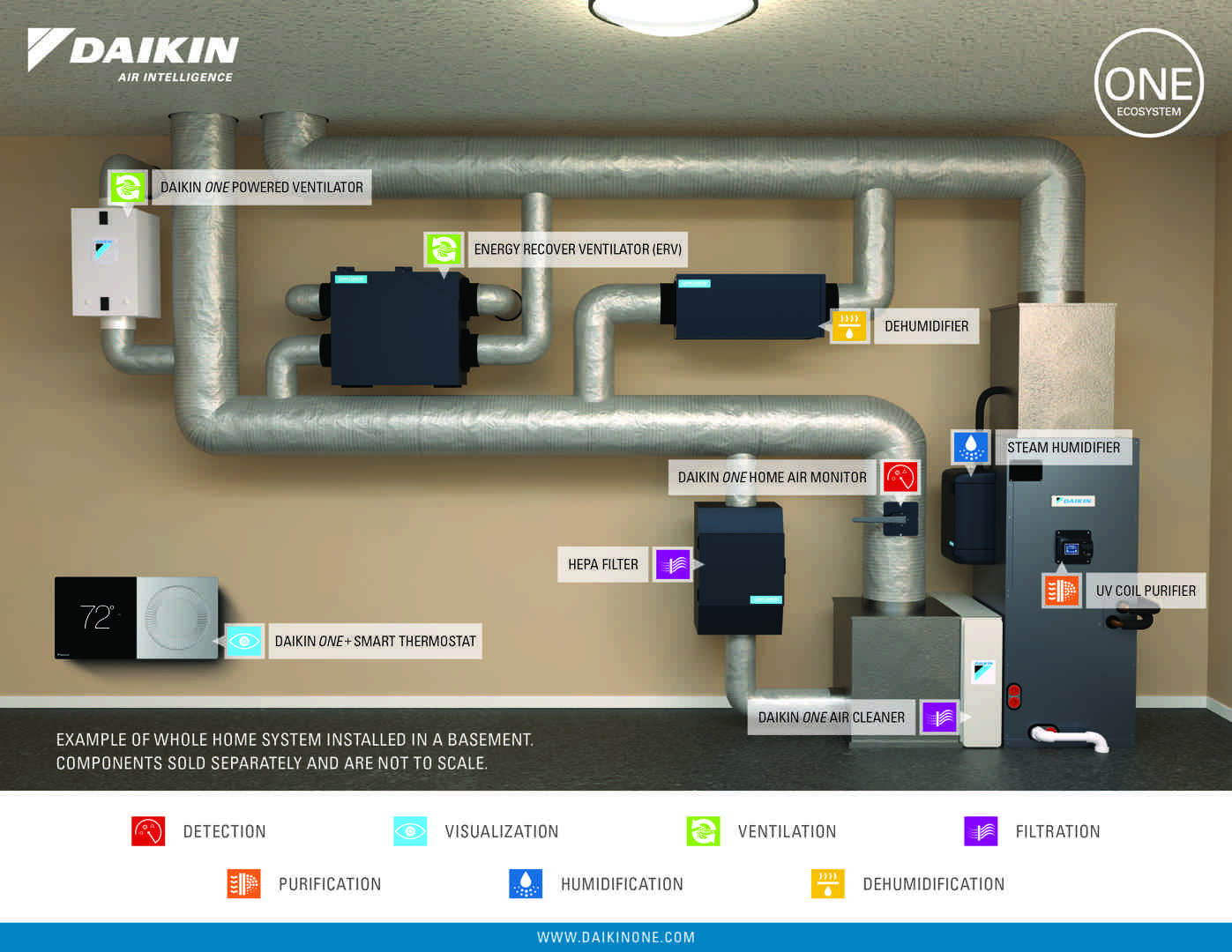
How Daikin air purification technology works step by step
To understand the journey of a single dust particle or virus, let's follow the airflow path through a Daikin unit:
- Powerful Suction: Air is drawn into the unit through large intakes.
- Prefilter Capture: Large particles like pet hair and house dust are trapped here.
- Electrostatic Charging: In many models, a plasma ionizer gives dust and pollen an electrical charge.
- HEPA Filtration: The charged particles are then pulled toward the electrostatic HEPA filter. Because they are electrically attracted to the filter fibers, they don't clog the mesh as quickly as they would in a standard filter.
- Streamer Decomposition: This is where the process becomes more advanced. The Streamer discharge hits the captured substances on the filter, breaking them down at a molecular level.
- Deodorization: Any remaining odors are absorbed by a specialized filter that is constantly "refreshed" by the Streamer technology.
- Clean Air Delivery: Purified, healthy air is released back into your Seattle home.
Why Daikin combines filtration with Streamer discharge
The combination of mechanical filtration and Streamer discharge is what makes this approach different. While the HEPA filter is incredibly efficient at capturing 99.97% of fine particles, it doesn't "kill" bacteria or "neutralize" chemicals on its own.
By adding Streamer technology, Daikin uses high-speed electrons to create a plasma discharge. This discharge has an oxidative power 1,000 times greater than standard plasma discharges. It doesn't just hold the pollutants on the filter; it decomposes them. This process also helps in filter regeneration, meaning the deodorizing capacity lasts much longer than traditional carbon filters. To learn more about how this specific mechanism tackles health threats, see How Daikin Air Purification Reduces Allergens, Pollutants and Pathogens.
Streamer Technology Explained: What It Is and What It Removes
If you've spent any time researching Daikin products, you've likely seen the term "Streamer Technology." It is a flagship purification feature, developed to provide a level of decomposition that filters alone cannot reach.
What is Daikin's Streamer technology?
Streamer technology is a type of plasma discharge that generates high-speed electrons. These electrons collide with nitrogen and oxygen molecules in the air to create four powerful oxidative elements. These elements are capable of oxidative decomposition, which effectively breaks apart the proteins and chemical bonds of harmful substances.
What makes it unique is its stability and range. While general plasma discharge can be difficult to control, Daikin created a wide-range discharge that stays active over a larger surface area of the filter, helping support comprehensive cleaning.
How daikin air purification technology works against allergens, mould, and odors
In the Pacific Northwest, homeowners deal with a unique mix of indoor pollutants. Between seasonal pollen and year-round moisture that can lead to mould, indoor air quality can become a real concern. How Daikin air purification technology works against these specific threats involves a three-step process often described as "Clash, Cycle, Clean":
- Clash: The Streamer discharge hits the allergens and hazardous chemicals, fragmenting their surface proteins.
- Cycle: The deodorizing filter absorbs the odors, which are then decomposed by the Streamer to maintain the filter's absorbing power.
- Clean: Bacteria and mould are removed from the filters and the humidifying water (in humidifying models), helping prevent any "re-pollution" of the air.
This process is highly effective at removing formaldehyde, mite allergens, and stubborn kitchen or pet odors.
Proven performance of Streamer technology
These results are backed by testing. Here are some key statistics regarding the effectiveness of Streamer technology:
- Viruses: Removes 99.98% of human coronavirus HCoV-229E and 99.93% of Influenza A (H1N1) in just 2.5 minutes at turbo speed.
- Pollen: Decomposes and removes more than 99.6% of pollen in 2 hours.
- Mould: Decomposes and removes more than 99.9% of mould spores within 24 hours.
- Allergens: Eliminates more than 99.61% of common household allergens in 24 hours.
- Bacteria: Reduces bacteria on the dust collection filter by more than 99% in 2.5 hours.
UV-LED and Filtration: How Daikin Suppresses Viruses and Fine Particles
In May 2026, there is even more demand for medical-grade protection in residential spaces. To meet this, Daikin has integrated UV-LED technology into its air purification lineup.
How daikin air purification technology works with UV-LEDs
While Streamer technology uses electrons to decompose substances, the UV-LED system uses light at a specific wavelength - approximately 265nm (UVC). This specific wavelength is the "sweet spot" for damaging the genetic information (DNA and RNA) of viruses and bacteria.
When a pathogen is captured on the HEPA filter, the UV-LED irradiates it. Because the pathogens cannot reproduce or function without their genetic code, they are effectively inactivated. This technology allows Daikin units to suppress 99% of viruses in only 30 minutes.
What filtration systems Daikin uses in its air purifiers
Daikin purifiers use a multi-stage approach to help ensure particles and odors are addressed:
- Prefilter: Catching the larger particles like dust and hair.
- Electrostatic HEPA Filter: This is the heart of the unit. It captures 99.97% of fine particles of 0.3 microns. Because it uses static electricity, it is less likely to clog, maintaining high airflow for longer.
- Deodorizing Filter: Uses a catalyst to absorb and break down odors.
- Humidifying Filter (on select models): Adds moisture to the air while using Streamer technology to help keep the water and filter free of bacteria.
Particle, bacteria, and odor removal performance
The effectiveness of these combined systems is significant. Here is a quick comparison of how these technologies work together:
| Technology | Primary Role | Target Pollutants |
|---|---|---|
| Electrostatic HEPA | Capture | Dust, PM2.5, Pollen, Pet Dander |
| Streamer Discharge | Decompose | Viruses, Mould, Odors, Formaldehyde |
| UV-LED (265nm) | Inactivate | Viruses, Bacteria, Pathogens |
| Activated Carbon | Adsorb | Volatile Organic Compounds (VOCs), Smells |
Daikin units are tested to remove 99% of particles between 0.1 microns and 2.5 microns in size, helping address even very small pollutants.
Safety, Maintenance, and Filter Life
A common concern when discussing UV light and plasma discharge is safety. Daikin air purifiers are designed with safety standards in mind to help protect your household.
How Daikin air purifiers prevent UV light leakage and protect indoor safety
UV light is invisible and can be harmful if humans are directly exposed. To prevent this, Daikin uses a sealed housing design. The UV-LEDs are positioned inside the unit, specifically aimed at the filter. The unit also uses specialized exhaust grilles that help prevent light from escaping. In addition, the systems undergo internal testing to support compliance with international safety standards regarding UV leakage. You get the benefits of advanced disinfection without direct exposure.
What maintenance is required and how long filters last
Daikin designs these components for long service life:
- Electrostatic HEPA Filter: In many premium models, the HEPA filter is designed to last up to 10 years before needing replacement.
- UV-LED: The UVC LED light has a 10+ year lifetime, meaning it typically does not need frequent replacement.
- Prefilter: This should be vacuumed or washed periodically to maintain airflow.
- Carbon/Deodorizing Filter: While some models feature 10-year filters, others may require a change every 1-2 years depending on usage and odor levels in the home.
What homeowners should know about day-to-day operation
For the best results in your Seattle home, AUTO mode is often the easiest choice. In this setting, the unit uses built-in sensors to detect dust, odors, and PM2.5 levels, adjusting the fan speed automatically. If you're cooking or cleaning, Turbo mode can clear the room quickly. For the bedroom, Daikin units can operate at just 19 dBA in Quiet mode - quieter than a rustling leaf.
Smart Controls, Air Monitoring, and Whole-Home Integration
Modern air purification is not just about the hardware; it's also about the data. Daikin makes it easier to see changes in indoor air quality.
How Daikin shows air quality in real time
Many Daikin units feature the DAIKIN EYE. This is a color-coded visual indicator that gives you an instant update on your indoor air quality:
- PM2.5 Sensor: Tracks fine particulate matter.
- Odor Sensor: Detects VOCs and smells.
- Humidity Sensor: Monitors moisture levels to help prevent dryness or mould-friendly conditions.
The display changes color, typically from blue to red, to show you when the unit is working harder to clean the air.
How Daikin air purifiers integrate with smart controls
If you have a Daikin system in your Seattle home, your air purifier can be part of a larger ecosystem. Using the Onecta App, you can monitor your air quality from your phone, set schedules, and adjust modes remotely.
For a more complete solution, the Daikin One IAQ system can monitor and actively improve your air across your entire home. To see how these systems work together, check out these resources:
- How the Daikin IAQ System Monitors and Actively Improves Your Air
- Daikin Indoor Air Quality System Benefits Guide
- Improve Air Quality with Daikin Ductless
- Daikin One Indoor Air Quality Guide Kent WA
Frequently Asked Questions About How Daikin Air Purification Technology Works
Is Daikin effective against viruses, bacteria, allergens, and odors?
Yes. As shown in lab results, Daikin's "Catch-and-Clean" approach removes 99.98% of certain coronaviruses in minutes and eliminates over 99.6% of pollen and mould. The combination of HEPA, Streamer, and UV-LED technologies addresses a wide range of indoor pollutants.
Do Daikin air purifiers emit ozone?
No. Daikin room air purifiers are designed to be ozone-free. The Streamer and UV technologies are contained within the unit and are engineered to meet strict safety standards for indoor use.
Are Daikin air purifiers good for bedrooms and living spaces?
Absolutely. With a sound pressure level as low as 19 dBA, they are well suited for bedrooms. They are also portable and compact, making it easy to move them from the kitchen after cooking to the living room or bedroom.
Conclusion
Understanding how Daikin air purification technology works is the first step toward a healthier home in the Pacific Northwest. By combining the physical capture of electrostatic HEPA filters with the molecular-level decomposition of Streamer technology and the disinfection power of UV-LEDs, Daikin provides a solution that does more than filter air - it helps transform it.
Whether you are dealing with Seattle's damp mould season, summer wildfire smoke, or year-round allergies, this technology is designed to support cleaner indoor air and greater peace of mind. If you're ready to breathe easier, visit the Pacific Northwest Daikin Experience Center in Seattle to see these units in action.
Ready to upgrade your indoor air quality? Explore our IAQ solutions today.
Schedule a Visit

your individual indoor comfort needs
products firsthand
with an authorized Daikin Dealer
.webp)
See why our customers Choose Us

“Jem is very inviting and knowledgeable. She gave us a walk through of the Daikin Experience Center and patiently answered all our questions. Learned a lot about HVAC’s through this visit.”
“Jem did a great job walking us through the various Daikin products and efficiencies of the products. She was very knowledgeable on everything Daikin. Highly recommend coming in for a tour prior to picking out your various AC systems.”
“Great experience at Daikin Seattle Experience Center: pre-purchase demos of home heating system (Daikin Fit), list of HVAC companies, working Daikin staff and external contractors to ensure highest quality. This experience sets the bar of how any home HVAC experience should be. Have got the Daikin Fit installed and so far seems to work very well – quiet, good home heating in peak winter (heat transfer/BTU/air handling); Functionality of Daikin thermostat and the iPhone app makes it very easy to use.”
“This place is awesome! If you are in the market for a new HVAC system, visit the Daikin Experience Center to get educated on the newest technology as well as available rebates and incentives for where you live. They’ll even connect you with local contractors in your area who install Daikin equipment.”
