

.webp)

.svg)


How the Daikin IAQ System Works With Your Heat Pump or Ductless Unit: Top 5 Secrets
Why Understanding How Your Daikin IAQ System Works With Your Heat Pump or Ductless Unit Changes Everything About Home Comfort
How the Daikin IAQ system works with your heat pump or ductless unit comes down to one connected ecosystem: the Daikin One platform links an air quality monitor, smart thermostat, and your heating and cooling equipment so they all respond together. Here's the short version:
- Detect - The Daikin One Home Air Monitor tracks pollutants like PM2.5, VOCs, and CO2 in real time
- Visualize - Your Daikin One+ thermostat or mobile app displays color-coded air quality alerts (Green, Yellow, Orange)
- Act - The system automatically adjusts fan speed, filtration, ventilation, or purification based on what it detects
This loop runs continuously - whether you have a ducted heat pump or a ductless mini-split.
Most Seattle homeowners assume that if their home feels comfortable, the air must be fine. But the EPA estimates that indoor pollutant concentrations can run 2 to 5 times higher than outdoor air - and Americans spend roughly 90% of their time indoors. That means the air inside your home in Seattle, WA matters far more than most people realize.
Daikin's IAQ ecosystem was built to close that gap. Instead of treating air quality as a separate problem from heating and cooling, it weaves monitoring and response directly into the equipment you already rely on. The result is a home that doesn't just stay at the right temperature - it actively works to keep the air cleaner, drier, and healthier throughout every season.
Simple guide to how the daikin iaq system works with your heat pump or ductless unit:
- Daikin Indoor Air Quality System Benefits
- How Daikin Air Purification Reduces Allergens Pollutants and Pathogens
How the Daikin IAQ System Works With Your Heat Pump or Ductless Unit
At a high level, the Daikin One ecosystem connects three jobs that used to be separate:
- sensing what is happening in your air
- showing that information clearly
- telling connected equipment what to do next
That matters because your heat pump or ductless system is already moving air, managing temperature, and controlling moisture. When we add IAQ monitoring and compatible accessories, the system becomes more proactive instead of reactive.
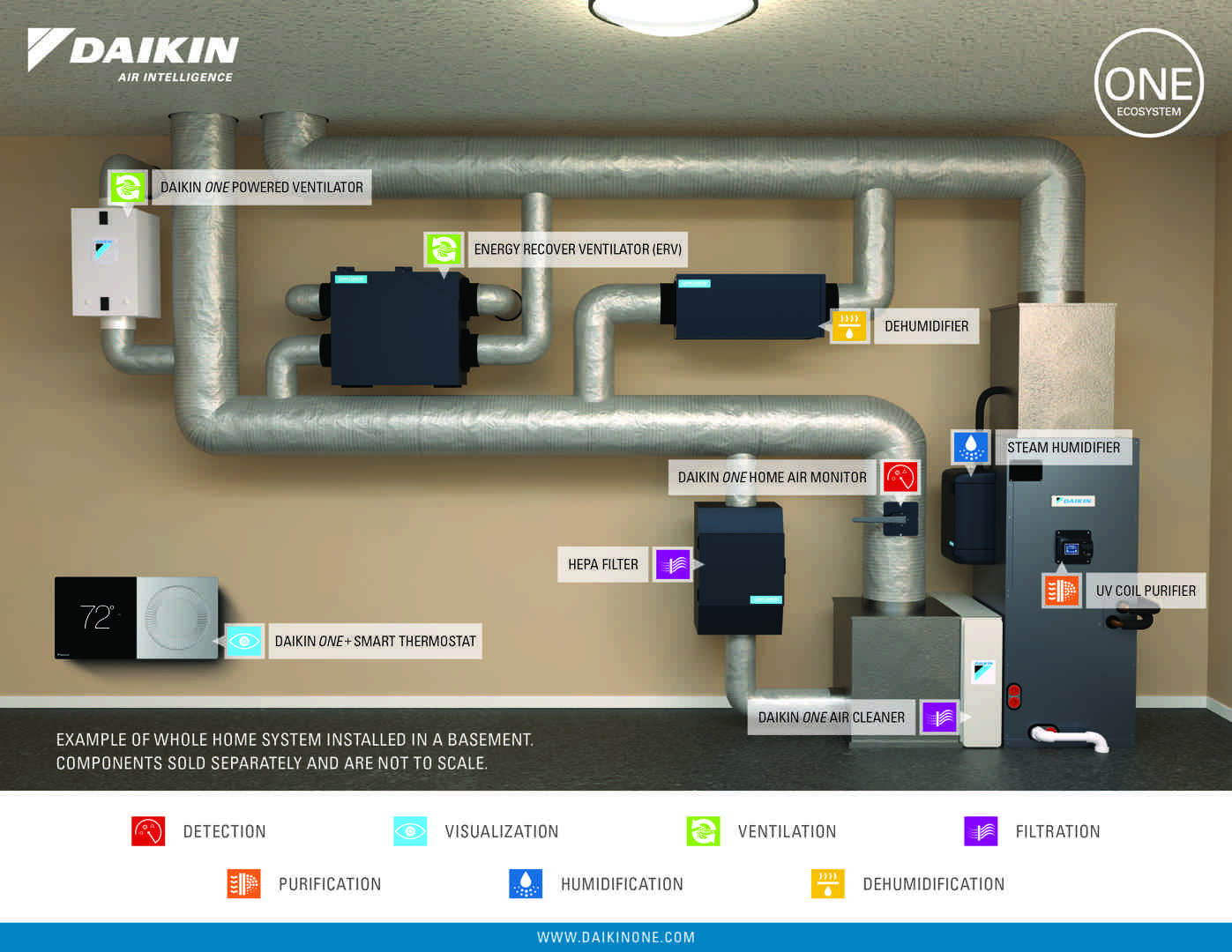
In practical terms, the setup may include:
- a Daikin One Home Air Monitor
- a Daikin One+ or Daikin One Touch thermostat or interface
- a ducted heat pump air handler or a ductless indoor unit
- filtration, purification, humidity control, and ventilation accessories
The real magic is the coordination. Your HVAC system is no longer just heating and cooling. It becomes part comfort system, part air quality assistant, minus the annoying small talk.
How the Daikin IAQ System Works With Your Heat Pump or Ductless Unit in a Ducted Home
In a ducted home, integration is the most complete because the system can treat air centrally as it moves through the air handler and ductwork.
A typical sequence looks like this:
- The air monitor detects a change such as rising PM2.5, VOCs, CO2, or humidity.
- The thermostat or app displays the issue using easy color alerts.
- Connected equipment responds by increasing fan circulation, running air through higher-efficiency filtration, or activating ventilation and humidity accessories.
With a ducted heat pump, this can support:
- whole-home filtration
- fresh air exchange through ERV or HRV equipment
- dehumidification or humidification
- cleaner circulation through the air handler
If you want a closer look at this ecosystem, our guide on how the Daikin IAQ system monitors and actively improves your air expands on the process.
How the Daikin IAQ System Works With Your Heat Pump or Ductless Unit in a Ductless Setup
Ductless homes work a little differently, but the concept is the same: detect, display, and respond.
A ductless mini-split does not have central ductwork, so it cannot use the exact same whole-home filter path as a ducted air handler. Instead, IAQ improvement usually comes from a combination of:
- zone-by-zone temperature and airflow control
- built-in filtration in indoor units
- standalone room purification where needed
- app-based control and monitoring
- fresh air and humidity strategies designed for the home layout
This is especially useful in Seattle-area homes with additions, finished basements, older construction, or rooms that never seem to match the rest of the house. Daikin multi-zone systems, including AURORA and MXS/MXM options, can pair comfort control with IAQ awareness while delivering high efficiency.
For more on that side of the equation, see Improve Air Quality with Daikin Ductless.
What the Detect, Visualize, Act Framework Means for Daily Operation
Daikin often describes IAQ using a "Detect, Visualize, Act" framework, and that is useful because it mirrors how homeowners actually experience the system.
- Detect: The monitor senses pollutants and environmental changes in real time.
- Visualize: The thermostat or app translates the data into simple alerts and trends.
- Act: Connected HVAC and IAQ accessories respond automatically or prompt you to make a change.
This means you do not have to guess whether a spike came from cooking, cleaning products, wildfire smoke, extra guests, or a house that just needs more fresh air. The system flags the issue and, when configured properly, can trigger a response. Our article on how Daikin air quality monitoring triggers your purification system automatically explains that workflow in more detail.
How the Daikin One Home Air Monitor Detects Problems in Real Time
The Daikin One Home Air Monitor is the "eyes and nose" of the IAQ ecosystem. It tracks changes in your home's air continuously, then compares those readings to what is normal for your space.
One of the most useful features is its 7-day baseline learning process. During that first week, the monitor learns your home's usual patterns. After that, it can identify meaningful deviations instead of reacting to every tiny change.
The system then sends color-coded alerts:
- Green for normal or healthy conditions
- Yellow for caution
- Orange for a stronger air quality concern
Which Sensors and Air Quality Parameters the System Tracks
Research indicates the broader Daikin IAQ monitoring approach can track up to 15 parameters using 12 sensors, depending on the platform. These can include:
- PM2.5
- PM10
- VOCs
- CO2
- humidity
- temperature
- pressure
- light
- noise
- electromagnetic pollution
For homeowners, the most important ones are usually the basics that directly affect comfort and health:
- fine particulates such as PM2.5 from smoke, dust, and cooking
- VOCs from cleaners, paints, personal care products, and off-gassing materials
- CO2 as a sign of stale, under-ventilated indoor air
- humidity that can make a home feel clammy, dry, or mold-friendly
How the 7-Day Baseline Learning Process Establishes Your Home’s Normal
Why does the baseline matter? Because your home is not a laboratory. It has routines.
Maybe you cook dinner every evening. Maybe the bathroom gets steamy every morning. Maybe the dog launches a one-pet fur storm every Saturday when visitors arrive. A smart IAQ monitor should learn those patterns.
Over about seven days, the monitor builds a picture of your home's typical conditions. It can then tell the difference between:
- a normal quick rise in humidity after a shower
- a persistent moisture problem
- a routine cooking event
- an unusual VOC spike from a product or pollutant source
- ordinary occupancy
- stale indoor air from poor ventilation
That reduces false alarms and helps the system respond more intelligently.
How Daikin One+ and One Touch Show IAQ Data and Alerts
The Daikin One+ and Daikin One Touch controls make the data usable. Instead of forcing you to interpret technical sensor readings, they present conditions in a clearer, homeowner-friendly format.
Depending on the setup, you can view:
- current IAQ status
- color-coded alerts
- temperature and humidity readings
- trend information
- system notifications
- remote status through the app
That is especially helpful when you are away from home, during wildfire season in the Pacific Northwest, or when you are trying to understand why a room feels stuffy even though the temperature seems perfect. Our Daikin One Indoor Air Quality Guide Kent, WA covers how these controls support daily use.
What Your System Does Automatically When Air Quality Drops
The value of a connected IAQ system is not just that it tells you there is a problem. It helps do something about it.
When conditions fall outside the learned baseline or cross certain thresholds, the system may respond by:
- increasing airflow
- running air through filtration more often
- activating purification equipment
- bringing in fresh air through ventilation accessories
- adjusting humidity-related operation
Exactly what happens depends on the equipment installed and how it is configured.
When the System Increases Filtration, Purification, or Ventilation
If the monitor detects particulates, odors, gases, or stale indoor air, the system can support cleaner air in several ways.
For ducted systems, that may mean sending more air through a high-efficiency cleaner. Daikin's premium air cleaner with a MERV 15 filter is reported to remove more than 85% of particles down to 0.3 microns and up to 99% of ragweed.
Additional purification options can help further. Daikin room air purifier testing cited in the research showed reductions such as:
- 96.7% of ragweed in 20 minutes
- 93.4% of cat dander in 20 minutes
- 90.7% of dust mites in 20 minutes
Some units also target VOCs and odors with activated carbon, which is useful after cleaning, painting, or enthusiastic salmon cooking.
Ventilation is another piece. If CO2 rises or the air becomes stale, an ERV or HRV can exchange indoor and outdoor air more efficiently than opening a window and hoping for the best. For more on purification, visit How Daikin Air Purification Reduces Allergens, Pollutants, and Pathogens.
How Humidity Control Protects Comfort, Mold Prevention, and System Performance
Humidity is not just a comfort issue. It affects health, air quality, and your equipment.
In general, the ideal indoor range is about 30% to 50% relative humidity. When humidity climbs too high, you may notice:
- a clammy feeling even at normal temperatures
- musty odors
- more favorable conditions for mold and mildew
- strain on comfort and system performance
When it drops too low, you may feel:
- dry skin and irritated sinuses
- static electricity
- less comfort during heating season
A heat pump already removes some moisture during cooling, but dedicated humidity control can improve results. Keeping moisture balanced also helps protect components and reduces the risk of conditions that can dirty coils or support biological growth.
How Mobile App Controls Help You Respond From Anywhere
Remote access is one of those features that sounds optional until the day it becomes very handy.
With app-connected controls, homeowners can often:
- check IAQ status remotely
- review alerts
- change schedules
- adjust fan or comfort settings
- use away mode when the house is empty
- verify conditions for kids, pets, or older family members at home
This turns IAQ into something you can manage proactively instead of discovering after you walk in and wonder why the house smells like last night's stir-fry.
The IAQ Components That Pair Best With Daikin Heat Pumps and Ductless Systems
Not every home needs every add-on. The best setup depends on whether you have ductwork, how airtight the house is, local outdoor air conditions, and whether your biggest issue is allergens, humidity, odors, smoke, or stale air.
Here is a simple comparison:
| IAQ component | Best for ducted heat pumps | Best for ductless systems |
|---|---|---|
| MERV 15 air cleaner | Excellent whole-home option | Not typically central to ductless |
| HEPA filtration | Strong add-on where airflow design supports it | Best in room-based purifiers |
| Room air purifier | Great for problem rooms | Excellent companion option |
| ERV/HRV ventilation | Very strong whole-home fit | Possible with home-specific design |
| Humidity control | Strong whole-home integration | Targeted strategy by zone/home layout |
| Streamer or Flash Streamer technology | Useful in purification strategy | Useful in select room-based applications |
Filtration and Purification: MERV 15, HEPA, and Streamer Technologies
Different technologies do different jobs.
MERV 15 filtration:
- captures very small airborne particles
- reported to remove more than 85% of particles down to 0.3 microns
- can capture high levels of allergens such as ragweed
HEPA filtration:
- highly effective for very fine particles
- room purifier HEPA filtration may trap up to 99.97% of particles in applicable product testing
- useful in targeted rooms where extra particle removal is the goal
Streamer and Flash Streamer technologies:
- go beyond trapping by helping break down contaminants through oxidative processes
- research notes Flash Streamer can decompose surface proteins of viruses and allergens
- this is useful as part of a layered IAQ strategy
Fresh Air Without Big Energy Losses: ERV and HRV Integration
Ventilation matters because even a well-filtered home can get stale if not enough fresh air enters.
ERVs and HRVs help solve that problem more efficiently. According to the research, energy recovery ventilators can:
- retain up to 60% of indoor heat
- limit moisture entry by up to 40%
- replace stale indoor air with fresh outdoor air
That is especially helpful in tighter Seattle-area homes where opening windows all day is not practical, comfortable, or desirable during smoke events, pollen season, or winter weather.
Can Ductless Mini-Splits Use IAQ Add-Ons Effectively?
Yes, but the approach is more targeted than central.
Ductless mini-splits can improve air quality through:
- washable internal filters
- steady zone airflow
- better humidity management through precise operation
- room purifiers in key living or sleeping spaces
- smart controls for visibility and response
This can work very well in bedrooms, home offices, additions, or homes without existing ducts. If you want to see how a room-focused setup can help, read Ductless Mini-Split with Built-In Air Purifier in Tukwila, WA.
Why Inverter Operation Helps Filtration and Comfort Stay More Consistent
Inverter technology is a quiet hero here. Instead of constantly blasting on and off, inverter-driven heat pumps and ductless systems can run longer at lower speeds.
That helps because:
- air circulates more consistently through filters
- temperatures stay more even
- humidity control is steadier
- the system avoids harsh stop-start swings
- components often experience less strain over time
That is one reason Daikin systems pair so naturally with IAQ strategies. You can learn more in How Ductless Mini-Split Systems Work.
Installation, Health Benefits, and Long-Term Performance for Seattle-Area Homes
Even the best monitor and filter setup will underperform if the system is not designed and commissioned correctly. IAQ is not just about buying good equipment. It is about making sure the equipment actually works together in your home.
Why Proper Installation by a Daikin Specialist Matters for IAQ Results
Proper installation affects airflow, filtration, ventilation, humidity control, and overall comfort.
Key details include:
- correct system sizing
- airflow balance
- proper refrigerant charge
- tight filter fit
- static pressure verification
- correct ventilation setup
- commissioning and control setup
This matters even more with higher-efficiency filtration. If airflow is wrong, a filter can become a bottleneck instead of a benefit. In the Pacific Northwest, where homes may deal with damp winters, shoulder-season humidity, and occasional wildfire smoke, setup quality has a direct impact on real-world performance.
For broader planning information, see our Heat Pump Solutions Seattle Complete Guide.
Health Benefits for Allergies, Asthma, Sleep, and Everyday Comfort
Cleaner indoor air can support better daily living in simple, noticeable ways.
Potential benefits include:
- fewer airborne allergens
- reduced exposure to fine particles like PM2.5
- lower VOC buildup from household products
- less stuffy air from elevated CO2
- better sleep comfort when temperature and humidity are steady
- less irritation of eyes, nose, and throat
For households dealing with allergies or asthma, filtration and purification can be especially meaningful. Research cited in the source material notes strong reductions in ragweed, cat dander, and dust mites with certain purifier testing, which aligns with the kinds of irritants many homeowners want to control.
Energy Savings and Equipment Longevity From Smarter IAQ Control
IAQ and efficiency are more connected than many people realize.
When your home has smarter ventilation, balanced humidity, and cleaner airflow, your HVAC system may benefit from:
- less buildup on coils and internal components
- better operating efficiency
- reduced strain from extreme swings in temperature and humidity
- more controlled fresh air exchange
- steadier runtime patterns
That does not mean IAQ accessories eliminate maintenance, but they can support healthier system conditions over time. For a broader overview of integrated solutions, visit Indoor Air Quality Solutions.
Frequently Asked Questions About How the Daikin IAQ System Works With Your Heat Pump or Ductless Unit
Can a ductless mini-split still improve air quality if there is no ductwork?
Yes. A ductless system can still support better air quality through built-in filtration, strong humidity management, and room-by-room comfort control. It can also pair well with room air purifiers and smart monitoring. You lose the central ducted filter path, but you gain targeted control exactly where people spend time.
Does the system only alert me, or can it act automatically too?
It can do both. The monitor and controls can notify you when IAQ changes, and compatible connected equipment can also respond automatically by adjusting airflow, filtration, purification, or ventilation. The exact response depends on the accessories installed and how the system is set up.
Is IAQ monitoring useful even if my home already feels comfortable?
Absolutely. Temperature alone does not tell the whole story. A room can feel comfortable while still having elevated CO2, high VOCs, poor particle levels, or humidity outside the ideal range. IAQ monitoring helps uncover hidden issues before they become comfort, health, or moisture problems.
Conclusion
When everything is connected correctly, your Daikin heat pump or ductless system does more than heat and cool. It helps detect pollution, show you what is happening, and respond in ways that support cleaner, healthier air throughout your home.
For Seattle and Pacific Northwest homeowners, that matters in every season - from damp winter days to smoky late-summer air events. If you want a system that treats comfort and indoor air quality as one complete job, explore Daikin indoor air quality solutions in Seattle.
Schedule a Visit

your individual indoor comfort needs
products firsthand
with an authorized Daikin Dealer
.webp)
See why our customers Choose Us

“Jem is very inviting and knowledgeable. She gave us a walk through of the Daikin Experience Center and patiently answered all our questions. Learned a lot about HVAC’s through this visit.”
“Jem did a great job walking us through the various Daikin products and efficiencies of the products. She was very knowledgeable on everything Daikin. Highly recommend coming in for a tour prior to picking out your various AC systems.”
“Great experience at Daikin Seattle Experience Center: pre-purchase demos of home heating system (Daikin Fit), list of HVAC companies, working Daikin staff and external contractors to ensure highest quality. This experience sets the bar of how any home HVAC experience should be. Have got the Daikin Fit installed and so far seems to work very well – quiet, good home heating in peak winter (heat transfer/BTU/air handling); Functionality of Daikin thermostat and the iPhone app makes it very easy to use.”
“This place is awesome! If you are in the market for a new HVAC system, visit the Daikin Experience Center to get educated on the newest technology as well as available rebates and incentives for where you live. They’ll even connect you with local contractors in your area who install Daikin equipment.”
