

.webp)

.svg)


Ductless Deep Coil Cleaning After Summer Smoke
The Hidden Impact of Late-Summer Smoke on Your Ductless System
As September arrives in the Pacific Northwest, the transition from summer heat to crisp autumn air is often interrupted by lingering wildfire smoke. When that smoke clears, you might think your home is safe, which is exactly why we find most ductless systems need a deep coil cleaning after summer smoke events. You wash the standard filter, wipe down the outside of the unit, and assume you are ready for winter. But the real damage is hiding out of sight, deep inside your equipment.
If you rely on Daikin ductless systems to keep your home comfortable, now is the perfect time to schedule a deep coil cleaning before the winter chill sets in.
Every September, as the post-wildfire season sets in, our team at the Daikin Seattle Experience Center pulls the covers off ductless units across the Tukwila and greater Seattle area. What we see inside is consistently a thick, sticky residue coating the internal coils. Homeowners are often surprised by this buildup because they have been diligent about washing their standard mesh filters after every major smoke event. Unfortunately, standard maintenance routines simply do not account for the unique characteristics of wildfire smoke.
The rapid transition from late-summer smoke events to the fall heating season leaves very little room for error. When a ductless system pulls in smoke-filled air, the internal components become compromised long before you notice a drop in performance. The decision point you face right now is whether to rely on a basic filter wash or invest in a professional deep cleaning before switching your system over to heating mode. Understanding what is actually happening inside your unit is the first step toward protecting your investment.
What We See Inside Local Systems
First-hand observation from our daily service calls tells a very clear story. What our technicians pull off coils every September across Tukwila is not normal household dust. It is a dense, ash-laden paste that clings stubbornly to the metallic fins of the heat exchanger. This material restricts airflow, insulates the coils (which prevents proper heat transfer), and forces the system to work significantly harder to achieve the temperature set on your thermostat. If left unaddressed, this hidden impact translates directly into higher energy bills and premature wear and tear on your equipment.
The Microscopic Threat: PM2.5 Ash vs. Standard Mesh Filters
In our experience diagnosing indoor air quality issues, to understand why your system is vulnerable, you have to look at the physical limitations of the filters that come standard with most mini split units. These standard mesh filters are highly effective at their primary job: catching large debris, household dust, and pet hair. They protect the internal components from large obstructions that could immediately block airflow.
However, wildfire smoke is a completely different type of pollutant. Smoke is primarily composed of PM2.5 microscopic ash particles. These particles are 2.5 micrometers in diameter or smaller. To put that into perspective, a single grain of fine beach sand is about 90 micrometers across. A human hair is roughly 50 to 70 micrometers in diameter. PM2.5 particles are so incredibly small that they easily slip right through the gaps in a standard mesh filter.
Why a Clean Filter is Misleading
The false sense of security: When you pull out your mini split's mesh filter after a smoky week, it might look slightly gray or even relatively clean. You rinse it in the sink, dry it, and put it back, assuming the unit is now free of smoke particulate. In reality, the vast majority of the microscopic ash has already bypassed the filter and entered the interior of the system.
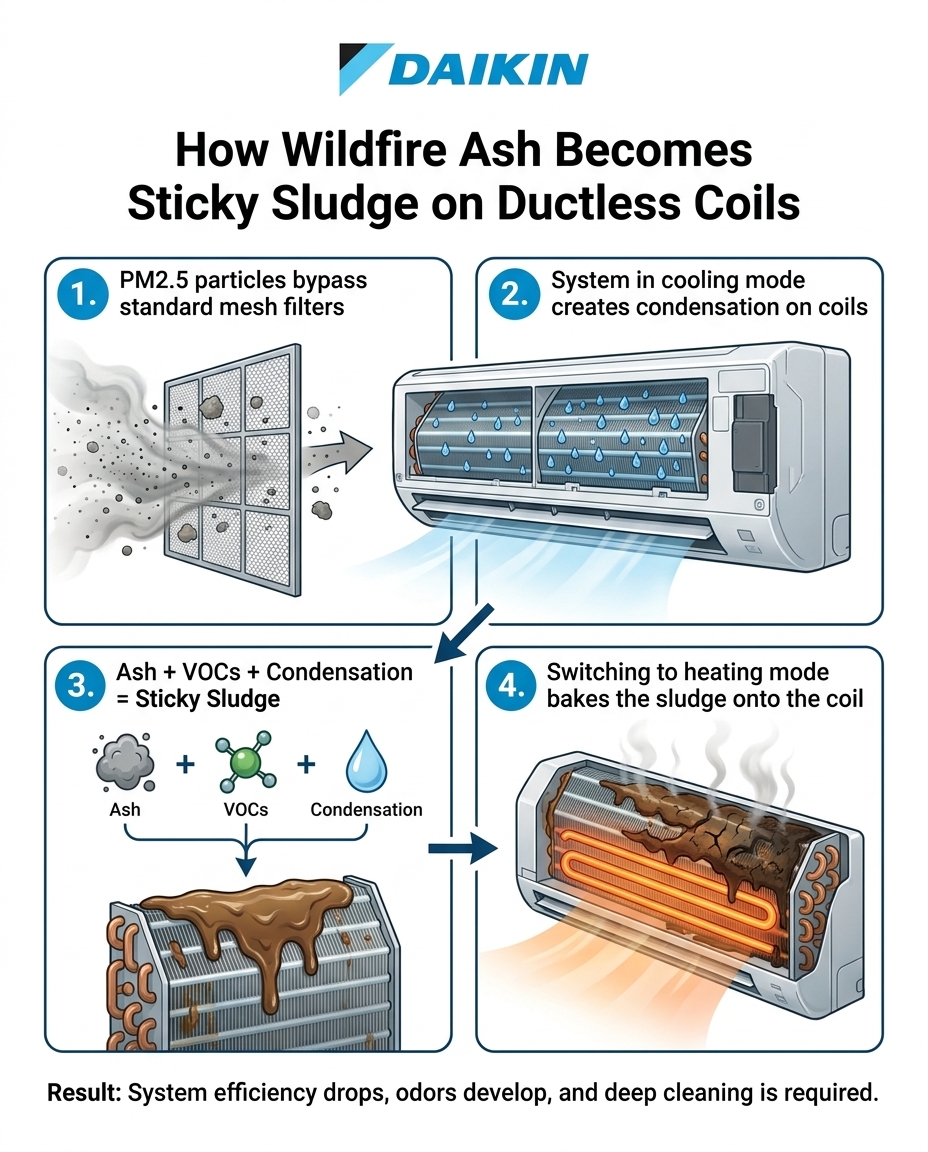
Because of our specialized knowledge of ductless coil spacing and internal component vulnerabilities here at the Daikin Seattle Experience Center, we know exactly where those particles end up. The incredibly tight spacing between the aluminum fins on a ductless coil is designed to maximize surface area for heat transfer. Unfortunately, this tight spacing also makes it the perfect trap for microscopic ash that has bypassed the primary filter. The PM2.5 particles settle deep within these fins, slowly accumulating layer by layer every time the system runs during a smoke event.
The Sticky Sludge: How Summer Cooling Traps Fine Ash
A pattern we see often in Tukwila homes is that the physical mechanics of how dry ash turns into a stubborn sludge is a direct result of how you use your system during the late summer. In the Pacific Northwest, late-summer smoke events often coincide with high temperatures. This means your ductless system is running heavily in cooling mode while simultaneously pulling in fine ash from the outside air.
The problem: Running the system in cooling mode naturally produces condensation on the indoor coil. As warm, humid indoor air passes over the freezing cold coils, moisture is pulled out of the air and forms water droplets on the metal fins. Under normal circumstances, this water simply drips down into the drain pan and flows outside.
The cause: Wildfire ash is not just dry carbon; it contains volatile organic compounds (VOCs), natural oils, and sap from burning vegetation. When this fine, oily ash bypasses your filter and hits the wet, condensing coil, a chemical and physical reaction occurs. The ash mixes with the condensation water, and the oils act as a binding agent.
The solution: Once this mixture dries, it forms a stubborn, sticky sludge that clings tightly to the delicate coil fins. This is not something that can be blown off with compressed air or lightly dusted away. It requires professional chemical agents to break down the oily bond.
Comparing the Threat: Dry Dust vs. Wet Ash Sludge
• Composition — Normal Household Dust: Skin cells, fabric fibers, dirt — Wildfire Ash Sludge: PM2.5 ash, VOCs, oils, sap
• Interaction with Moisture — Normal Household Dust: Becomes damp but easily washes away — Wildfire Ash Sludge: Binds and forms a sticky, tar-like paste
• Filter Penetration — Normal Household Dust: Caught by standard mesh filters — Wildfire Ash Sludge: Bypasses standard mesh entirely
• Removal Method — Normal Household Dust: Basic wiping or rinsing — Wildfire Ash Sludge: Professional deep chemical cleaning
Signs Your Mini Split Absorbed Wildfire Smoke
You do not have to be an HVAC technician to recognize the warning signs that your system has been compromised by summer smoke. When homeowners call our Tukwila office in the weeks following a major air quality event, they frequently report a specific set of symptoms. If you notice any of the following issues, your internal coils are likely coated in ash sludge.
• A lingering campfire smell: If you notice a stale smoke odor every time the unit turns on, the ash is trapped inside. This smell persists even immediately after washing the standard mesh filter because the odor is coming from the sludge on the coils, not the filter itself.
• Noticeably reduced airflow: Put your hand near the indoor unit. If the air feels weak or if you notice uneven temperature distribution in the room, the coil fins are likely choked with debris, preventing the blower wheel from pushing air efficiently.
• Visible dark buildup: Take a flashlight and look closely at the louvers (the directional vanes) and the interior components behind them. Visible dark grime, spotting, or a greasy film is a clear indicator of smoke residue.
• Increased energy consumption: Because the system is struggling to pull air through clogged coil fins, the compressor has to run longer and harder to reach your desired temperature. This spike in energy usage is a direct result of poor coil health.
Recognizing these symptoms early is the best way to protect your equipment. Routine Daikin AC maintenance is always recommended, but post-smoke symptoms require immediate, specialized attention before the seasons change.
The Danger of the Fall Heating Transition with Dirty Coils
We constantly remind our customers that the most critical risk to your ductless system occurs during the rapid shift in local weather. In our region, we often transition from late-summer smoke events directly into chilly fall mornings that require heat. Switching your system from cooling to heating mode with ash-caked coils is a recipe for long-term equipment damage.
When a ductless system operates in heating mode, the refrigeration cycle reverses. The indoor coil, which was previously freezing cold and wet with condensation, now becomes extremely hot. If that coil is covered in sticky ash sludge from September / Post-Wildfire Season, the high temperatures effectively bake the sludge onto the metallic components.
The Mechanical Impact of Baked-On Sludge
Once the ash is baked onto the coil, it hardens into a dense crust. This crust acts as a powerful insulator, preventing the heat generated by the refrigerant from transferring into your home's air. The immediate result is a severe drop in heating efficiency. Your system will run continuously, blowing lukewarm air while consuming massive amounts of electricity.
Furthermore, the restricted airflow creates immense static pressure inside the unit. The blower motor has to work overtime to push air through the clogged fins, leading to overheating and premature motor failure. The outdoor compressor also suffers; because the heat cannot escape the indoor coil, the refrigerant returns to the compressor at the wrong temperature, placing dangerous mechanical strain on the heart of your entire system.
Why Surface Wiping Isn't Enough for Ductless Coils
It is entirely understandable that homeowners want to clean their own equipment. However, we have seen firsthand how DIY methods for dealing with baked-on smoke sludge are not just ineffective—they are often destructive. Standard filter washing does absolutely nothing to clean the internal coils, and surface wiping can cause permanent damage.
The fragility of coil fins: The aluminum fins on a ductless coil are paper-thin and easily bent. DIY wiping with a rag, or brushing with a stiff bristle brush, will easily crush these fins flat. Once bent, the fins block airflow completely, ruining the efficiency of the unit. Furthermore, wiping often just pushes the sticky ash deeper into the center of the coil block where it can never be reached.
What Professional Deep Coil Cleaning Entails
A professional deep coil cleaning is a specialized process that goes far beyond a standard tune-up. While we cannot provide a DIY tutorial—as this level of maintenance requires a licensed professional to ensure the system isn't damaged—it is helpful to understand the process.
Technicians use specialized, non-acidic cleaning agents specifically formulated to break down the oily VOC bonds of wildfire ash without corroding the aluminum fins. The indoor unit is carefully disassembled, and a custom bib or catchment bag is installed around the unit to protect your walls and flooring. The cleaning solution is applied, allowed to dwell and break down the sludge, and then safely flushed out using low-pressure water systems designed specifically for delicate mini split coils. This process completely removes the baked-on sludge, restoring the unit to factory-level efficiency.
Upgrading Your Home's Defense Against Future Smoke Events
Understanding how vulnerable standard mesh filters are to PM2.5 particles is the first step toward better preparation. While a deep clean will fix the immediate problem, relying solely on your mini split's basic filter during the next smoke season will just result in the same sticky buildup.
To truly protect your home and your HVAC equipment, you need a comprehensive strategy that includes supplementary indoor air quality solutions. These solutions work alongside your ductless system to capture microscopic particles before they ever reach the delicate internal coils.
Real-World Solutions for Better Air
For instance, one local homeowner recently visited our Daikin Seattle Experience Center because they wanted to learn about the latest solutions in HVAC technology. After dealing with poor air quality during the summer, they realized their standard setup wasn't enough. They wanted to be educated on current Daikin technology so they could incorporate better filtration into their decision-making process.
By exploring advanced filtration options, such as standalone HEPA air purifiers or whole-home air scrubbers that integrate with ducted systems, homeowners can drastically reduce the volume of PM2.5 ash circulating in their living spaces. Understanding the latest HVAC technology helps you build a layered defense, ensuring that when the smoke returns next summer, your air remains clean and your ductless coils remain free of sludge.
Restore Your System's Efficiency Before Winter Arrives
As local HVAC experts, we know that the transition from summer cooling to winter heating is the most demanding time of year for your ductless mini split. Removing the sticky ash sludge left behind by late-summer smoke events is not just about eliminating a lingering campfire smell; it is about protecting the mechanical integrity of your system and ensuring you have reliable, efficient heat when the freezing temperatures arrive.
Do not wait for the first cold snap to discover your system is struggling to perform. Take action now to ensure efficient, odor-free heating all winter long. Reach out today to schedule a deep coil cleaning and give your system the professional care it needs to keep your home comfortable and safe.
Frequently Asked Questions
Why does my ductless system smell like a campfire?
A lingering campfire smell occurs because microscopic wildfire ash and volatile organic compounds (VOCs) have bypassed your filter and stuck to the internal coils. When the system turns on, air blows directly over this sticky residue, pushing the stale smoke odor back into your living space. The only way to eliminate the smell is to have the internal coils professionally cleaned, a service our technicians perform daily during the fall transition.
Do mini splits filter wildfire smoke?
The short answer is no; standard mini split filters do not effectively catch wildfire smoke. They are equipped with basic mesh filters designed to stop large dust particles and pet hair, but smoke consists of PM2.5 particles that are far too small for the mesh to capture. To filter smoke, you need supplemental HEPA filtration in the room.
Does wildfire smoke damage mini splits?
Yes, wildfire smoke can cause significant long-term damage to mini splits if the residue is not removed. The fine ash mixes with condensation to form a sludge that coats the coils, restricting airflow and forcing the blower motor and compressor to overwork. Over time, this added strain leads to premature mechanical failure and spiked energy bills.
How do you clean a ductless AC after a fire?
Cleaning a ductless AC after a smoke event requires a professional deep coil cleaning using specialized chemical agents and low-pressure water flushing. Homeowners should only wash the removable mesh filters; attempting to wipe or brush the internal coils yourself can bend the delicate aluminum fins and push the ash deeper into the unit.
Can I just wash the standard filter to remove the smoke smell?
Washing the standard filter is a good maintenance habit, but it will not remove the smoke smell. The odor-causing ash and oils have already passed through the filter and are stuck to the internal blower wheel and heat exchanger coils. Until those internal components are professionally washed, the smell will persist.
What happens if I turn on my heat pump with ash on the coil?
If you switch your heat pump to heating mode with ash on the coils, the high temperatures will bake the sticky sludge into a hard crust. This crust acts as an insulator, drastically reducing the system's ability to heat your home and causing a severe drop in energy efficiency. It also makes the residue much harder for a technician to remove later.
Schedule a Visit

your individual indoor comfort needs
products firsthand
with an authorized Daikin Dealer
.webp)
See why our customers Choose Us

“Jem is very inviting and knowledgeable. She gave us a walk through of the Daikin Experience Center and patiently answered all our questions. Learned a lot about HVAC’s through this visit.”
“Jem did a great job walking us through the various Daikin products and efficiencies of the products. She was very knowledgeable on everything Daikin. Highly recommend coming in for a tour prior to picking out your various AC systems.”
“Great experience at Daikin Seattle Experience Center: pre-purchase demos of home heating system (Daikin Fit), list of HVAC companies, working Daikin staff and external contractors to ensure highest quality. This experience sets the bar of how any home HVAC experience should be. Have got the Daikin Fit installed and so far seems to work very well – quiet, good home heating in peak winter (heat transfer/BTU/air handling); Functionality of Daikin thermostat and the iPhone app makes it very easy to use.”
“This place is awesome! If you are in the market for a new HVAC system, visit the Daikin Experience Center to get educated on the newest technology as well as available rebates and incentives for where you live. They’ll even connect you with local contractors in your area who install Daikin equipment.”
